
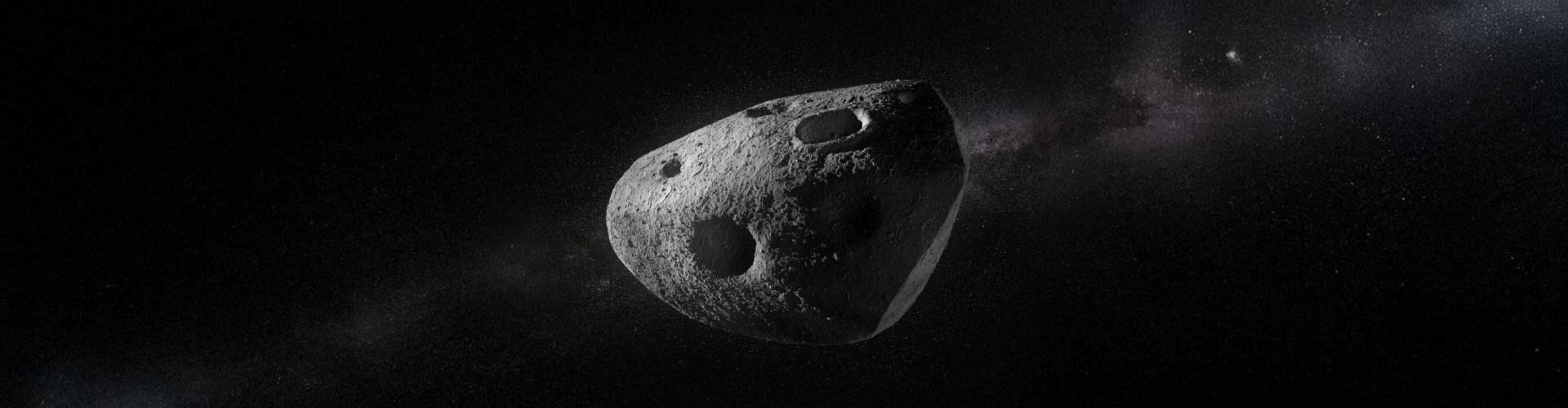
Asteroid 16 Psyche is one of the largest and most massive celestial bodies in the main asteroid belt, orbiting between Mars and Jupiter. Measuring roughly 222 kilometers (138 miles) in diameter, it is scientifically famous for being primarily composed of metallic iron and nickel, leading scientists to believe it could be the exposed core of an ancient, unfinished planet. Image: Artist’s concept of the asteroid 16 Psyche, which is thought to be a stripped planetary core. Credit: Maxar/ASU/P. Rubin/NASA/JPL-Caltech
Related channels: PSYCHE (NASA SPACECRAFT), ASTEROIDS, HAYABUSA (JAXA SPACECRAFT), DAWN (NASA SPACECRAFT), DWARF PLANETS


Asteroid Mission Captures Mars In Stunning New Light | WION Podcast
NASA’s Psyche mission has captured a rare and fascinating new view of Mars while travelling toward a mysterious metallic asteroid deep in space. During a gravity-assisted flyby, the spacecraft photographed the Red Planet from a completely different angle, revealing glowing crescents, dust storms, and dramatic surface details. Scientists say the mission could unlock secrets about the hidden interiors of planets and the early formation of the Solar System. The journey may lead to one of the biggest breakthroughs in planetary science.
#mars #psychemission #wionpodcast
About Channel:
WION The World is One News examines global issues with in-depth analysis. We provide much more than the news of the day. Our aim is to empower people to explore their world. With our Global headquarters in New Delhi, we bring you news on the hour, by the hour. We deliver information that is not biased. We are journalists who are neutral to the core and non-partisan when it comes to world politics. People are tired of biased reportage and we stand for a globalized united world. So for us, the World is truly One.
Please keep discussions on this channel clean and respectful and refrain from using racist or sexist slurs and personal insults.
Subscribe to our channel at https://goo.gl/JfY3NI
Check out our website: http://www.wionews.com
Join our WhatsApp Channel: https://bit.ly/455YOQ0
Connect with us on our social media handles:
Facebook: https://www.facebook.com/WIONews
Twitter: https://twitter.com/WIONews
Instagram: https://www.instagram.com/wionews/
Follow us on Google News for the latest updates
Zee News:- https://bit.ly/2Ac5G60
Zee Business:- https://bit.ly/36vI2xa
DNA India:- https://bit.ly/2ZDuLRY
WION: https://bit.ly/3gnDb5J
Zee News Apps: https://bit.ly/ZeeNewsApps
Psyche Spacecraft Prepares for Mars Flyby
NASA’s Psyche spacecraft will pass about 2,800 miles (4,500 kilometers) from the Martian surface at 12,328 mph (19,840 kph) on May 15, 2026. The Red Planet will provide a crucial gravity assist, enabling the spacecraft to reach its namesake destination in the main asteroid belt.
Known as a gravitational slingshot, the propellant-saving maneuver harnesses Mars’ gravity to boost the spacecraft’s speed and adjust its trajectory toward the metal-rich asteroid Psyche for a 2029 arrival.
The mission team will use the encounter to calibrate the spacecraft’s instruments. By capturing thousands of observations of Mars with the multispectral imager, engineers can hone the precise imaging and navigation techniques required to orbit Psyche and study what scientists believe is the exposed nickel-iron core of an ancient planet. This flyby represents a critical intersection of orbital mechanics and deep-space instrument testing on the mission’s journey to a metal world.
For more information, go to: https://science.nasa.gov/mission/psyche/
Credit: NASA/JPL-Caltech/ASU
Produced by True Story Films
Discover clues to asteroid Psyche's origin with Tucson study
Researchers at the University of Arizona's Lunar and Planetary Laboratory are delving into the origins of the asteroid 16 Psyche. Large craters on the asteroid may offer crucial insights into its formation. The NASA Psyche mission, set to arrive in 2029, aims to determine whether Psyche is a leftover building block of an early planet or a planetary fragment.
NASA's Psyche Mission: Exploring a Metal World
NASA's Psyche Mission: Exploring a Metal World
Dr. David Williams
November 21st, 2025
Psyche, the largest metallic type asteroid in the Solar System, will be visited by a robotic mission developed by Arizona State University. This mission will explore one of the few remaining types of unexplored worlds in our Solar System.
Home of Amateur Astronomers, Inc. https://www.asterism.org
Asteroid Psyche Is The Most Metal Of Space Rocks, but not Worth $10,000,000,000,000,000,000
There's a lot of stories about asteroid 16 Psyche being worth ridiculous amounts of money based on its mineral content. And the truth is that yes it probably has more accessible gold than most places in the solar system, it's still an inaccessible rock in the middle of the asteroid belt.
But it's still a fascinating rock in the middle of the asteroid belt.
Asteroid Filled With Gold And Most Expensive Things in Space
What are asteroids? And what's the difference between asteroids, comets, and meteors? When you think of asteroids, if ever you ever do, don’t just picture rocky celestial bodies, flying somewhere between the planets. Asteroids are much more curious and unique. Did you know they can contain huge amounts of valuable elements? Or that some asteroids can be unimaginably expensive? It’s true!
Asteroids come in a variety of shapes and sizes. One of the largest is Vesta. Its diameter is bigger than the length of the Grand Canyon. The smallest asteroid ever observed is smaller than a car. Scientists call asteroids minor planets because they are too small to be real planets and can’t be classified as comets. Asteroids orbit the Sun in the asteroid belt that lies between Mars and Jupiter.
#brightside
Other videos you might like:
If an Asteroid Falls in the Ocean, Will It Cause a Tsunami? https://www.youtube.com/watch?v=e96hbCGIZfc&
A Strange Object Has Visited Our Solar System And Confused Scientists https://www.youtube.com/watch?v=7a9o3gbSAi8&
That's What'll Happen to the Earth In 1,000,000,000 Years https://www.youtube.com/watch?v=blf9PKCNXcs&
Preview photo credit:
Artist's concept of the asteroid 16 Psyche, which is thought to be a stripped planetary core: By Maxar/ASU/P. Rubin/NASA/JPL-Caltech, https://solarsystem.nasa.gov/asteroids-comets-and-meteors/asteroids/16-psyche/in-depth
The animation is created by Bright Side. TIMESTAMPS:
How asteroids form 0:49
The Hoba meteorite 1:09
Jewelry could literally fall from the sky! 1:42
16 Psyche (the “golden” asteroid) 2:44
Can we mine asteroids? 3:52
The most expensive thing known 6:14
Music by Epidemic Sound https://www.epidemicsound.com/
Subscribe to Bright Side : https://goo.gl/rQTJZz
----------------------------------------------------------------------------------------
Our Social Media:
Facebook: https://www.facebook.com/brightside/
Instagram: https://www.instagram.com/brightgram/
5-Minute Crafts Youtube: https://www.goo.gl/8JVmuC
Stock materials (photos, footages and other):
https://www.depositphotos.com
https://www.shutterstock.com
https://www.eastnews.ru
----------------------------------------------------------------------------------------
For more videos and articles visit:
http://www.brightside.me/
Inside NASA's Psyche Mission to Study a Metallic Asteroid
Join NASA Psyche Mission Co-Investigator Dr. Tim McCoy as he takes us on a journey from his first geology class to his current role as Curator-in-Charge of the US National Meteorite Collection at the Smithsonian National Museum of Natural History and his role on the Psyche Mission Science Team. Along the way, McCoy highlights the significance of studying a metallic asteroid and what it may be able to tell us about the formation of the solar system and our own planet. It’s the journey of a lifetime, and he didn’t want to miss it. Psyche is both the name of an asteroid orbiting the Sun between Mars and Jupiter — and the name of a NASA space mission to visit that asteroid, led by Arizona State University. For more information about NASA's Psyche mission go to:
http://www.nasa.gov/psyche
This Metal Asteroid Could Reveal Secrets About Earth’s Core | Countdown to Launch
NASA and Arizona State University plan to send an orbiter to the Psyche asteroid, which is believed to be made mostly out of metal. This mission could be the key to understanding the inside of Earth's core.
» Subscribe to Seeker!http://bit.ly/subscribeseeker
» Watch more Countdown to Launch: http://bit.ly/CTLplaylist
Between Mars and Jupiter, you can find Psyche, one of the only asteroids that scientists believe might be made mostly of metal and researchers from NASA and and Arizona State University will be sending an orbiter to the asteroid for the very first time.
Exploring Psyche’s terrain could be our only key to understanding what the inside of Earth’s core could be like.
Visiting asteroids isn’t new to space exploration with Vesta, Ceres, Ryugu, and Bennu being some of the most recent mission destinations.
And asteroids, for the most part, have been all the same; usually rocky, airless drifting through the cosmos as leftover debris from a chaotic beginning.
But Psyche is different.
“We’re pretty sure that it’s largely made of iron-nickel metal. And there are very, very few asteroids out in the asteroid belt that we think are made of metal or largely of metal,” Lindy Elkins-Tanton, Principal Investigator of the NASA Psyche mission, told Seeker
Researchers suspect Psyche is an exposed core of a protoplanet, which is a planet in its early formation stages and it’s most likely that the asteroid lost its rocky exterior during violent collisions in the beginning of our solar system’s evolution...at least, that’s what scientists’ best assumptions are.
And no one really knows what Psyche looks like beyond a speck of light, and so the 2022 Psyche mission will include sending back camera images of the asteroid so we can take a look at what a metallic body like this looks like.
Find out more about this metallic asteroid and how the team of researchers plans to explore its terrain on this episode of Countdown to Launch.
#Asteroid #Earth #Space #Science #Seeker #CountdownToLaunch
Read More:
MISSION TO A METAL WORLD: Psyche
https://www.jpl.nasa.gov/missions/psyche/
"Because we cannot see or measure Earth's core directly, Psyche offers a unique window into the violent history of collisions and accretion that created terrestrial planets. The mission is led by Arizona State University. NASA's Jet Propulsion Laboratory is responsible for mission management, operations and navigation."
16 Psyche
https://solarsystem.nasa.gov/asteroids-comets-and-meteors/asteroids/16-psyche/in-depth/
"Unlike most other asteroids that are rocky or icy bodies, scientists think the M-type (metallic) asteroid 16 Psyche is comprised mostly of metallic iron and nickel similar to Earth’s core. Scientists wonder whether Psyche could be an exposed core of an early planet, maybe as large as Mars, that lost its rocky outer layers due to a number of violent collisions billions of years ago."
Instruments & Science Investigations
https://psyche.asu.edu/mission/instruments-science-investigations/
"The Gamma Ray and Neutron Spectrometer will detect, measure, and map Psyche’s elemental composition. The instrument is mounted on a 6-foot (2-meter) boom to distance the sensors from background radiation created by energetic particles interacting with the spacecraft and to provide an unobstructed field of view."
____________________
Countdown to Launch takes a deep dive into upcoming space missions from around the world. We interview the people involved and explore the science, innovation and technology that makes them possible.
Seeker empowers the curious to understand the science shaping our world. We tell award-winning stories about the natural forces and groundbreaking innovations that impact our lives, our planet, and our universe.
Visit the Seeker website https://www.seeker.com/videos
Elements on Facebook https://www.facebook.com/SeekerElements/
Subscribe now! http://www.youtube.com/subscription_center?add_user=dnewschannel
Seeker on Twitter http://twitter.com/seeker
Seeker on Facebook https://www.facebook.com/SeekerMedia/
Seeker http://www.seeker.com/
GOLDEN ASTEROID - Most Expensive 1 000 000 000 000 $ Trillion
Did you know that diamonds sometimes just fall from the sky? Platinum, too. And nickel, and gold even. No, this is not a joke. It is indeed possible. Chemical composition of meteorites includes all kinds of substances. Some are quite valuable, although platinum is indeed rare among them. Typically, meteorites are just plain boulders – and this totally makes sense, because most likely they are fragments of ancient planets. Psyche 16 is the most expensive thing in the world. Space facts and science.
Imagine throwing a rock at a glass bottle – the swift motion of an arm, the whooshing sound, the glass shattering into dozens of shards. According to one theory, this is more or less how meteorites come to be, although on a different scale. Millions of years ago, a planet was silently making its way through the expanses of outer space. Suddenly it met another large celestial body and burst into pieces as a result of the collision. Larger fragments continued their existence as asteroids, and smaller ones became meteorites and meteors.
Each of these rocks has a trajectory of its own, determined by the collision. Of the billions of the planetary fragments flying through space, a few come close to Earth and even fall on our planet.
For copyright matters and any suggestions be welcome at: [email protected]
#Gold #Asteroid #NASA #Psyche #Space #Expensive
NASA Psyche Mission: Journey to a Metal World
Psyche is both the name of an asteroid orbiting the Sun between Mars and Jupiter — and the name of a NASA space mission to visit that asteroid, led by Arizona State University. Join the Psyche team to explore why this mission was selected for NASA’s Discovery Program, how we’ll get to the asteroid, what we hope to learn from Psyche, and the importance of scientific discovery.
Credits: NASA/JPL-Caltech/Arizona State Univ./Peter Rubin/SSL
16 Psyche - NASA Mission to A Giant Metal Core World
You can buy Universe Sandbox 2 game here: http://amzn.to/2yJqwU6
Hello and welcome to What Da Math!
In this video, we will talk about 16 Psyche
Support this channel on Patreon to help me make this a full time job:
https://www.patreon.com/whatdamath
Space Engine is available for free here: http://spaceengine.org
Enjoy and please subscribe.
Other videos here: https://www.youtube.com/playlist?list=PL9hNFus3sjE7jgrGJYkZeTpR7lnyVAk-x
Twitter: https://twitter.com/WhatDaMath
Facebook: https://www.facebook.com/whatdamath
Twitch: http://www.twitch.tv/whatdamath
The video introduction made by Daniel Bates
His YouTube channel with more of his work is here: https://www.youtube.com/mroutrochannel
The new music theme made by Bogdan Bratis
Check out his work here: http://www.bratis.uk/
NASA to send spacecraft to 16 Psyche asteroid
NASA is working to uncover the mystery behind an asteroid that may contain a priceless treasure trove of minerals. The space agency is planning to send an unmanned spacecraft to the chunk of metal known as 16 Psyche. Some scientists estimate its minerals could be worth $10,000 quadrillion dollars. Carter Evans reports.
Also Recommended
 Psyche (NASA Spacecraft)
 ASTEROID BELT
 Asteroid Dimorphos and Didymos
 ASTEROID DAY
 Asteroid Bennu
 Asteroid Redirect Mission – ARM (NASA Spacecraft)
 ASTEROID RYUGU
 Asteroid 99942 Apophis
 ASTEROID VESTA
 DAWN (NASA SPACECRAFT)
 HAYABUSA (JAXA SPACECRAFTS)
 DART (NASA Spacecraft)
 LUCY (NASA SPACECRAFT)
 Hera (ESA Spacecraft)
 METEORS
 Asteroids
 The Mars Society
 NEO Surveyor (NASA Spacecraft)




