Wow, NASA DART Mission May Have Completely Resurfaced The Asteroid
Get a Wonderful Person Tee: https://teespring.com/stores/whatdamath
More cool designs are on Amazon: https://amzn.to/3QFIrFX
Alternatively, PayPal donations can be sent here: http://paypal.me/whatdamath
Hello and welcome! My name is Anton and in this video, we will talk about new updates about the DART mission that collided a probe with an asteroid
Links:
https://arxiv.org/abs/2402.04145
https://www.nature.com/articles/s41550-024-02200-3
Previous updates: https://youtu.be/MFvaA4H45zw
#dart #nasa #asteroid
0:00 DART Updates
0:40 New videos and new animation
1:02 Didymos and Dimorphos in a nutshell
2:10 How this initially affected the asteroid
2:40 What happened to most of the ejecta?
3:50 Complete resurfacing and no crater
4:25 These are rubble piles
5:25 Discoveries of properties of both asteroids
6:55 Overall results and conclusions
7:50 What about other asteroids though?
8:10 Additional info in 2026 from Hera
Support this channel on Patreon to help me make this a full time job:
https://www.patreon.com/whatdamath
Bitcoin/Ethereum to spare? Donate them here to help this channel grow!
bc1qnkl3nk0zt7w0xzrgur9pnkcduj7a3xxllcn7d4
or ETH: 0x60f088B10b03115405d313f964BeA93eF0Bd3DbF
Space Engine is available for free here: http://spaceengine.org
Enjoy and please subscribe.
Twitter: https://twitter.com/WhatDaMath
Facebook: https://www.facebook.com/whatdamath
Twitch: http://www.twitch.tv/whatdamath
The hardware used to record these videos:
New Camera: https://amzn.to/34DUUlv
CPU: https://amzn.to/2LZFQCJ
Video Card: https://amzn.to/2M1W26C
Motherboard: https://amzn.to/2JYGiQQ
RAM: https://amzn.to/2Mwy2t4
PSU: https://amzn.to/2LZcrIH
Case: https://amzn.to/2MwJZz4
Microphone: https://amzn.to/2t5jTv0
Mixer: https://amzn.to/2JOL0oF
Recording and Editing: https://amzn.to/2LX6uvU
Some of the above are affiliate links, meaning I would get a (very small) percentage of the price paid.
Thank you to all Patreon supporters of this channel
Special thanks also goes to all the wonderful supporters of the channel through YouTube Memberships
Images/Videos:
ESA/NASA
Dr Nicolas Erasmus CC BY-SA 4.0 https://en.wikipedia.org/wiki/Double_Asteroid_Redirection_Test#/media/File:DART-impact-SAAO-Lesedi-Mookodi.gif
Phoenix7777 CC BY-SA 4.0 https://en.wikipedia.org/wiki/Dimorphos#/media/File:Animation_of_DART_around_Didymos_-_Impact_on_Dimorphos.gif
Licenses used:
https://creativecommons.org/licenses/by/4.0/
https://creativecommons.org/licenses/by-sa/4.0/
https://creativecommons.org/licenses/by/3.0/
https://creativecommons.org/licenses/by-sa/3.0/
https://creativecommons.org/licenses/by/2.5/
https://creativecommons.org/licenses/by-sa/2.5/
https://creativecommons.org/licenses/by/2.0/
https://creativecommons.org/licenses/by-sa/2.0/
From Impact to Innovation: A Year of Science and Triumph for Historic DART Mission
Last fall, the world watched as the DART spacecraft — the Double Asteroid Redirection Test — guided itself toward the asteroid Dimorphos for a direct collision, a major technical achievement and the first successful planetary defense test in history. DART targeted the asteroid moonlet Dimorphos, a small body just 490 feet (150 meters) in diameter, which orbits a larger, 2,500-foot (760-meter) asteroid called Didymos. Neither asteroid posed a threat to Earth, but the system proved to be the perfect target for the experimental mission. https://jhuapl.link/DART-1yr
As a part of NASA’s overall planetary defense strategy, DART’s impact with the asteroid Dimorphos demonstrated a viable mitigation technique for protecting the planet from an Earth-bound asteroid, if one were discovered. Revisit DART’s triumphant collision with Dimorphos and the resulting year of science analysis and discoveries that followed.
DART Asteroid Collision Updates: Unexplained Changes After 1 Year
Get a Wonderful Person Tee: https://teespring.com/stores/whatdamath
More cool designs are on Amazon: https://amzn.to/3wDGy2i
Alternatively, PayPal donations can be sent here: http://paypal.me/whatdamath
Hello and welcome! My name is Anton and in this video, we will talk about updates from the DART asteroid collision mission
Links:
https://arxiv.org/abs/2308.15488
https://esahubble.org/news/heic2302/?lang
https://esahubble.org/news/heic2307/?lang
https://arxiv.org/abs/2307.12506
https://www.nature.com/articles/s41586-023-05805-2
Original Video: https://youtu.be/vwrAhdyUChM
#dart #nasa #asteroid
Support this channel on Patreon to help me make this a full time job:
https://www.patreon.com/whatdamath
Bitcoin/Ethereum to spare? Donate them here to help this channel grow!
bc1qnkl3nk0zt7w0xzrgur9pnkcduj7a3xxllcn7d4
or ETH: 0x60f088B10b03115405d313f964BeA93eF0Bd3DbF
Space Engine is available for free here: http://spaceengine.org
Enjoy and please subscribe.
Twitter: https://twitter.com/WhatDaMath
Facebook: https://www.facebook.com/whatdamath
Twitch: http://www.twitch.tv/whatdamath
Images/Videos:
NASA, ESA, STScI, J. Li (PSI)
Dr Nicolas Erasmus Amanda Sickafoose CC BY 2.5 https://en.wikipedia.org/wiki/Double_Asteroid_Redirection_Test#/media/File:DART-impact-SAAO-Lesedi-Mookodi.gif
Phoenix7777 CC BY-SA 4.0 https://en.wikipedia.org/wiki/Double_Asteroid_Redirection_Test#/media/File:Animation_of_DART_around_Didymos_-_Impact_on_Dimorphos.gif
NASA, ESA, and D. Jewitt (University of California, Los Angeles)
The hardware used to record these videos:
New Camera: https://amzn.to/34DUUlv
CPU: https://amzn.to/2LZFQCJ
Video Card: https://amzn.to/2M1W26C
Motherboard: https://amzn.to/2JYGiQQ
RAM: https://amzn.to/2Mwy2t4
PSU: https://amzn.to/2LZcrIH
Case: https://amzn.to/2MwJZz4
Microphone: https://amzn.to/2t5jTv0
Mixer: https://amzn.to/2JOL0oF
Recording and Editing: https://amzn.to/2LX6uvU
Some of the above are affiliate links, meaning I would get a (very small) percentage of the price paid.
Thank you to all Patreon supporters of this channel
Special thanks also goes to all the wonderful supporters of the channel through YouTube Memberships Licenses used:
https://creativecommons.org/licenses/by/4.0/
https://creativecommons.org/licenses/by-sa/4.0/
https://creativecommons.org/licenses/by/3.0/
https://creativecommons.org/licenses/by-sa/3.0/
https://creativecommons.org/licenses/by/2.5/
https://creativecommons.org/licenses/by-sa/2.5/
https://creativecommons.org/licenses/by/2.0/
https://creativecommons.org/licenses/by-sa/2.0/
How Citizen Science Supported the DART Mission ft. Dr. Ariel Graykowski
We asked Dr. Ariel Graykowski three questions about the DART Mission, her new paper in Nature, and what the Unistellar Citizen Science Network is up to next.
Press release: https://www.seti.org/press-release/unistellar-citizen-science-network-and-seti-institute-contribute-planetary-defense
If you like science, support the SETI Institute! We're a non-profit research institution whose focus is understanding the nature and origins of life in the universe. Donate here: https://seti.org/donate
Learn more about the SETI Institute and stay up-to-date on awesome science:
- Subscribe to our YouTube channel at https://www.youtube.com/c/SETIInstitute/
- Watch our streams over on Twitch at https://www.twitch.tv/setiinstitute
- Listen to our podcast, Big Picture Science http://www.bigpicturescience.org/
- Subscribe to our newsletter https://seti.org/signup
- Buy merchandise from Chop Shop https://www.chopshopstore.com/collections/seti-institute/SETI
Don't forget to like and subscribe! Ring the bell for notifications of when we go live.
#science #space #astronomy #planetaryscience #planetarydefense #dartmission #citizenscience #unistellar
The Insane Engineering of the DART Mission
Take the Real Engineering X Brilliant Course and get 20% off your an annual subscription: https://brilliant.org/realengineering
Watch this video ad free on Nebula:
Links to everything I do:
https://beacons.ai/brianmcmanus
Get your Real Engineering shirts at: https://standard.tv/collections/real-engineering
Credits:
Writer/Narrator: Brian McManus
Editor: Dylan Hennessy
Animator: Mike Ridolfi
Animator: Eli Prenten
Sound: Graham Haerther
Thumbnail: Simon Buckmaster References:
[1] “Tsar Bomba | History, Location, Megatons, & Facts | Britannica.” [Online]. Available: https://www.britannica.com/topic/Tsar-Bomba. [Accessed: Oct. 11, 2022]
[2] “In Depth | DART,” NASA Solar System Exploration. [Online]. Available: https://solarsystem.nasa.gov/missions/dart/in-depth. [Accessed: Oct. 03, 2022]
[3] “SMART Nav: Giving Spacecraft the Power to Guide Themselves.” [Online]. Available: https://www.jhuapl.edu/interactive/navigating-double-asteroid-redirection-test-on-its-own. [Accessed: Oct. 07, 2022]
[4] “DART BUllseye.” [Online]. Available: https://dart.jhuapl.edu/News-and-Resources/article.php?id=20220926. [Accessed: Oct. 07, 2022]
[5] https://youtu.be/fsZo1cxMqck?t=1682
[6] https://www.nasa.gov/mission_pages/station/research/news/changing-how-solar-power-rolls
[5] “Why the asteroid threat should be taken seriously | Astronomy Magazine,” Astronomy.com. [Online]. Available: https://astronomy.com/bonus/asteroidday. [Accessed: Oct. 11, 2022]
[6] “DART Overview.” [Online]. Available: https://dart.jhuapl.edu/Mission/Impactor-Spacecraft.php. [Accessed: Oct. 07, 2022]
[7] T. Talbert, “DART Tests Autonomous Navigation System Using Jupiter and Europa,” NASA, Sep. 20, 2022. [Online]. Available: http://www.nasa.gov/feature/dart-tests-autonomous-navigation-system-using-jupiter-and-europa. [Accessed: Oct. 07, 2022]
[8] “DART Webb.” [Online]. Available: https://dart.jhuapl.edu/News-and-Resources/article.php?id=20220929. [Accessed: Oct. 07, 2022]
[9] L. M. Gowran, “Bullseye: NASA’s DART strikes asteroid in historic deflection test,” Silicon Republic, Sep. 27, 2022. [Online]. Available: https://www.siliconrepublic.com/innovation/nasa-dart-asteroid-planetary-defense-dimorphos. [Accessed: Oct. 07, 2022]
[10] https://iopscience.iop.org/article/10.3847/PSJ/ac880d
Select imagery/video supplied by Getty Images
Thank you to AP Archive for access to their archival footage.
Music by Epidemic Sound: http://epidemicsound.com/creator
Thank you to my patreon supporters: Adam Flohr, Henning Basma, Hank Green, William Leu, Tristan Edwards, Ian Dundore, John & Becki Johnston. Nevin Spoljaric, Jason Clark, Thomas Barth, Johnny MacDonald, Stephen Foland, Alfred Holzheu, Abdulrahman Abdulaziz Binghaith, Brent Higgins, Dexter Appleberry, Alex Pavek, Marko Hirsch, Mikkel Johansen, Hibiyi Mori. Viktor Józsa, Ron Hochsprung
SETI Live: DART Impact - It worked now what?
Join us for a special SETI Live with Andy Cheng, planetary scientist at JHU/APL and a Lead Investigator for the DART mission to discuss the recent announcement about the mission. Analysis of data obtained 2 weeks after the historical impact by the investigation team shows the spacecraft's kinetic impact with its target asteroid, Dimorphos, successfully altered the asteroid’s orbit. This marks humanity’s first time purposely changing the motion of a celestial object and the first full-scale demonstration of asteroid deflection technology.
Andy Cheng will discuss with Senior Astronomer Franck Marchis on what has been learned from the impact, its surprising effect on the asteroid’s moon and what we can learn on the future of planetary defense.
If you like science, support the SETI Institute! We're a non-profit research institution whose focus is understanding the nature and origins of life in the universe. Donate here: https://seti.org/givenow
Learn more about the SETI Institute and stay up-to-date on awesome science:
- Subscribe to our YouTube channel at https://www.youtube.com/c/SETIInstitute/
- Watch our streams over on Twitch at https://www.twitch.tv/setiinstitute
- Listen to our podcast, Big Picture Science http://www.bigpicturescience.org/
- Subscribe to our newsletter https://seti.org/signup
- Buy merchandise from Chop Shop https://www.chopshopstore.com/collections/seti-institute/SETI
Don't forget to like and subscribe! Ring the bell for notifications of when we go live.
#setilive
NASA mission to defend Earth from asteroids “a success”- BBC News
The American space agency NASA says its recent mission to deflect the path of an asteroid was successful.
The Dart spacecraft smashed into a 160m-wide space rock known as Dimorphos, seven million miles from Earth.
Scientists studying the asteroid’s orbit say it was successfully deflected onto an altered course.
NASA hopes the technology will eventually be able to protect Earth by detecting threatening asteroids on collision course with Earth and intercepting them.
Huw Edwards presents BBC News at Ten reporting by science editor Rebecca Morelle.
Please subscribe HERE http://bit.ly/1rbfUog
#BBCNews
Update on DART Mission to Asteroid Dimorphos (NASA News Conference Oct. 11, 2022)
Experts discuss early results of the NASA's Double Asteroid Redirection Test (DART) mission and its intentional collision with its target asteroid, Dimorphos.
On Monday, Sept. 26, DART successfully impacted its asteroid target in the world’s first planetary defense technology demonstration. As a part of NASA’s overall planetary defense strategy, DART’s impact with the asteroid Dimorphos will help to determine whether asteroid deflection using a kinetic impactor spacecraft is a viable mitigation technique for protecting the planet from an Earth-bound asteroid or comet, if one were discovered. Johns Hopkins APL manages the DART mission for NASA's Planetary Defense Coordination Office as a project of the agency's Planetary Missions Program Office. Neither DART’s target asteroid, Dimorphos, nor its larger asteroid parent, Didymos, poses a hazard to Earth.
Participants include:
• NASA Administrator Bill Nelson
• Italian Space Agency President Giorgio Saccoccia
DART update panel:
• Lori Glaze, director of the Planetary Science Division at NASA Headquarters in Washington
• Tom Statler, DART program scientist at NASA Headquarters
• Nancy Chabot, DART coordination lead at the Johns Hopkins Applied Physics Laboratory (APL) in Laurel, Maryland
More on DART: https://nasa.gov/dart
Credit: NASA
PSW 2464 DART The Double Asteroid Redirection Test | Cheng, Rivkin
Lecture Starts at 11:11
pswscience.org
PSW #2464
DART: The Double Asteroid Redirection Test
Andrew Cheng, Andrew Rivkin
APL/JHU
October 7, 2022
An on-orbit demonstration of asteroid deflection is a key test that NASA and other agencies wish to perform before any actual need presents itself to protect earth from impact with a large space object. The double asteroid redirection test mission (DART) mission is NASA’s demonstration of kinetic impactor technology that has the potential to deflect an object away from an earth-bound trajectory, before it impacts the planet. The aim of DART is to impact an asteroid to adjust its speed and path. DART will be the first space mission to demonstrate asteroid deflection by a kinetic impactor.
DART’s target is a binary asteroid system called Didymos, composed of a larger asteroid, also called Didymos (780 meters in diameter) and smaller “moonlet” asteroid, called Dimorphos (160 meters in diameter) that orbits the larger asteroid, with an orbital period of 11 hours and 55 minutes. The DART spacecraft will impact Dimorphos nearly head-on. The impact should shorten the orbital period several minutes.
The Didymos system is an eclipsing binary as viewed from Earth: Dimorphos passes in front of and behind Didymos as seen from Earth. Earth-based telescopes can observe variations in brightness of the system that allow its orbital period to be accurately determined. Observations of the orbital period before and after impact will allow mission scientists to determine the effect of the impact. Impact has been timed to occur when the distance between Earth and Didymos is at a minimum, about 11 million kilometers, to allow for the best observation of the impact from earth. A global observing campaign will measure the effect of DART’s impact.
Andrew Cheng
Andy Cheng is Chief Scientist for Space Science at the Johns Hopkins Applied Physics Laboratory (APL), and he is co-lead investigator for the Double Asteroid Redirection Test (DART).
He previously served as Deputy Chief Scientist for Space Science in NASA’s Science Mission Directorate, he was the Project Scientist for the NEAR mission, and he served as Orbital LIDAR scientist on the Joint Science Team for the Japanese Hayabusa mission to asteroid Itokawa. He also was a scientist on the Galileo mission, a co-investigator on the Cassini mission, and the principal investigator for the Long Range Reconnaissance Imager (LORRI) on the New Horizons mission. He joined APL in 1983, and founded the Planetary Exploration Group there in 2004.
Andrew earned a BS in Physics at Princeton University and a PhD in Physics at Columbia University.
Andrew S. Rivkin
Andy Rivkin is a Planetary Astronomer at the Johns Hopkins University Applied Physics Laboratory and Investigation Lead for the Double Asteroid Redirection Test. His research centers on near-infrared spectroscopy and spectrophotometry of asteroids. In addition to observational work, he has been active in the broader Near-Earth Object community, serving as a team member on several efforts to understand and report Earth impact hazards and how to mitigate them. He also leads a group studying and reporting to NASA about the most important unknown factors related to human exploration of an asteroid.
Asteroid 13743 was named for him, in recognition of his work.
He earned a PhD in Planetary Sciences from the University of Arizona.
www.pswscience.org
LIVE! PSW 2464 DART: The Double Asteroid Redirection Test
Join PSW Science® on October 7th at 8 PM as we welcome Andrew Cheng and Andrew Rivkin, from the Applied Physics Laboratory at Johns Hopkins University. Cheng and Rivkin will discuss the double asteroid redirection test mission (DART) mission, which demonstrates NASA’s utilization of kinetic impactor technology that has the potential to deflect an object away from an earth-bound trajectory, before it impacts the plane. For more information on this meeting, please visit: https://pswscience.org/meeting/2464/
PSW Science, founded in 1871, is one of the oldest scientific societies in Washington D.C. Now, over 150 years later, we celebrate the Society's rich history and contributions to scientific discovery and cross-disciplinary collaboration. For information on how to become a member of PSW Science and membership benefits, please visit https://pswscience.org/join/
See Hubble's view of DART and Deep Impact's asteroid slams
The Hubble Space Telescope captured aftermath imagery of NASA's DART and Deep Impact asteroid 'encounters.' See the footage and learn about other Hubble discoveries in our solar system. Full Story: https://www.space.com/webb-hubble-observe-dart-didymos-asteroid-crash
Credit: NASA Goddard Space Flight Center
Paul Morris: Lead Producer
Music & Sound
“The Beauty Beyond” by Jeremy Noel William Abbott [PRS] and Vasco [PRS] via Freshworx Music Limited [PRS] and Universal Production Music
So NASA crashed into an asteroid…now what
Head to https://linode.com/scishow to get a $100 60-day credit on a new Linode account. Linode offers simple, affordable, and accessible Linux cloud solutions and services.
Could we send an asteroid off of its collision path? NASA is testing to make sure. Hosted by: Stefan Chin (he/him)
SciShow is on TikTok! Check us out at https://www.tiktok.com/@scishow
----------
Support SciShow by becoming a patron on Patreon: https://www.patreon.com/scishow
----------
Huge thanks go to the following Patreon supporters for helping us keep SciShow free for everyone forever:
Matt Curls, Alisa Sherbow, Dr. Melvin Sanicas, Harrison Mills, Adam Brainard, Chris Peters, charles george, Piya Shedden, Alex Hackman, Christopher R Boucher, Jeffrey Mckishen, Ash, Silas Emrys, Eric Jensen, Kevin Bealer, Jason A Saslow, Tom Mosner, Tomás Lagos González, Jacob, Christoph Schwanke, Sam Lutfi, Bryan Cloer, Bennett Johnson
----------
Looking for SciShow elsewhere on the internet?
SciShow Tangents Podcast: https://scishow-tangents.simplecast.com/
Facebook: http://www.facebook.com/scishow
Twitter: http://www.twitter.com/scishow
Instagram: http://instagram.com/thescishow
#SciShow #science #education
----------
Sources:
https://dart.jhuapl.edu/News-and-Resources/article.php?id=20220926
https://www.nytimes.com/live/2022/09/26/science/nasa-dart-asteroid-mission
https://www.esa.int/ESA_Multimedia/Videos/2022/09/DART_asteroid_impact_impresses_in_ESA_s_view_from_the_ground
https://solarsystem.nasa.gov/asteroids-comets-and-meteors/asteroids/didymos/in-depth/
https://www.smithsonianmag.com/science-nature/dinosaur-killing-asteroid-impact-chicxulub-crater-timeline-destruction-180973075/
https://www.esa.int/Space_Safety/Planetary_Defence/ESA_to_capture_light_from_deflected_asteroid_s_new_plume
https://www.space.com/dart-asteroid-impact-observations-from-earth
https://www.eurekalert.org/news-releases/966477
https://dart.jhuapl.edu/Mission/index.php
https://www.space.com/dart-asteroid-impact-when-well-know
https://solarsystem.nasa.gov/asteroids-comets-and-meteors/asteroids/in-depth/
https://www.eurekalert.org/news-releases/966255
https://agupubs.onlinelibrary.wiley.com/doi/10.1029/2021AV000627
https://www.nasa.gov/press-release/nasa-s-dart-mission-hits-asteroid-in-first-ever-planetary-defense-test
https://solarsystem.nasa.gov/missions/james-webb-space-telescope/in-depth/
https://www.nasa.gov/feature/goddard/2022/webb-hubble-capture-detailed-views-of-dart-impact
https://www.nasa.gov/feature/goddard/2022/webb-hubble-capture-detailed-views-of-dart-impact
https://www.gettyimages.com/detail/photo/teenage-girl-observing-the-winter-night-sky-with-royalty-free-image/1356507899?phrase=kid%20telescope&adppopup=true
https://www.gettyimages.com/detail/photo/gulf-of-mexico-3d-render-topographic-map-color-royalty-free-image/1020383430?phrase=Gulf%20of%20Mexico&adppopup=true
https://www.gettyimages.com/detail/photo/new-zealand-country-3d-render-topographic-map-royalty-free-image/1334825477?phrase=new%20zealand&adppopup=true
https://www.nasa.gov/feature/goddard/2022/webb-hubble-capture-detailed-views-of-dart-impact
https://agupubs.onlinelibrary.wiley.com/doi/10.1029/2021AV000627
https://commons.wikimedia.org/wiki/File:K-T_boundary.jpg
https://en.wikipedia.org/wiki/File:Logan_Formation_Cross_Bedding_Scour.jpg
https://commons.wikimedia.org/wiki/File:Yucatan_chix_crater.jpg
https://commons.wikimedia.org/wiki/File:Hera_in_orbit.jpg
https://commons.wikimedia.org/wiki/File:Hera_glides_past_Didymos.jpg
https://en.wikipedia.org/wiki/File:2004_Indonesia_Tsunami_edit.gif
https://commons.wikimedia.org/wiki/File:Discovery_Channel_Telescope.JPG
https://commons.wikimedia.org/wiki/File:DART-Illustration-revised.jpg
https://commons.wikimedia.org/wiki/File:DART_AnimatedSequence-2020_from_launch_to_impact_along_with_separation_of_LICIACube.webm
https://commons.wikimedia.org/wiki/File:Asteroid-golevka.jpeg
Hubble Views Aftermath of DART Impact
The DART mission deployed a kinetic impactor to smack the small moon Dimorphos of the asteroid Didymos on the evening of Sept. 26.
This was an on-orbit demonstration of asteroid deflection, a key test of NASA's kinetic impactor technology, designed to impact an asteroid to adjust its speed and path.
This particular asteroid moon is NOT a threat to Earth, but is technology being explored to use for when we DO find a potentially hazardous asteroid.
The Hubble Space Telescope captured these extraordinary views of the asteroid moon soon after the successful impact.
For more information, visit https://nasa.gov/hubble.
Credit: NASA's Goddard Space Flight Center
Paul Morris: Lead Producer
Music & Sound
“The Beauty Beyond” by Jeremy Noel William Abbott [PRS] and Vasco [PRS] via Freshworx Music Limited [PRS] and Universal Production Music
This video can be freely shared and downloaded at https://svs.gsfc.nasa.gov/14215. While the video in its entirety can be shared without permission, the music and some individual imagery may have been obtained through permission and may not be excised or remixed in other products. Specific details on such imagery may be found here: https://svs.gsfc.nasa.gov/14215. For more information on NASA’s media guidelines, visit https://www.nasa.gov/multimedia/guidelines/index.html.
See more Hubble videos on YouTube: https://www.youtube.com/playlist?list=PLiuUQ9asub3Ta8mqP5LNiOhOygRzue8kN
Follow NASA's Hubble Space Telescope:
· Facebook: https://www.facebook.com/NASAHubble
· Twitter: https://twitter.com/NASAHubble
· Instagram: https://www.instagram.com/NASAHubble
· Flickr: https://www.flickr.com/photos/nasahubble
---
If you liked this video, subscribe to the NASA Goddard YouTube channel:
https://www.youtube.com/NASAGoddard
Follow NASA’s Goddard Space Flight Center
· Instagram http://www.instagram.com/nasagoddard
· Twitter http://twitter.com/NASAGoddard
· Twitter http://twitter.com/NASAGoddardPix
· Facebook: http://www.facebook.com/NASAGoddard
· Flickr http://www.flickr.com/photos/gsfc
ESA's Hera mission will investigate asteroid DART impacted
In 2024, ESA will launch the Hera spacecraft to study the NASA DART impact of asteroid Dimorphos. Learn about the mission and its instruments here. NASA's DART mission has a sequel: https://www.space.com/hera-asteroid-mission-nasa-dart-impact-aftermath
Credit: ESA
NASA Smashed an Asteroid while Ian Smashed NASA // LIVE SHOW
POST SHOW MEMBER STREAM: https://youtu.be/v7gDs3c7V04
Welcome to your weekly Space Community live talk show! Grab a cosmic drink, lay back in your zero gravity chair, and start chatting away!
If you would like to contribute to Ryan’s GoFundMe campaign you may do so here: https://gofund.me/9fe714b9
Remember you can always help out the shows of TMRO by becoming a member here: https://www.youtube.com/user/TMRO/join
Continue the conversation by joining TMRO on Discord: https://discord.gg/htEJMHyFBE
#SpaceLive #SpaceNews #SpaceNerds #artemis
The World’s First-Ever Planetary Defense Test on This Week @NASA – September 30, 2022
The world’s first-ever planetary defense test is a big hit, a major hurricane spotted from space, and moving our mega Moon rocket back inside ahead of that storm … a few of the stories to tell you about – This Week at NASA!
Download Link:
https://images.nasa.gov/details-The%20World’s%20First-Ever%20Planetary%20Defense%20Test%20on%20This%20Week%20@NASA%20–%20September%2030,%202022
NASA Just Smashed Into an Asteroid! DART Mission and What We Know So Far
Get a Wonderful Person Tee: https://teespring.com/stores/whatdamath
More cool designs are on Amazon: https://amzn.to/3wDGy2i
Alternatively, PayPal donations can be sent here: http://paypal.me/whatdamath
Hello and welcome! My name is Anton and in this video, we will talk about the recent success of the DART mission
Links:
https://www.nasa.gov/feature/dart-s-final-images-prior-to-impact
https://en.wikipedia.org/wiki/Double_Asteroid_Redirection_Test
https://www.nasa.gov/feature/jpl/nasa-s-next-generation-asteroid-impact-monitoring-system-goes-online
Can we nuke an asteroid? https://youtu.be/3gmtSTpZvRY
#dart #nasa #asteroid
Support this channel on Patreon to help me make this a full time job:
https://www.patreon.com/whatdamath
Bitcoin/Ethereum to spare? Donate them here to help this channel grow!
bc1qnkl3nk0zt7w0xzrgur9pnkcduj7a3xxllcn7d4
or ETH: 0x60f088B10b03115405d313f964BeA93eF0Bd3DbF
Space Engine is available for free here: http://spaceengine.org
Enjoy and please subscribe.
Twitter: https://twitter.com/WhatDaMath
Facebook: https://www.facebook.com/whatdamath
Twitch: http://www.twitch.tv/whatdamath
The hardware used to record these videos:
New Camera: https://amzn.to/34DUUlv
CPU: https://amzn.to/2LZFQCJ
Video Card: https://amzn.to/2M1W26C
Motherboard: https://amzn.to/2JYGiQQ
RAM: https://amzn.to/2Mwy2t4
PSU: https://amzn.to/2LZcrIH
Case: https://amzn.to/2MwJZz4
Microphone: https://amzn.to/2t5jTv0
Mixer: https://amzn.to/2JOL0oF
Recording and Editing: https://amzn.to/2LX6uvU
Some of the above are affiliate links, meaning I would get a (very small) percentage of the price paid.
Thank you to all Patreon supporters of this channel
Special thanks also goes to all the wonderful supporters of the channel through YouTube Memberships
Images/Videos:
NASA/ESA
Phoenix7777 CC BY-SA 4.0 https://en.wikipedia.org/wiki/Deep_Impact_(spacecraft)#/media/File:Animation_of_Deep_Impact_trajectory.gif
ATLAS https://twitter.com/i/status/1574583529731670021
MichaelMaggs CC BY-SA 3.0 https://en.wikipedia.org/wiki/Inelastic_collision#/media/File:Bouncing_ball_strobe_edit.jpg
https://en.wikipedia.org/wiki/Double_Asteroid_Redirection_Test#/media/File:Animation_of_DART_trajectory_around_Sun.gif
Licenses used:
https://creativecommons.org/licenses/by/4.0/
https://creativecommons.org/licenses/by-sa/4.0/
https://creativecommons.org/licenses/by/3.0/
https://creativecommons.org/licenses/by-sa/3.0/
https://creativecommons.org/licenses/by/2.5/
https://creativecommons.org/licenses/by-sa/2.5/
https://creativecommons.org/licenses/by/2.0/
https://creativecommons.org/licenses/by-sa/2.0/
DART: Can We Change an Asteroid’s Course and Save Planet Earth?
NASA’s Double Asteroid Redirection Test, or DART, is the world’s first full-scale planetary defense test, demonstrating one method of asteroid deflection technology. True to its name, DART is a focused mission to prove whether a spacecraft can autonomously navigate to a target asteroid, intentionally collide with it and protect Earth from a potential asteroid impact.
The mission target, which poses no threat to Earth, is the asteroid moonlet Dimorphos (Greek for “two forms”), which orbits a larger asteroid named Didymos (Greek for “twin”).
Join SETI Institute Senior Astronomer Franck Marchis and Beth Johnson for a special SETI Talks with scientists involved in the mission or planetary defense at large. We will follow the spacecraft as it approaches its target, learn about the navigation system from JPL and APL engineers and scientists, see how astronomers around the world will watch the impact using other facilities and discuss why it matters. Finally, we will collaborate with Unistellar citizen astronomers live from Reunion Island to watch the impact and see if any aftermath is detected.
Our guests will include:
Dr. Larry Denneau, ATLAS Co-PI and Senior Software Engineer at the Institute for Astronomy, University of Hawai'i
Dr. Julie Bellerose, DART Navigation Team Chief at NASA Jet Propulsion Laboratory
Dr. Amanda Sickafoose, Planetary Science Institute
Dr. Nicolas Erasmus, Planetary Science Institute
Dr. Michael Busch, SETI Institute research scientist
Dr. Andrew Chen, chief scientist at Johns Hopkins University Applied Physics Laboratory
Dr. Jian-Yang Li, Planetary Science Institute
Dr. Ryan Lambert, SETI Institute
Patrice Huet, Unistellar Network
Dr. Joe Masiero, Caltech/IPAC
Schedule:
2:30-2:40pm PDT
Welcome and introduction
2:40-3:00pm PDT
Larry Denneau – Introduction to near-Earth asteroids and ATLAS
Julie Bellerose - DART navigation, sequence of events
3:00pm-3:20pm PDT
Alex Meyer (Colorado University) - post-impact dynamics – what can we expect.
Amanda Sickafoose & Nic Erasmus (from SA)
3:20-3:40pm PDT
Michael Busch - What do we know from RADAR ops?
Andy Cheng - “Why Dart?” and reveal of first image of Dimorphos
3:40-4:00pm PDT
Jian-Yang Li - HST observations of the DART impact, as well as other planned observations of the ejecta
Ryan Lambert
4:00-4:20pm PDT
Impact live (NASA feed + Reunion Island feed) - Impact!
Patrice Huet and more observers in Reunion Island
Joe Masiero - NEOWISE and NEO Surveyor
4:20-4:40pm PDT
Wrap up with all scientists
If you like science, support the SETI Institute! We're a non-profit research institution whose focus is understanding the nature and origins of life in the universe. Donate here: https://seti.org/donate
Learn more about the SETI Institute and stay up-to-date on awesome science:
- Subscribe to our YouTube channel at https://www.youtube.com/c/SETIInstitute/
- Watch our streams over on Twitch at https://www.twitch.tv/setiinstitute
- Listen to our podcast, Big Picture Science http://www.bigpicturescience.org/
- Subscribe to our newsletter https://seti.org/signup
- Buy merchandise from Chop Shop https://www.chopshopstore.com/collections/seti-institute/SETI
Don't forget to like and subscribe! Ring the bell for notifications of when we go live.
#setilive #dartmission #asteroid
DART's Impact with Asteroid Dimorphos (Official NASA Broadcast)
Countdown to impact as NASA’s Double Asteroid Redirection Test (DART) attempts humanity’s first-ever test of planetary defense! The DART spacecraft will intentionally crash into asteroid Dimorphos at 7:14 p.m. ET on Monday, September 26, 2022 to see if kinetic force can change its orbit. Why? If this test is successful, the same technique could be used to deflect an Earth-threatening asteroid in the future, should one ever be discovered.
The #DARTMission's target asteroid is NOT a threat to Earth before, during or after the impact event.
DART hits asteroid Dimorphos!
For NASA’s Double Asteroid Redirection Test (DART), the DART spacecraft impacted asteroid Dimorphos, from the binary asteroid system Didymos, on 26 September 2022, at 23:14 UTC (19:14 EDT). The binary asteroid system Didymos is NOT a threat to Earth, making it a perfect testing ground to see if intentionally crashing a spacecraft into an asteroid is an effective way to change its course.
Credit: NASA
#DARTMission



 Hera (ESA Spacecraft)
 Asteroid Dimorphos and Didymos
 OSIRIS-REx / OSIRIS-APEX (NASA Spacecraft)
 Psyche (NASA Spacecraft)
 Asteroid Redirect Mission – ARM (NASA Spacecraft)
 LUCY (NASA SPACECRAFT)
 DAWN (NASA SPACECRAFT)
 NEO Surveyor (NASA Spacecraft)
 Parker Solar Probe (NASA spacecraft)
 VERITAS (NASA Spacecraft)
 EUROPA CLIPPER (NASA SPACECRAFT)
 Juno (NASA Spacecraft)
 Dragonfly (NASA Spacecraft)
 Didymos (Asteroid 65803) and Dimorphos
 CASSINI (NASA SPACECRAFT)
 NEW HORIZONS (NASA SPACECRAFT)
 NASA Planetary Defense Coordination Office (PDCO)
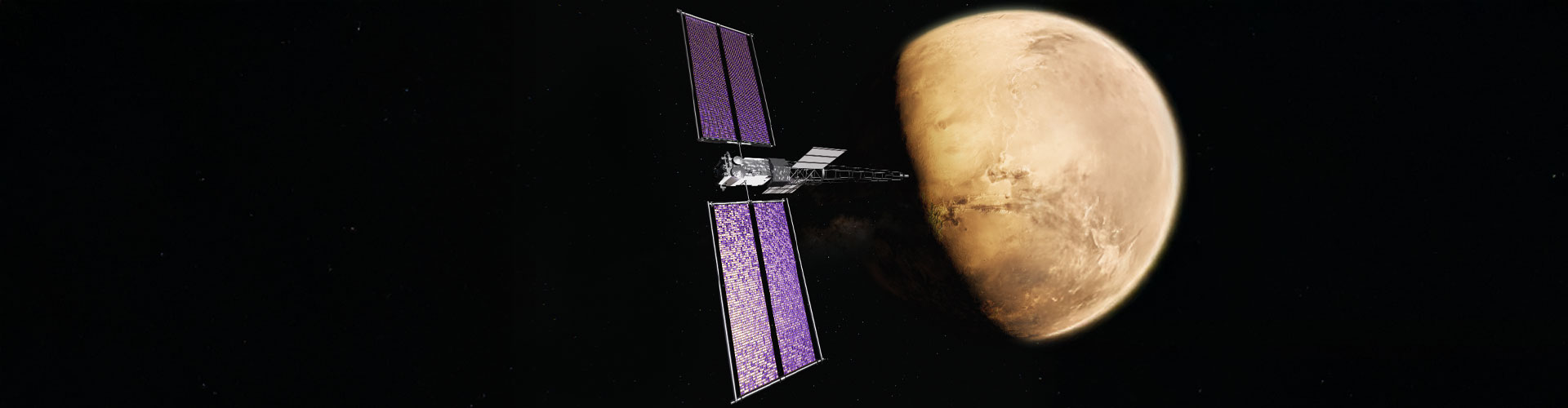 Space Reactor-1 Freedom (NASA Spacecraft)