
eROSITA is an X-ray instrument built by the Max Planck Institute for Extraterrestrial Physics (MPE) in Germany. It is part of the German-Russian Spektr-RG space observatory.
Related channels: SPEKTR-RG X-RAY SPACE OBSERVATORY, EROSITA SPACE TELESCOPE, X-RAY ASTRONOMY, KEPLER SPACE TELESCOPE, TESS SPACE TELESCOPE, ARIEL SPACE TELESCOPE


How to steal a space telescope
Hi Spacecats, I'm Dr Maggie Lieu and welcome to my channel, where you can find all things space, astronomy and physics! Russia is about to steal a space telescope! In this video you'll find out why!
Links:
https://www.mpe.mpg.de/eROSITA
Media credits:
eROSITA all sky image: Sanders, Brunner & eSASS team (MPE)
eROSITA video DLR
LMC: Haberl/Maitra (MPE)
Vela nebula: Predehl/Becker/Mella Support me through my shop:
www.maggielieu.com/shop
If you enjoyed the video, please consider by liking, sharing and subscribing! I'm also on:
twitter: https://twitter.com/space_mog
instagram: https://instagram.com/space_mog/
facebook: https://facebook.com/spacemog/
Bayes vs. machine learning in large-scale survey demographics with eROSITA (Johannes Buchner)
Contributed presentation at 2021 IAP conference "Debating the potential of machine learning in astronomical surveys"
Abstract:
Demographic studies in astronomy are a complex, multi-step process, involving characterizing the biased detection process, association to multi-wavelength counterparts for the assembly of the spectral energy distribution, removal of non-target objects, estimation of redshifts and characterisation of the physics underlying the emission process, and finally, the synthesis of the population across parameters of interest (e.g., luminosity or mass functions). In each of these steps, machine learning is part of modern analyses. From analysis of millions of X-ray photons in the deepest X-ray observations with Chandra, most recently our team applied novel methods to the avalanche of sources discovered by the new X-ray surveyer eROSITA on board SRG towards obtaining a unbiased and complete picture of the impact of supermassive black hole accretion onto galaxy evolution. In this talk, I will review how population demographics from biased samples is possible in a principled Bayesian framework, by combining machine learning techniques with selection-bias-aware hierarchical Bayesian models. The framework is applicable to any selection wavelength and object class of interest.
Colloquium Oct 15, 2021 - Galaxy Groups and Clusters in the eROSITA Final Depth Equatorial Survey
Esra Bulbul
Harvard University
Galaxy Groups and Clusters in the eROSITA Final Depth Equatorial Survey
Clusters of galaxies trace the highest peaks in the cosmic density field and offer an independent and powerful probe of the growth of structure and their abundance is strongly dependent on the underlying cosmology. In the near future, the availability of the final eROSITA All-Sky Survey catalogues with more than 100,000 clusters will put us on the verge of a breakthrough in precision cosmological measurements. At the depth of the final All-Sky Survey, the eROSITA Final Equatorial Survey (eFEDS), executed during the Performance Verification phase, have provided a sneak preview on the cluster science that will be achieved by 2026. I will summarise these first results on clusters of galaxies and present the first results from the first All-Sky Survey.
HE4 -The SRG Mission: First Results from eROSITA and ART-XC - July 6
HE4 -The SRG Mission: First Results from eROSITA and ART-XC - July 6
SRG/eRosita: X-ray map of the whole sky. Some results of the first all-sky survey and future plans
Prof. Dr. Rashid Sunyaev (Max Planck Institute for Astrophysics)
October 1, 2020
Spektr-RG Orbital Observatory with Russian ART-XC and German eRosita X-ray telescopes aboard was launched on July 13th of 2019 from Baykonur. During the flight to the L2 point of the Sun-Earth system, SRG performed calibrations and long duration detailed Performance Verification Observations of more than a dozen of the targets.
Starting in the middle of December during half of the year the SRG Observatory scanned the whole sky and discovered more than a million point X-Ray sources, mainly AGNs and QSOs, stars with hot and bright coronae, more than 16 thousand clusters of galaxies. SRG constructed the X-Ray map of the whole sky, which is now seems to be the best among existing. It provides a lot of information about the distribution of absorbing gas in the Milky Way and provides a beautiful image of the North Polar Spur and similar bright emitting feature on another side from
the Central Part of the Galaxy.
I plan to find time to explain the plans of the Observatory for the future, to demonstrate several images from PV phase observations and from the second whole sky survey which is going now.
eROSITA leaves MPE
Final packaging of the complete eROSITA telescope leaving the MPE assembly Hall for the End to End testing in the Panter Facility.
eROSITA free paper model to download & print
eROSITA (extended Roentgen Survey with an Imaging Telescope Array). Free paper model to download and print: https://www.sternwarte.uni-erlangen.de/wp-content/uploads/1/SRG_paper_model.pdf (more detailed version than in the video)
The eROSITA X-ray telescope - On the hunt for Dark Energy
+Animation +
Very little is known about the Universe. The ingredients that make up four percent of its energy density – ‘normal’ material such as protons and neutrons – is only a very small part of the ‘Universe recipe’. What the other 96 percent is composed of remains a mystery. Today it is believed that 26 percent is Dark Matter. However, the largest share, estimated at 70 percent, is comprised of Dark Energy. To track this down, scientists must observe something unimaginably large and extremely hot. Galaxy clusters are composed of up to several thousand galaxies that move at different velocities within a common gravitational field. Inside, these strange structures are permeated by a thin, extremely hot gas that can be observed through its X-ray emissions. This is where eROSITA’s X-ray ‘eyes’ come into play. They allow to observe galaxy clusters and see how they move in the Universe, and above all, how fast they are travelling. We hope that this motion will tell us more about Dark Energy.
https://www.dlr.de/dlr/en/desktopdefault.aspx/tabid-10081/151_read-36232/#/gallery/35604
Deutsche Version: https://youtu.be/JxzksObzjss
Cleanfeed: https://vimeo.com/342935821
e-ROSITA: Tearing the skies apart.
In this video I talk about the upcoming e-ROSITA mission on board of Spekr-RG due to launch Friday 21st June 2019. How X-ray detectors work, what they are good for looking at and how this mission will tear the skies apart.
If you want more content like this make sure you follow me on
instagram: space_mog
twitter: @space_mog
credits:
videos: MPE/IKI
images: yuzhny (protonM), CHANDRA/NASA (supernova remnant), ROSAT (several), MPE (several), MPE/Friedrich, ESA/GAIA, Buchner (CCD), ESA/XMM
Also Recommended
 SPEKTR-RG X-RAY SPACE OBSERVATORY
 Einstein Probe (ESA/CAS Space Telescope)
 IXPE Space Telescope
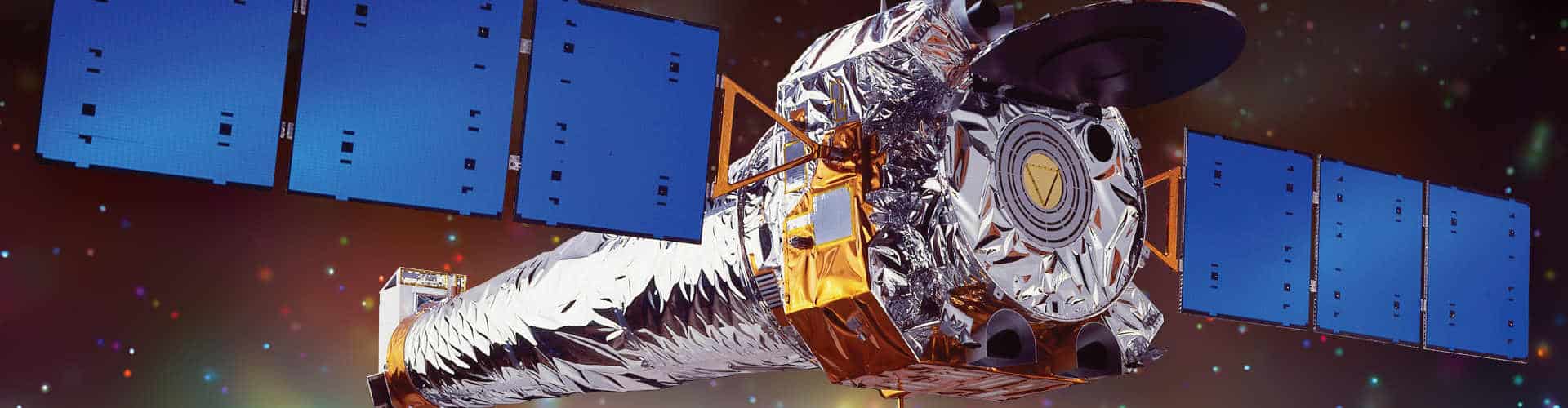 CHANDRA SPACE TELESCOPE
 XPoSat Space Telescope
 Xuntian Space Telescope
 NuSTAR Space Telescope
 Euclid Space Telescope
 Neil Gehrels Swift Observatory
 CGRO SPACE TELESCOPE
 Nancy Grace Roman Space Telescope
 HUBBLE SPACE TELESCOPE
 XMM-NEWTON SPACE TELESCOPE
 James Webb Space Telescope
 VISTA TELESCOPE
 TESS SPACE TELESCOPE
 KEPLER SPACE TELESCOPE
 CHEOPS SPACE TELESCOPE