
X-ray astronomy is an observational branch of astronomy which deals with the study of X-ray observation and detection from astronomical objects. X-radiation is absorbed by the Earth’s atmosphere, so instruments to detect X-rays must be taken to high altitude by balloons, sounding rockets, and satellites.
Related channels: XPOSAT SPACE TELESCOPE, IXPE SPACE TELESCOPE, HUBBLE SPACE TELESCOPE, JAMES WEBB SPACE TELESCOPE, KEPLER SPACE TELESCOPE, TESS SPACE TELESCOPE, ARIEL SPACE TELESCOPE
Latest X-ray Astronomy videos
1
/
4


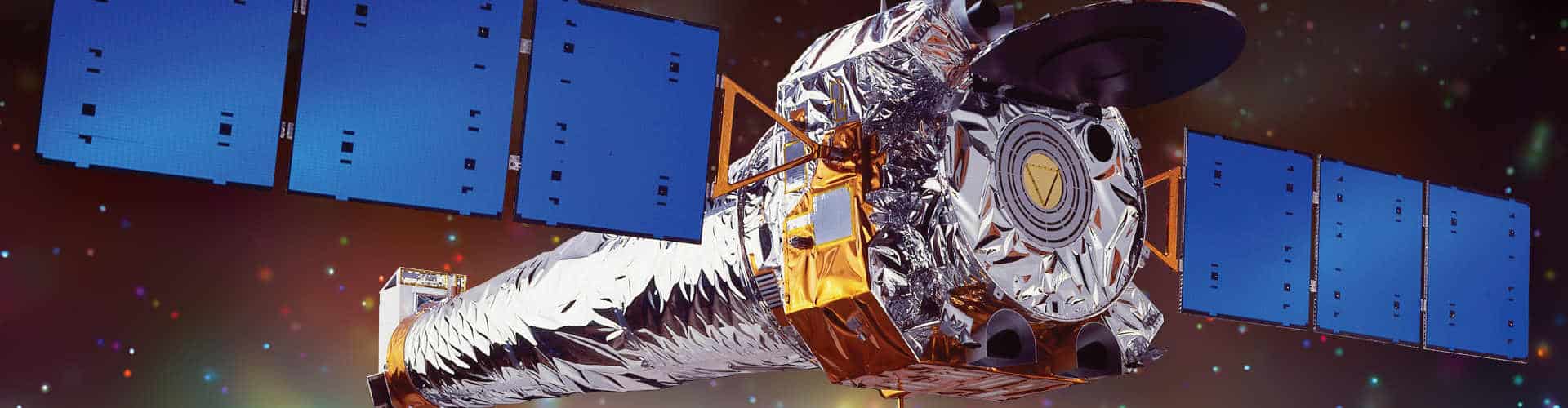
Strange New Class of X-Ray Objects discovered using Chandra Observatory
Scientists using NASA’s Chandra X-ray Observatory have discovered 84 mysterious “hypersoft X-ray sources.” These strange objects could help solve long-standing mysteries in astrophysics.
Credit: NASA/CXC/A. Hobart
Tour: NASA's Chandra Unveils Mysterious X-ray Objects
Scientists have discovered a new class of objects that are behaving unlike any they have seen before by using NASA’s Chandra X-ray Observatory. Astronomers suggest that these new objects may help solve not one, but two, long-standing questions in astrophysics.
The researchers found a total of 84 of what they call “hypersoft X-ray sources” in six different galaxies. They named them this because these mysterious objects give off unusually low-energy X-rays but intense levels of ultraviolet radiation.
The team discovered the hypersoft X-ray sources by looking for objects in the Chandra archive containing the lowest-energy X-rays. Two of the galaxies with these new objects are spirals, M31 and M101, and the other four are ellipticals. In addition to their different galactic homes, the hypersoft X-ray sources were found in both regions of active star formation and areas where there are older stars.
Given all of the clues the researchers gathered, they think the most likely explanation for these new sources involves a black hole, neutron star or white dwarf pulling material from a companion star. The material pulled from the companion star is heated up to produce X-rays before falling onto the white dwarf or neutron star, or into the black hole. Binary systems like this have been seen before but astronomers have never seen them behaving in this manner.
The discovery of this new class of sources suggests that large populations of binary systems with energetic ultraviolet radiation have previously been missed. Why were these hypersoft X-ray sources not found until now? In addition to the low-energy X-ray output, which is very difficult for X-ray telescopes to detect, the high-energy ultraviolet radiation is readily absorbed by helium and hydrogen gas that fills the space in between the stars, creating a “nearly impenetrable barrier” to look through.
By overcoming this observational obstacle, the researchers think this new class of objects may help explain the origin of Type Ia supernova explosions — the kind used to measure the accelerating expansion of the universe — as well as the stripping of electrons in gas in between galaxies. Whatever their role turns out to be, astronomers will be searching for more of these unusual objects and studying them with Chandra in the future.
More at: https://chandra.si.edu/photo/2026/m101
Tour: The Red Potato Galaxy
A black hole may be stirring a “pot” of gas containing a neighboring galaxy in the early universe, according to a new study using NASA’s Chandra X-ray Observatory. The galaxy slowly being “cooked” has been nicknamed the “red potato” by astronomers because of how it looks in images from NASA’s James Webb Space Telescope.
The red potato galaxy is located about 11.7 billion light-years from Earth at an intersection where gigantic web-like structures of galaxies and gas meet. Astronomers targeted this area with Webb because they knew it contains one of the heaviest concentrations of galaxies and growing supermassive black holes in the early universe.
Since data from the Very Large Telescope in Chile shows the red potato galaxy is surrounded by an enormous cloud, or “pot”, of relatively cold gas, astronomers expected that it would have large numbers of young stars that formed after some of the gas was pulled into the galaxy. Scientists have found nearby galaxies surrounded by cold gas ablaze with star formation, but that was not the case for the red potato.
Since stars were not forming like they thought they would, a group of researchers went searching for the reason why. Using Chandra, they discovered that a jet of particles from a black hole in a neighboring galaxy is striking the gas cloud around the red potato galaxy. The jet may be causing the gas to be turbulent, preventing most of the gas from falling onto the red potato galaxy to form large numbers of new stars.
If the black hole’s jet is stirring up the gas around the red potato it could greatly slow down how quickly the galaxy can acquire new, fresh material to form stars. With the energy from the stirring, the galaxy will starve and not be able to produce new stars at the rate expected for similar galaxies at the same cosmic epoch.
Astronomers want to learn how galaxies and black holes interact with each other — especially at this critical epoch in the universe’s history – and how that impacts when and how stars form.
More at: https://chandra.si.edu/photo/2026/redpotato
Tour: NASA's Chandra Discovers Possible Supernova Remnant in Galactic Center
Astronomers may have found a supernova remnant in an intriguing neighborhood of our galactic downtown.
This new supernova remnant, if confirmed, would be one of the closest ever discovered to the supermassive black hole at the central region of the Milky Way Galaxy, an exotic region crammed with massive stars, long threads of magnetic fields and dense clouds of gas orbiting rapidly around the Galactic center.
The evidence for this supernova remnant, located about 26,000 light-years from Earth, comes from X-ray data from NASA’s Chandra X-ray Observatory and ESA’s XMM-Newton. The X-ray data reveal a “blob” of X-ray emission that may come from the remains of a massive star that self-destructed as a supernova, buried within a larger cloud of expanding gas.
If this is indeed a supernova remnant, then it is expanding at about two million miles per hour and is at least about 1,700 years old. Previously, observations with NASA’s now-retired SOFIA telescope had shown evidence for an expanding shell of gas surrounding Sgr C. This gave astronomers a hint that a stellar explosion had occurred in the same spot.
Supernova remnants are the expanding remains of exploded stars and provide elements — like iron, oxygen, and silicon — that are critical for the formation of planets and for life as we know it to form and flourish.
More at: https://chandra.si.edu/photo/2026/sgrc
Tour: Connecting the Dots With NASA's Chandra and Webb
A newly discovered object may be a key to unlocking the true nature of a mysterious class of sources that astronomers have found in the early universe in recent years.
Shortly after NASA’s James Webb Space Telescope started its science observations, reports of a new class of mysterious objects emerged. Astronomers found small, red objects that are about 12 billion light-years from Earth or farther that became known as “little red dots,” or LRDs.
Many scientists think LRDs are supermassive black holes embedded in clouds of dense gas, which mask some of the typical signatures in different kinds of light — including X-rays — that astronomers usually use to identify them. This would make them different from typical growing supermassive black holes, which are not embedded in dense gas, allowing bright ultraviolet light and X-rays from material orbiting the black holes to escape.
Because of this and their potential similarities to stellar atmospheres, astronomers have called this the “black hole star” scenario for LRDs.
This new object discovered by Chandra is exciting because it is the first LRD that is known to give off X-rays. Because of that, the astronomers who found this object nicknamed it the “X-ray dot.”
Located about 11.8 billion light-years from Earth, the X-ray dot may provide a crucial bridge between black hole stars and typical growing supermassive black holes. It exhibits most of the features of an LRD, including being small, red, and located at a vast distance, but it glows in X-ray light, unlike other LRDs.
Finding a little red dot that does gives researchers important new insight into what could power them. The researchers suggest that the X-ray dot represents a transition phase from an LRD to a typical growing supermassive black hole. As the black hole star consumes its surrounding gas, patchy holes in the clouds of gas appear. This allows X-rays from material falling onto the black hole to poke through, which are observed by Chandra. Eventually all the gas is consumed, and the black hole star ceases to exist.
The astronomers were only able to find this X-ray emitting little red dot by comparing new surveys from James Webb with deep observations from Chandra. They will continue to combine the data from these two powerful observatories to look for more examples of this behavior to hopefully help further unravel the mysteries surrounding little red dots.
https://chandra.si.edu/photo/2026/xraydot
AAS Journal Author Series: Fatemeh Kayanikhoo on 2025ApJ...995...10K
atemeh Kayanikhoo (Nicolaus Copernicus Astronomical Center of the Polish Academy of Sciences; Silesian University in Opava, Czech Republic) chats about her article on the energy flow and radiation efficiency of accreting neutron stars as potential ultraluminous X-ray sources, finding that simulations with magnetic dipole strengths below 30 GigaGauss exhibit apparent luminosities consistent with those observed in ultraluminous X-ray sources as a result of beaming.
Energy Flow and Radiation Efficiency in Radiative GRMHD Simulations of Neutron Star Ultraluminous X-Ray Sources
https://scixplorer.org/abs/2025ApJ...995...10K/abstract
Fatemeh's web presence:
https://fkayanikhoo.wixsite.com/fatima
The intended audience for the AAS Journal Author Series is active researchers.
Quick Look: Cosmic Holiday Greetings From NASA's Chandra X-ray Observatory
Here are four new “winter” space images from NASA’s Chandra X-ray Observatory.
Each image contains X-rays from Chandra and data from other telescopes.
These images resemble a snowman, Christmas tree, winter landscape, and a partridge.
Chandra is releasing these images to help celebrate the winter season.
More at: https://chandra.si.edu/photo/2025/holidays/
NASA’s next big infrared telescope
SPHEREx is NASA's latest telescope slated to launch in just over a week from Vandenberg Space Force Base in California. This mission is slated to map the sky in infrared and will be searching for the answers to the origin of our universe on its 2 year mission.
And remember you can always help out the shows of TMRO by becoming a member here: https://www.youtube.com/user/TMRO/join
Continue the conversation by joining TMRO on Discord: https://discord.gg/htEJMHyFBE
How NASA Will Observe the Universe with SPHEREx
NASA’s SPHEREx mission will explore the universe in a way that has never been done in astronomy before. The observatory has both a wide field of view and the ability to examine the sky in over 100 colors. This approach will help SPHEREx in its quest to understand the origins of our universe as well as water and other molecules important for life. Learn more about this innovative mission at: https://science.nasa.gov/mission/spherex/?utm_source=science&utm_medium=youtube&utm_campaign=2026
Narrator/Writer/Producer: Elizabeth Landau
Writer/Producer: Robert Hurt
Editor/Animator: Keith Miller
Additional Animations: Juan Vargas
Additional assets provided by:
Frank Summers/STScI
Credit: NASA
ASL STREAM - Seeing in X-Ray Vision (Glenn Lecture)
ASL STREAM - On July 23, 1999, NASA launched the Chandra X-ray Observatory into space aboard Space Shuttle Columbia. Since then, astronomers have pulled from Chandra’s data to create incredibly detailed images of some of the universe’s most dramatic events, from supernova explosions to black hole jets. This summer marks the 25th anniversary of a telescope that has given astronomers unprecedented views of the universe in x-rays.
Join us to hear from astronauts who deployed the Chandra X-ray Observatory during the STS-93 mission as well as scientists from the Smithsonian Astrophysical Observatory who analyze the important data sent back to us here on Earth.
Full screen version available here: https://youtube.com/live/_UjgAHIi9ns
Sponsored by Boeing
A Window to the Universe is Shutting...
Is this the end of American x-ray space imaging? Neil deGrasse Tyson talks about the great space observatories, the new telescopes taking up the mantle, and the future of The Chandra X-ray Observatory.
Learn about Lyman Spitzer’s groundbreaking idea to put observatories in space to better view the cosmos. Neil walks us through the great space telescopes: Hubble, Spitzer, Compton, and Chandra. He breaks down the Hubble Space Telescope and its journey and impact on humanity. Find out what telescopes are replacing and updating these original telescopes and what people can do to stop Chandra’s decommission.
Timestamps:
00:00 - Introduction: The Great Space Observatories
00:38 - Lyman Spitzer & The Idea of Space Telescopes
3:32 - Launching Hubble
7:25 - Spitzer, Compton, & Chandra
9:23 - The Replacements: JWST, Nancy Grace Roman, & Fermi
10:21 - Decommissioning Chandra
Check out our second channel, @StarTalkPlus
Get the NEW StarTalk book, 'To Infinity and Beyond: A Journey of Cosmic Discovery' on Amazon: https://amzn.to/3PL0NFn
Support us on Patreon: https://www.patreon.com/startalkradio
FOLLOW or SUBSCRIBE to StarTalk:
Twitter: http://twitter.com/startalkradio
Facebook: https://www.facebook.com/StarTalk
Instagram: https://www.instagram.com/startalk
About StarTalk:
Science meets pop culture on StarTalk! Astrophysicist & Hayden Planetarium director Neil deGrasse Tyson, his comic co-hosts, guest celebrities & scientists discuss astronomy, physics, and everything else about life in the universe. Keep Looking Up!
#StarTalk #NeildeGrasseTyson
Bizarre Cosmological Bubbles Visible From Earth Reveal More Secrets (eROSITA Bubbles)
Get a Wonderful Person Tee: https://teespring.com/stores/whatdamath
More cool designs are on Amazon: https://amzn.to/3QFIrFX
Alternatively, PayPal donations can be sent here: http://paypal.me/whatdamath
Hello and welcome! My name is Anton and in this video, we will talk about new discoveries about bizarre x-ray bubble structures coming from the galactic center
Links:
https://iopscience.iop.org/article/10.3847/2041-8213/ad47e0
https://www.mpe.mpg.de/7540556/news20201210
https://news.uchicago.edu/story/scientists-may-have-found-spot-where-our-supermassive-black-hole-vents
https://arxiv.org/abs/2310.02892
Previous videos:
https://youtu.be/ZjT8qv39h6E
https://youtu.be/El1PXDX84P0
https://youtu.be/u3ZIpHobDFc
#sgra* #milkyway #blackhole
0:00 Mystery of Erosita bubbles and what they are
2:00 Was this a supernova or a blackhole emission?
4:05 First proofs from the recent study
5:20 Source discovered near SgrA*
6:45 How these structures probably form
7:20 What we still don't know and conclusions
Support this channel on Patreon to help me make this a full time job:
https://www.patreon.com/whatdamath
Bitcoin/Ethereum to spare? Donate them here to help this channel grow!
bc1qnkl3nk0zt7w0xzrgur9pnkcduj7a3xxllcn7d4
or ETH: 0x60f088B10b03115405d313f964BeA93eF0Bd3DbF
Space Engine is available for free here: http://spaceengine.org
Enjoy and please subscribe.
Twitter: https://twitter.com/WhatDaMath
Facebook: https://www.facebook.com/whatdamath
Twitch: http://www.twitch.tv/whatdamath
The hardware used to record these videos:
New Camera: https://amzn.to/34DUUlv
CPU: https://amzn.to/2LZFQCJ
Video Card: https://amzn.to/2M1W26C
Motherboard: https://amzn.to/2JYGiQQ
RAM: https://amzn.to/2Mwy2t4
PSU: https://amzn.to/2LZcrIH
Case: https://amzn.to/2MwJZz4
Microphone: https://amzn.to/2t5jTv0
Mixer: https://amzn.to/2JOL0oF
Recording and Editing: https://amzn.to/2LX6uvU
Some of the above are affiliate links, meaning I would get a (very small) percentage of the price paid.
Thank you to all Patreon supporters of this channel
Special thanks also goes to all the wonderful supporters of the channel through YouTube Memberships
Credit:
NASA/CXC/Univ. of Chicago/S.C. Mackey et al.; Radio: NRF/SARAO/MeerKAT; Image Processing: NASA/CXC/SAO/N. Wolk
Haslam, C.G.T. et al., Astron. Astrophys. Suppl. Ser. 1982
NASA/CXC/SAO/N. Wolk
G. Ponti et al.
Licenses used:
https://creativecommons.org/licenses/by/4.0/
https://creativecommons.org/licenses/by-sa/4.0/
https://creativecommons.org/licenses/by/3.0/
https://creativecommons.org/licenses/by-sa/3.0/
https://creativecommons.org/licenses/by/2.5/
https://creativecommons.org/licenses/by-sa/2.5/
https://creativecommons.org/licenses/by/2.0/
https://creativecommons.org/licenses/by-sa/2.0/
The biggest structures in the universe
Alexia Lopez - a doctoral candidate at the University of Central Lancashire in the UK - identified The Giant Arc, a cluster of galaxies spanning 3.3 billion lightyears.
Learn more:
GALAXY CLUSTERS https://www.spacetv.net/galaxy-clusters/
X-RAY ASTRONOMY https://www.spacetv.net/x-ray-astronomy/
COSMOLOGY https://www.spacetv.net/cosmology/
THE UNIVERSE https://www.spacetv.net/the-universe/
Written by Luke Madams
https://www.lukemadams.co.uk/
Fact Checker Emily Whitehead
Senior Fact Checker Natalia Kissova
https://www.linkedin.com/in/natalia-kissova-5a9473143/
Narrated by Cherry McIntosh
https://www.cherrymcintoshvo.com/
Technical support by TheseWorlds
https://theseworlds.com
Sources:
https://www.sciencealert.com/a-giant-wall-of-galaxies-has-been-found-stretching-across-the-universe
https://www.livescience.com/giant-arc-in-space.html
https://www.sciencenews.org/article/galaxy-giant-arc-3-billion-light-years-long-cosmology-space
https://en.wikipedia.org/wiki/The_Giant_Arc
https://www.bbc.com/future/article/20230302-the-giant-arcs-that-may-dwarf-everything-in-the-cosmos?utm_source=pocket-newtab
https://www.techexplorist.com/giant-arc-galaxies-discovered-9-2-billion-light-years-away/39713/
https://www.youtube.com/watch?v=DXtmRRXTiSw
https://doi.org/10.1093/mnras/stac2204
https://arxiv.org/pdf/2201.06875.pdf
https://www.star.uclan.ac.uk/~alopez/aas238_press_release.pdf Credits:
NASA/Goddard Space Flight Center Scientific Visualization Studio. Gaia DR2: ESA/Gaia/DPAC. Constellation figures based on those developed for the IAU by Alan MacRobert of Sky and Telescope magazine (Roger Sinnott and Rick Fienberg).
ESA/Hubble & NASA, RELICS
Alexia Lopez/UCLan
The University of Central Lancashire - UCLan
Stellarium/University of Central Lancashire/PA
ESO/B. Tafreshi (twanight.org)
ALMA (ESO/NAOJ/NRAO)/B.Tafreshi
ESO/INAF-VST/OmegaCAM/A. Fujii/Digitized Sky Survey 2.
ESA - European Space Agency
ESA/Vintergatan – Renaud, Agertz et al.
Horv´ath et al. 2015).
ESO/L. Calçada
Dpomarede
ESA/Hubble & NASA
ESO/M. Kornmesser
ESO/Digitized Sky Survey 2/A. Fujii. Acknowledgement: Aniello Grado and Luca Limatola.
Contact SPACETV https://www.spacetv.net/contact-us/
SPACETV.NET 2024
Chandra X-ray Observatory captures 20-year timelapse showing evolution of stellar explosions
NASA's Chandra X-Ray Observatory has released two new timelapse movies showing dramatic changes in two of the most famous supernova remnants in the Universe: the Crab Nebula and Cassiopeia A.
The supernova movies were both created using x-ray data captured by Chandra over a span of two decades.
Credit; X-ray: NASA/CXC/SAO; Optical: NASA/STScI; Image Processing: NASA/CXC/SAO/J. Major, A. Jubett, K. Arcand
SPHEREx: Zooming Out To See The Big Picture (Live Public Talk)
Meet NASA’s next cosmic mapmaker! SPHEREx – or the Spectro-Photometer for the History of the Universe, Epoch of Reonization and Ices Explorer – will create a map of the universe like none before. The space telescope will survey the sky in optical and near-infrared light, creating an all-sky map every six months. This unique spectral survey will enable science ranging from our solar system to the very beginnings of the universe.
Speaker:
Dr. Jamie Bock, SPHEREx Principal Investigator, Caltech/NASA JPL
Host:
Marc Razze, Office of Communications and Education, NASA JPL
Co-host:
Kaitlyn Soares, Universe Public Engagement Lead, NASA JPL
Original Air Date: Feb. 22, 2024
eROSITA new map of the Universe: black holes, filaments and clusters of galaxies
Hi Spacecats, I'm Dr Maggie Lieu and welcome to my channel, where you can find all things space, astronomy and physics! Journey through the universe like never before with eROSITA's groundbreaking first data release! This video unveils the secrets hidden in X-ray light, showcasing the largest ever catalog of cosmic sources (nearly 1 million!) and mind-blowing discoveries like:
- 700,000+ supermassive black holes revealed, mapping the universe's hidden giants.
- Massive cosmic structures never seen before, pushing the boundaries of our understanding.
- Clues to the formation of stars and galaxies, peering into the universe's birthplaces.
- Potential impact on the search for habitable planets, uncovering hidden stellar environments.
This is more than just data, it's a revolution in X-ray astronomy! Join me as we:
-Explore the stunning X-ray images captured by eROSITA.
-Break down the key findings and their significance.
-Discuss the challenges of this groundbreaking mission.
-Answer your burning questions about the universe!
Subscribe for more space exploration content and hit the notification bell to stay tuned.
Links:
List of the papers: https://erosita.mpe.mpg.de/publications/
Main paper: https://arxiv.org/pdf/2401.17274.pdf
Media credits:
eROSITA: DLR
dwarf star: ESO/Calcada/SpaceEngine
eROSITA energy bands: MPE
point sources: MPE/Sanders/eROSITA
extended sources: MPE/Sanders/eROSITA
eROSITA bubbles: MPE
neutron star: NASA/Smith
binary star: ESO
Galaxy deblending: Reiman & Göhre https://arxiv.org/abs/1810.10098
Cosmic web: Eagle simulations
Filament: ESO/Calcadaa/Subaru/National Astronomical Observatory of Japan/Tanaka
Cosmic web: Springel
Special thanks to my youtube perks members: Annex Celestial, Wheely Big Bike Trip, Steven Yee, Thomas Seiler, Anders Welander, Bill Fratt, David Brant, John Lewis, TudományosFikció, Spacecatluna & Sentient Design
You can also sign up on my channel page to get access to perks:
https://www.youtube.com/channel/UClO6TuRE6XLzbMBmQ_KY38A/join
Support me through my shop:
www.maggielieu.com/shop
If you enjoyed the video, please consider by liking, sharing and subscribing! I'm also on:
twitter: https://twitter.com/space_mog
instagram: https://instagram.com/space_mog/
facebook: https://facebook.com/spacemog/
onegarden: onegarden.com/?rfc=7wL
FIRST IMAGES From Japan's NEW X-RAY Telescope! | XRISM
↓↓↓ Links and more in full description below ↓↓↓
Japan's brand new x-ray telescope, XRISM, has just releasd it's first ever images. They show a galaxy cluster called Abell 2319 and a supernova remnant called N132D. In this video we'll have a look at these images, how good they are and what they're showing, as well as looking at XRISM's mission in general. We also touch on how x-ray telescopes work and the risk we have of having no x-ray telescope in space at all. Enjoy, and leave me any questions or comments down below!
You can buy me a coffee if you enjoyed this and want to support these videos. You don't have to though, no pressure. https://www.buymeacoffee.com/chrispattison
How X Ray Telescopes work video: https://youtu.be/VDOm1IudAOo?si=Xx_4G1Ows2u04n3u
How Gamma Ray Telescopes work: https://youtu.be/-1gRR9J8FZo
LINKS and SOURCES:
Xrism Specs and Tech: https://www.xrism.jaxa.jp/en/technology/
https://xrism.isas.jaxa.jp/en/technology/detail_02/
Xrism Factsheet: https://www.esa.int/Science_Exploration/Space_Science/XRISM_factsheet
ESA Press Release (First Images): https://www.esa.int/Science_Exploration/Space_Science/XRISM_s_first_views_signal_shake-up_for_X-ray_astronomy#Anchor2
JAXA Press Release: https://global.jaxa.jp/press/2024/01/20240105-1_e.html
Abell 2319 Image: https://www.esa.int/ESA_Multimedia/Images/2024/01/Galaxy_cluster_Abell_2319
Supernova Remnant N132D Image: https://www.esa.int/Science_Exploration/Space_Science/XRISM_s_first_views_signal_shake-up_for_X-ray_astronomy
Supernova remnant 30 Doradus B Chandra Image: https://www.nasa.gov/image-article/nasa-telescopes-start-the-year-with-a-double-bang
Chapters:
00:00 - Intro
00:27 - What is Xrism?
02:10 - The AMAZING way X-ray Telescopes Work
03:11 - NEW IMAGE 1 (Supernova Remnant N132D)
05:43 - NEW IMAGE 2 (Galaxy Cluster Abell 2319)
07:31 - Future Plans for XRISM
08:02 - Outro Hey team!
If there is some other cool topic in physics you think we should learn about together, leave a comment down below!
Until next time, stay safe.
Please consider subscribing if you enjoyed the video, and you can also find me on Twitter and Instagram:
https://twitter.com/chrisdpattison
https://www.instagram.com/chrispattison22/
India: ISRO to usher in 2024 with XPoSat mission | Latest News | WION
After a highly productive 2023, with the successful launch of the third Lunar Mission Chandrayaan-3 and the first Sun exploratory Aditya-L1, a buoyant Indian Space Research Organisation (ISRO) will usher in 2024 with the launch of PSLV-C58/X-ray Polarimeter Satellite (XPoSat) mission on January 1st. #xposat #isro #latestnews About Channel:
WION The World is One News examines global issues with in-depth analysis. We provide much more than the news of the day. Our aim is to empower people to explore their world. With our Global headquarters in New Delhi, we bring you news on the hour, by the hour. We deliver information that is not biased. We are journalists who are neutral to the core and non-partisan when it comes to world politics. People are tired of biased reportage and we stand for a globalized united world. So for us, the World is truly One.
Please keep discussions on this channel clean and respectful and refrain from using racist or sexist slurs and personal insults.
Subscribe to our channel at https://goo.gl/JfY3NI
Check out our website: http://www.wionews.com
Join our WhatsApp Channel: https://bit.ly/455YOQ0
Connect with us on our social media handles:
Facebook: https://www.facebook.com/WIONews
Twitter: https://twitter.com/WIONews
Follow us on Google News for the latest updates
Zee News:- https://bit.ly/2Ac5G60
Zee Business:- https://bit.ly/36vI2xa
DNA India:- https://bit.ly/2ZDuLRY
WION: https://bit.ly/3gnDb5J
Zee News Apps: https://bit.ly/ZeeNewsApps
ISRO's Mega New Launch On First Day Of 2024 | XPoSat Mission After Chandrayaan-3 And Aditya L1
Indian space agency ISRO is all set to launch an ambitious mission on the first day of 2024. ISRO will launch XPoSat mission from Satish Dhawan Space Center in Sriharikota on January 1, 2024. The XPoSat mission will study the emission from black holes. This will be another landmark mission for ISRO after the historic Chandrayaan-3 landing and the successful launch of Aditya L1 this year.
#isro #chandrayaan3 #adityal1 #adityal1launch #Isronewmission #xposat #narendramodi #adityal1mission #isrosunmission #chandrayaan3 #isrochandrayaan3 #vikramlander #adityal1missiondate #englishnews
Hindustan Times Videos brings all the News for the Global Indian under one umbrella. We break down news from across the globe from the unique lens of a Rising India. Tune in for Explainers, Opinions, Analysis and a 360 degree view of big events in India and the World which impact your present and future.
Follow the Hindustan Times Channel on WhatsApp for News Alerts, Top Stories and Editor picks. Join Us Today - https://www.bit.ly/3PQ4kSv
Subscribe to the Hindustan Times YT channel and press the bell icon to get notified when we go live.
Visit our website https://www.hindustantimes.com/
Follow us on Twitter https://twitter.com/htTweets
Follow us on Facebook https://www.facebook.com/hindustantimes
PSLV-C58/XPoSAT Mission Vehicle Integration Video | ISRO | PSLV-DL
🗓Launch: 09:10 IST/03:40 UTC on Jan 01, 2024
#ISRO #PSLVC58 #XPOSAT #PSLVDL
India is set to launch its first X-Ray Polarimeter Satellite (XPoSat), aiming to investigate the polarization of intense X-Ray sources. While space-based X-Ray astronomy has been established in India, focusing predominantly on imaging, time-domain studies, and spectroscopy, this upcoming mission marks a major value-addition. The astronomy community is particularly enthused about the prospect of a systematic exploration into the polarization of X-Rays emitted by astronomical sources. This research, supplementing traditional time and frequency domain studies, introduces a novel dimension to X-Ray astronomy, generating anticipation and excitement within the scientific community.
1
/
4
Also Recommended
 SPEKTR-RG X-RAY SPACE OBSERVATORY
 XRISM (X-ray Imaging and Spectroscopy Mission)
 FERMI GAMMA RAY SPACE TELESCOPE
 Ultraviolet Astronomy
 RADIO ASTRONOMY
 Infrared Astronomy
 Einstein Probe (ESA/CAS Space Telescope)
 DEEP ASTRONOMY
 NuSTAR Space Telescope
 ASTRONOMY CRASH COURSE
 CHANDRA SPACE TELESCOPE
 Astronomy
 ASTRONOMY FOR EVERYONE
 Caltech Astronomy Department
 Neil Gehrels Swift Observatory
 UNIVERSE UNPLUGGED
 GAMMA RAYS
 XPoSat Space Telescope




