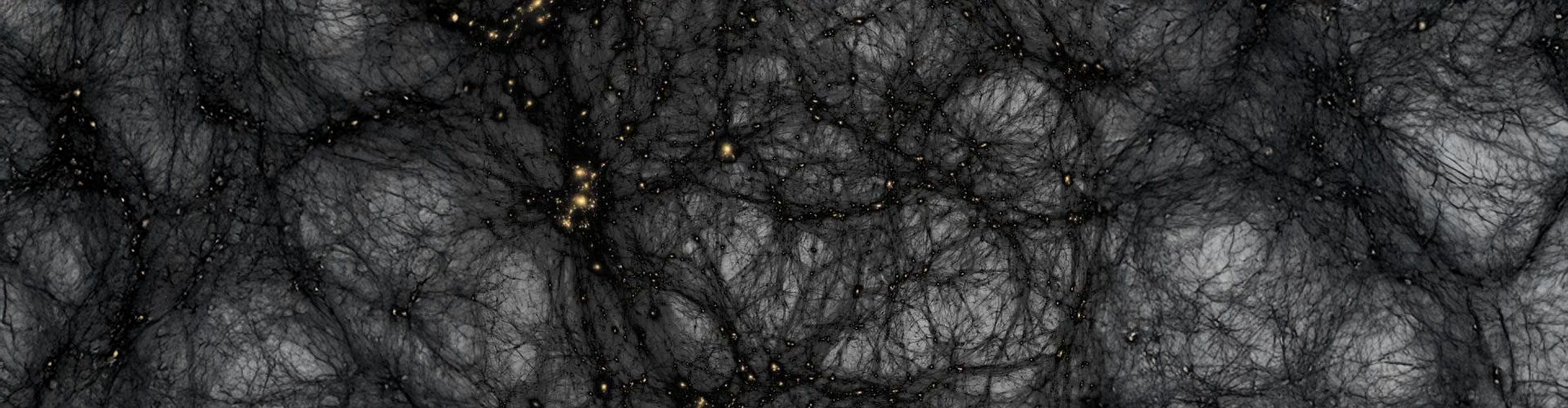
Galaxy clusters are immense collections of galaxies gravitationally bound together. They serve as cosmic metropolises, hosting hundreds to thousands of galaxies, and provide valuable insights into the structure and evolution of the universe. Image credit: NRAI, AUI, NFS
Related channels: GALAXIES, THE MILKY WAY, ANDROMEDA GALAXY, HUBBLE SPACE TELESCOPE, STARS, GRAVITY, ASTRONOMY, COSMOLOGY, DARK MATTER
Latest videos about Galaxies
1
/
2


The biggest structures in the universe
Alexia Lopez - a doctoral candidate at the University of Central Lancashire in the UK - identified The Giant Arc, a cluster of galaxies spanning 3.3 billion lightyears.
Learn more:
GALAXY CLUSTERS https://www.spacetv.net/galaxy-clusters/
X-RAY ASTRONOMY https://www.spacetv.net/x-ray-astronomy/
COSMOLOGY https://www.spacetv.net/cosmology/
THE UNIVERSE https://www.spacetv.net/the-universe/
Written by Luke Madams
https://www.lukemadams.co.uk/
Fact Checker Emily Whitehead
Senior Fact Checker Natalia Kissova
https://www.linkedin.com/in/natalia-kissova-5a9473143/
Narrated by Cherry McIntosh
https://www.cherrymcintoshvo.com/
Technical support by TheseWorlds
https://theseworlds.com
Sources:
https://www.sciencealert.com/a-giant-wall-of-galaxies-has-been-found-stretching-across-the-universe
https://www.livescience.com/giant-arc-in-space.html
https://www.sciencenews.org/article/galaxy-giant-arc-3-billion-light-years-long-cosmology-space
https://en.wikipedia.org/wiki/The_Giant_Arc
https://www.bbc.com/future/article/20230302-the-giant-arcs-that-may-dwarf-everything-in-the-cosmos?utm_source=pocket-newtab
https://www.techexplorist.com/giant-arc-galaxies-discovered-9-2-billion-light-years-away/39713/
https://www.youtube.com/watch?v=DXtmRRXTiSw
https://doi.org/10.1093/mnras/stac2204
https://arxiv.org/pdf/2201.06875.pdf
https://www.star.uclan.ac.uk/~alopez/aas238_press_release.pdf Credits:
NASA/Goddard Space Flight Center Scientific Visualization Studio. Gaia DR2: ESA/Gaia/DPAC. Constellation figures based on those developed for the IAU by Alan MacRobert of Sky and Telescope magazine (Roger Sinnott and Rick Fienberg).
ESA/Hubble & NASA, RELICS
Alexia Lopez/UCLan
The University of Central Lancashire - UCLan
Stellarium/University of Central Lancashire/PA
ESO/B. Tafreshi (twanight.org)
ALMA (ESO/NAOJ/NRAO)/B.Tafreshi
ESO/INAF-VST/OmegaCAM/A. Fujii/Digitized Sky Survey 2.
ESA - European Space Agency
ESA/Vintergatan – Renaud, Agertz et al.
Horv´ath et al. 2015).
ESO/L. Calçada
Dpomarede
ESA/Hubble & NASA
ESO/M. Kornmesser
ESO/Digitized Sky Survey 2/A. Fujii. Acknowledgement: Aniello Grado and Luca Limatola.
Contact SPACETV https://www.spacetv.net/contact-us/
SPACETV.NET 2024
The earliest known Dark Matter detected, with Dr Maggie Lieu
Dark Matter is still one of the most profound mysteries in astrophysics and cosmology, and we still have no idea what it is, how it's produced, or what it's role is in the evolution of the universe.
Special thanks to Dr Maggie Lieu for her expert contribution. Subscribe to Space Mog https://www.youtube.com/@SpaceMog and watch Maggie's video about the Euclid Space Telescope https://www.youtube.com/watch?v=7fpgw9e1Iis
Learn more:
DARK MATTER https://www.spacetv.net/dark-matter-dark-energy/
EUCLID SPACE TELESCOPE https://www.spacetv.net/euclid-space-telescope/
VERA RUBIN OBSERVATORY https://www.spacetv.net/vera-c-rubin-observatory/
GALAXY CLUSTERS https://www.spacetv.net/galaxy-clusters/
GALAXIES https://www.spacetv.net/galaxies/
Written by Paul McCracken
https://paulmccracken91.wixsite.com/my-site
https://www.linkedin.com/in/paul-mccracken-49b0aa156/
Narrated by Antonio Bustos
https://www.linkedin.com/in/antonio-bustos-018670224/
Sources:
https://www.sciencealert.com/dark-matter-has-now-been-measured-in-some-of-the-universe-s-youngest-galaxies
https://www.livescience.com/space/einstein-was-right-about-invisible-dark-matter-massive-new-map-of-the-universe-suggests
https://www.space.com/if-dark-matter-invisible-how-do-we-know-it-exists
https://www.kcl.ac.uk/news/axions-shedding-light-on-dark-matter
https://www.nationalgeographic.com/science/article/dark-matter
Credits:
ESO/VISTA VMC/N. Risinger (skysurvey.org)
ESA - European Space Agency
NASA's Goddard Space Flight Center/CI Lab
NASA/ESA/M.Kornmesser
ESA - European Space Agency
NASA, ESA/Hubble, M. Kornmesser, L. Calçada
ICRAR/GAMA/Will Parr, Mark Swinbank and Dr. Peder Norberg (Durham University)
ESO/M. Kornmesser
ESO/INAF-VST/OmegaCAM. Music: John Dyson (from the album Moonwind)
ALMA (NRAO/ESO/NAOJ)/Luis Calçada (ESO)
NASA/CXC/A. Hobart/
Chandra X-ray Observatory YouTube
NASA, ESA, P. Kelly, M. Postman, J. Richard, S. Allen, N. Bartmann
NASA/Goddard Space Flight Center and the Advanced Visualization Laboratory at the National Center for Supercomputing Applications
Wu, Hahn, Wechsler, Abel(KIPAC), Visualization: Kaehler (KIPAC)
NASA's Goddard Space Flight Center Conceptual Image Lab
NASA / WMAP Science Team
The Hyper Suprime-Cam Survey collaboration
NASA/GSFC/National Center for Supercomputing/Advanced Visualization Laboratoy/B. O'Shea and M. Norman
SubaruTelescope, NAOJ
Science Office/LSST Project/NSF/AURA
Land on the Golden Gate by Chris Zabriskie is licensed under a Creative Commons Attribution 4.0 licence. https://creativecommons.org/licenses/by/4.0/
Source: http://chriszabriskie.com/stuntisland/
Artist: http://chriszabriskie.com/
Mario Bava Sleeps In a Little Later Than He Expected To by Chris Zabriskie is licensed under a Creative Commons Attribution 4.0 licence. https://creativecommons.org/licenses/by/4.0/
Source: http://chriszabriskie.com/vendaface/
Artist: http://chriszabriskie.com/
Cylinder Seven by Chris Zabriskie is licensed under a Creative Commons Attribution 4.0 licence. https://creativecommons.org/licenses/by/4.0/
Source: http://chriszabriskie.com/cylinders/
Artist: http://chriszabriskie.com/
Follow SPACETV on Twitter https://twitter.com/SPACETVnet
SPACETV.NET 2023
Cosmic Wonders: Exploring Galaxies and Clusters on an Incredible Journey
Embark on a breathtaking cosmic journey! Explore UGC 2885, a colossal spiral galaxy, and witness Stephan's Quintet, an extraordinary group of interacting galaxies. Traverse Pegasus to encounter a captivating galaxy cluster, Abell 370, showcasing the gravitational lensing effect. Marvel at the power of Hercules A, an active galaxy with merging possibilities. Discover Pandora's Cluster, a mesmerizing interaction of galaxies in Abell 2744. Witness the grandeur of the Coma Cluster and explore the relic galaxy NGC 1277 for insights into early galaxies. Join us on this awe-inspiring journey through the cosmos!
Disclaimer:
Credit: Scientific Visualization Studio
https://svs.gsfc.nasa.gov/
the appropriate credit lines are ‘burned in’ or overlaid on the each part in the video
Credit: NASA's Goddard Space Flight Center Scientific Visualization Studio/Earth Observatory Animators Trent L. Schindler (USRA) [Lead] Jesse Allen (SSAI) Robert Simmon (Sigma Space Corporation) Writer Aries Keck (ADNET) Scientist Christopher Elvidge (NOAA/NGDC) Producers Kayvon Sharghi (USRA) and Mike Carlowicz (NASA/HQ)
Credit: NASA Earth Observatory and NASA's Goddard Space Flight Center/Animators Robert Simmon (Sigma Space Corporation) [Lead] Jesse Allen (SSAI) Trent L. Schindler (USRA) Writer Mike Carlowicz (NASA/HQ) [Lead] Video editor Kayvon Sharghi (USRA) Scientist Christopher Elvidge (NOAA/NGDC) [Lead] Producers Kayvon Sharghi (USRA) Mike Carlowicz (NASA/HQ)
Usage of ESO Images, Videos, Web texts and Music
licensed under a Creative Commons Attribution 4.0 International License
link to license https://creativecommons.org/licenses/by/4.0/
Source: https://www.eso.org/public/videos/
The appropriate credit lines are ‘burned in’ or overlaid on each part of the video
Image, Video Credit: ESO/L. Calçada/M. Kornmesser/spaceengine.org. Music: Jennifer Athena Galatis, Video Credit: A. M. Swinbank and Zieleniewski
Hubble Space Telescope
https://hubblesite.org/home
The appropriate credit lines are ‘burned in’ or overlaid on each part at the beginning or end of video clips
Credits: NASA, ESA, and J. DePasquale (STScI), Credits: G. Bacon, J. DePasquale, F. Summers, Z. Levay (STScI), Credits: NASA, ESA, and G. Bacon (STScI), Credit: NASA, ESA, and Z. Levay; F. Summers; G. Bacon; T. Davis; and L. Frattare (Viz 3D Team/STScI); Mark Malanoski (GST) Project support Frank Summers (STScI), Greg Bacon (STScI), Lisa Frattare (STScI), Mark Malanoski (GST), Tiffany Davis (STScI), Zoltan Levay (STScI), Credits: NASA, ESA, and G. Bacon (STScI); Acknowledgment: NASA, ESA, A. Fujii, Digitized Sky Survey (DSS), STScI/AURA, Palomar/Caltech, and UKSTU/AAO, and J. Lotz, M. Mountain, A. Koekemoer, and the HFF Team (STScI), Credits: NASA, ESA, and the Hubble SM4 ERO Team, Credits: NASA, ESA, and G. Bacon (STScI), Credits: NASA, ESA, and J. DePasquale (STScI), Credits: NASA, ESA, G. Bacon, J. DePasquale, and Z. Levay (STScI), Acknowledgment: Y. Yang (Texas A&M/Weizmann Institute of Science), Credits: NASA, ESA, and G. Bacon (STScI); Acknowledgment: NASA, ESA, A. Mellinger, Digitized Sky Survey ((DSS), STScI/AURA, Palomar/Caltech, and UKSTU/AAO), J. Dalcanton (University of Washington), the PHAT team, and R. Gendler
James Webb Sees Galaxies 830 Million Years After The Big Bang
Webb identifies the earliest strands of the cosmic web
Galaxies are not scattered randomly across the universe. They gather together not only into clusters, but into vast interconnected filamentary structures with gigantic barren voids in between. This “cosmic web” started out tenuous and became more distinct over time as gravity drew matter together.
Astronomers for the ASPIRE program using the NASA/ESA/CSA James Webb Space Telescope have discovered a thread-like arrangement of 10 galaxies that existed just 830 million years after the Big Bang. This deep galaxy field from Webb’s NIRCam (Near-Infrared Camera) shows an arrangement of these 10 distant galaxies marked by eight white circles in a diagonal, thread-like line. (Two of the circles contain more than one galaxy.) This 3 million light-year-long filament is anchored by a very distant and luminous quasar – a galaxy with an active, supermassive black hole at its core. The quasar, called J0305-3150, appears in the middle of the cluster of three circles on the right side of the image. Its brightness outshines its host galaxy. The 10 marked galaxies existed just 830 million years after the big bang. The team believes the filament will eventually evolve into a massive cluster of galaxies.
[Image description: Hundreds of tiny galaxies appear across the black expanse of space. The galaxy colors vary. Most galaxies are so distant they appear as single points of light. Ten galaxies are denoted with eight white circles in a diagonal, thread-like line. This line is anchored by a bright quasar, called J0305-3150, whose brightness outshines its host galaxy.]
NASA, ESA, CSA, F. Wang (University of Arizona)
Learn more at the ESA/Webb site: https://esawebb.org/images/aspire1/
Like us on Facebook at:
Astronomy Wonders and Discoveries:
https://www.facebook.com/astronomyteach
Song title:
Spatium by Keys of Moon | https://soundcloud.com/keysofmoon
Music promoted by https://www.chosic.com/free-music/all/
Attribution 4.0 International (CC BY 4.0)
https://creativecommons.org/licenses/by/4.0/
Galaxy Clusters
video on galaxy clusters A Brief History of Time ( Stephen Hawking) : https://amzn.to/3K2imh3 Gemini promo: https://www.gemini.com/share/wez59xq3e
Quick Look: Untangling a Knot of Galaxy Clusters
A new image of a chaotic scene of colliding galaxy clusters has been captured.
Galaxy clusters are some of the biggest objects in the Universe.
They grow to their immense size through merging with other galaxy clusters.
NASA’s Chandra X-ray Observatory and other telescopes enabled this result.
For more information, visit: https://chandra.si.edu/photo/2023/a2256/
Galaxy clusters
Welcome to Wednesday public open evenings at Cambridge University Astronomy! Every Wednesday evening during the winter we open our doors to the public, with a popular talk about some fascinating astronomy research followed by (weather-dependent) stargazing.
Our talk this week will be "Galaxy clusters", by astronomer Dr Naomi Robertson.
The Bullet Cluster (of Galaxies) - Sixty Symbols
Dr Maggie Lieu discusses The Bullet Cluster (1E 0657-56), among other galaxy clusters.
More links and info below ↓ ↓ ↓
Dr Lieu is based at the University of Nottingham.
Her website: https://maggielieu.com
Catch more with Maggie at our astronomy channel Deep Sky Videos: https://www.youtube.com/user/deepskyvideos
Objectivity (videos with Brady looking at cool, famous science objects): http://bit.ly/Objectivity
Visit our website at http://www.sixtysymbols.com/
We're on Facebook at http://www.facebook.com/sixtysymbols
And Twitter at http://twitter.com/sixtysymbols
This project features scientists from The University of Nottingham
http://bit.ly/NottsPhysics
Patreon: https://www.patreon.com/sixtysymbols
Sixty Symbols videos by Brady Haran
http://www.bradyharanblog.com
Email list: http://eepurl.com/YdjL9
The Mega-Structure that Shocked Astronomers
The Saraswati is one of the largest structures in the entire universe. Discovered by Indian astronomers at IISER and IUCAA in 2017, the supercluster is named after the Hindu Goddess of music and knowledge, Saraswati.
On the largest scale, the Universe looks like a giant cosmic web. First, stars, including our Sun, are grouped into galaxies. Then, the galaxies are clustered into galactic groups, bound together to form galaxy clusters. When these galaxy clusters occasionally merge, they create the largest structures called "Superclusters." They can contain baryonic masses of up to trillions of times the mass of the Sun and stretch over tens to hundreds of mega-parsecs. Thus, they trace the most extensive scale structure in the Universe comprising dozens of galaxy clusters.
Saraswati is one such supercluster 4 billion light years away.
Basics of Astrophysics: https://bit.ly/3xII54M
Created by: Rishabh Nakra
Written by: Harshita Gandhi
Narrated by: Jeffrey Smith
#astronomy #space #science #saraswati #galaxy
Galaxy Clusters: Nature’s Giant Magnifying Glasses - MN Institute for Astrophysics Public Lecture
University of Minnesota School of Physics and Astronomy Assistant Professor Patrick Kelly describes a recent discovery that individual stars in galaxies more than halfway across the universe can become so highly magnified by galaxy clusters that we can see them one-by-one from Earth.
A Quick Look at Bending the Bridge Between Two Galaxy Clusters
Several hundred million years ago, two galaxy clusters in Abell 2384 collided and then passed through each other.
Galaxy clusters are the largest objects in the universe held together by gravity, and they contain huge amounts of heated gas that glows in X-rays.
The powerful collision in Abell 2384 released a flood of hot gas from each galaxy cluster that formed an unusual bridge between the two objects.
This bridge is now being pummeled by particles driven away from a supermassive black hole in one of the clusters.
A new composite image contains X-rays from NASA's Chandra X-ray Observatory, ESA's XMM-Newton, radio data from a telescope in India and optical data from the DSS.
Astronomers consider objects like Abell 2384 to be important for understanding the growth of galaxy clusters.
Using Galaxy Clusters to Look Into the Past
Gravitational lensing has given us a look at a galaxy in the very, very distant cosmic past using x-ray light, and NASA finally got its ICON mission off the ground!
History Pop: http://youtube.com/historypop
Stories Retold: http://youtube.com/storiesretold
Hashed Out: http://youtube.com/hashedout
Hosted by: Hank Green
SciShow has a spinoff podcast! It's called SciShow Tangents. Check it out at http://www.scishowtangents.org
----------
Support SciShow by becoming a patron on Patreon: https://www.patreon.com/scishow
----------
Huge thanks go to the following Patreon supporters for helping us keep SciShow free for everyone forever:
Matt Curls, Sam Buck, Christopher R Boucher, Avi Yashchin, Adam Brainard, Greg, Alex Hackman, Sam Lutfi, D.A. Noe, Piya Shedden, Scott Satovsky Jr, Charles Southerland, Patrick D. Ashmore, charles george, Kevin Bealer, Chris Peters
----------
Like SciShow? Want to help support us, and also get things to put on your walls, cover your torso and hold your liquids? Check out our awesome products over at DFTBA Records: http://dftba.com/scishow
----------
Looking for SciShow elsewhere on the internet?
Facebook: http://www.facebook.com/scishow
Twitter: http://www.twitter.com/scishow
Tumblr: http://scishow.tumblr.com
Instagram: http://instagram.com/thescishow
----------
Sources:
Old galaxy:
https://doi.org/10.1038/s41550-019-0888-7
https://academic.oup.com/mnras/article/399/3/1191/1073770
https://arxiv.org/pdf/1801.09719.pdf
https://www.eurekalert.org/pub_releases/2019-10/miot-aug101019.php
https://arxiv.org/pdf/1901.06939.pdf
ICON:
https://www.space.com/nasa-icon-space-weather-mission-launch-success.html
https://www.nasa.gov/sites/default/files/atoms/files/icon_presskit_oct2019.pdf
https://www.nasa.gov/mission_pages/launch/pegasus_countdown101.html
https://www.researchgate.net/profile/Nesrin_Sarigul-Klijn/publication/237448317_Flight_Mechanics_of_Manned_SubOrbital_Reusable_Launch_Vehicles_with_Recommendations_for_Launch_and_Recovery/links/541d1de40cf241a65a15cf41/Flight-Mechanics-of-Manned-SubOrbital-Reusable-Launch-Vehicles-with-Recommendations-for-Launch-and-Recovery.pdf
Images:
https://svs.gsfc.nasa.gov/12599
https://en.wikipedia.org/wiki/File:Accretion_disk.jpg
https://www.nasa.gov/mission_pages/chandra/multimedia/gb1428.html
https://svs.gsfc.nasa.gov/12699
https://www.nasa.gov/image-feature/hurricane-florence-as-it-was-making-landfall-0
https://svs.gsfc.nasa.gov/12910
What Galaxy Clusters Teach Us About Dark Matter - Ask a Spaceman!
Full podcast episodes: http://www.askaspaceman.com
Support: http://www.patreon.com/pmsutter
Follow: http://www.twitter.com/PaulMattSutter and http://www.facebook.com/PaulMattSutter
What are galaxy clusters made of, besides galaxies? How can we use them to understand dark matter? And how can we make pretend ones on a computer?
Follow all the show updates at http://www.askaspaceman.com, and help support the show at http://www.patreon.com/pmsutter!
Keep those questions about space, science, astronomy, astrophysics, and cosmology coming to #AskASpaceman for COMPLETE KNOWLEDGE OF TIME AND SPACE! Music by Jason Grady and Nick Bain.
Galaxy Clusters are Awesome and You Need to Know About Them - Ask a Spaceman!
Full podcast episodes: http://www.askaspaceman.com
Support: http://www.patreon.com/pmsutter
Follow: http://www.twitter.com/PaulMattSutter and http://www.facebook.com/PaulMattSutter
What are galaxy clusters made of, besides galaxies? How can we use them to understand dark matter? And how can we make pretend ones on a computer? I discuss these questions and more in today’s Ask a Spaceman!
Follow all the show updates at http://www.askaspaceman.com, and help support the show at http://www.patreon.com/pmsutter!
Keep those questions about space, science, astronomy, astrophysics, and cosmology coming to #AskASpaceman for COMPLETE KNOWLEDGE OF TIME AND SPACE! Music by Jason Grady and Nick Bain.
Galaxy Clusters (Lecture 1) by Stefano Borgani
Program
Cosmology - The Next Decade
ORGANIZERS : Rishi Khatri, Subha Majumdar and Aseem Paranjape
DATE : 03 January 2019 to 25 January 2019
VENUE : Ramanujan Lecture Hall, ICTS Bangalore
The great observational progress in cosmology has revealed some very intriguing puzzles, the most important of which are the existence of new mysterious components of the Universe: the dark matter and the dark energy. While a standard model of cosmology — the Lambda cold dark matter (LCDM) paradigm — has emerged, many puzzles are as yet unsolved. Is dark energy really just a cosmological constant (Lambda), or is it something dynamical, perhaps even a clue that Einstein’s general relativity needs modifications at cosmological scales? Is dark matter a new particle beyond the Standard Model, and do its microscopic properties leave any imprint at cosmological or galactic scales (e.g., deep inside galaxy clusters, or in dwarf galaxies)? The nature of dark matter would also have very interesting consequences for the reionization history of the Universe, which is already being constrained by observations of high redshift quasars and galaxies and is expected to be determined in considerable detail by upcoming and future 21cm experiments.
This is therefore a very exciting time in cosmology as we make new proposals for cosmological experiments and wait for the next generation of the already approved experiments to become operational. The nature of data that will be provided by the next generation of cosmological experiments would be overwhelming quantitatively (in the case of large scale structure surveys) and very different from the current data sets qualitatively (in the case of the CMB spectral distortions and polarization and 21 cm experiments). There are also large gaps — mainly driven by astrophysical uncertainties in our theoretical understanding of the large scale structure; these must be filled in order to get the full benefit of these new data sets.
This is the backdrop against which we plan to have the School and Workshop to explore and discuss these issues as we look forward to another 10 exciting years in cosmology.
The topics covered in the School will include:
1. Cosmological perturbation theory and CMB anisotropies
2. Growth of cosmological LSS and the Cosmic Web
3. Gravitational lensing
4. 21cm physics
5. Galaxy formation and evolution
6. Galaxy clusters
7. CMB spectral distortions
8. Large-scale relativistic effects in the observed LSS
9. Astro-particle physics, dark matter detection and neutrino cosmology
10.Cross-correlations between observational probes
11.Numerical simulations
12.Gravitational wave physics and cosmology
The Workshop will bring together a larger number of scientists working in these and related areas for a more advanced discussion of the latest developments in these and related areas.
In addition, as part of the workshop, there will be one day (a Survey Day) reserved for detailed discussion current and upcoming large scale structure and CMB experiments, especially keeping mind core Indian involvement to specific missions and surveys.
As part of the program there will be Infosys - ICTS Chandrasekhar Lectures by Prof. Rashid Sunyaev, ICTS Distinguished lectures by Prof. Richard Bond and ICTS Vishveshwara lecture by Prof. Lyman Page. CONTACT US: [email protected]
PROGRAM LINK: https://www.icts.res.in/program/cosmo2019
Hubble Image of Galaxy Cluster Converted Into Sound
An image of a treasure trove of galaxies taken by the Hubble space telescope is converted directly into sound. Time flows from left to right and the frequency of sound changes from bottom to top, so that objects near the bottom of the image are heard as the lowest tones. Compact galaxies and a few foreground stars create brief tones while elongated spiral galaxies produce longer notes that can change pitch. Listen for the greater number of galaxies near the center of the image (in the mid-frequency range) where they cluster around a massive elliptical galaxy. The entire cluster is known as RXC J0142.9+4438 and this image was taken by the Hubble Space Telescope on August 13, 2018. The cluster's enormous mass distorts spacetime and acts like a giant magnifying lens, giving us a closer (although distorted) view of galaxies that lie far beyond the cluster.
Created by SYSTEM Sounds (Matt Russo/Andrew Santaguida) with
NASA/Hubble: https://svs.gsfc.nasa.gov/13061
Listen to Part 2! youtu.be/jHLwJTbyBTs and visit system-sounds.com for more.
Simulation TNG50: A Galaxy Cluster Forms
Credit: IllustrisTNG Project
Visualization: Dylan Nelson et al.
Music: Symphony No. 5 (Ludwig van Beethoven)
Details: https://apod.nasa.gov/apod/ap190226.html
This Is How Big The Local Group of Galaxies Is
You can buy Universe Sandbox 2 game here: http://amzn.to/2yJqwU6
Hello and welcome to What Da Math!
In this video, we will talk about the local group of galaxies
Support this channel on Patreon to help me make this a full time job:
https://www.patreon.com/whatdamath
Space Engine is available for free here: http://spaceengine.org
Enjoy and please subscribe.
Twitter: https://twitter.com/WhatDaMath
Facebook: https://www.facebook.com/whatdamath
Twitch: http://www.twitch.tv/whatdamath
Bitcoins to spare? Donate them here to help this channel grow!
1GFiTKxWyEjAjZv4vsNtWTUmL53HgXBuvu
The hardware used to record these videos:
CPU: https://amzn.to/2LZFQCJ
Video Card: https://amzn.to/2M1W26C
Motherboard: https://amzn.to/2JYGiQQ
RAM: https://amzn.to/2Mwy2t4
PSU: https://amzn.to/2LZcrIH
Case: https://amzn.to/2MwJZz4
Microphone: https://amzn.to/2t5jTv0
Mixer: https://amzn.to/2JOL0oF
Recording and Editing: https://amzn.to/2LX6uvU
Thank you to all Patreon supporters of this channel
Specifically, great thanks to the following members:
Mayumi
Lilith Dawn
William
Tim Sageser
Nick Dolgy
Luminger
Lauren Smith
Brad Ashmore
Michael Tiganila
Marin Templeton
Jordan
Michael Mitsuda
Mark Teranishi
Greg Lambros
Galaxia
Lyndon Riley
The Amazing Spatterman
Alexander Leimbeck
Sander Stols
Kai Raphahn
Sergio Ruelas
Moonic
Olegas Budnik
Chase Staggs
Robert MacDonald
Jer
Tracy Burgess
Leo Wehrli
Jason Neuschmid
Gordon Cooper
Adrian Sierra
Arikkat A Unnikrishnan
Aneliya Pancheva
Becky
Steven
Jayjay Volz
Alexander Mahrt
AA
Aneliya Pancheva
Andy DeLay
Angelina Werner
Bob Davies
Jakub Glos
Andrey Vesnin
Steve Wotton
MrR
Check the Patreon page to join
Why Alien Civilizations May Be Moving To Galaxy Clusters
You can now support us on Patreon! https://www.patreon.com/EventHorizonShow
Event Horizon's Website:
https://www.eventhorizonshow.com/
Follow us on Twitter and Instagram @JMGEventHorizon
https://twitter.com/jmgeventhorizon
https://www.instagram.com/jmgeventhorizon/
In this clip from our first episode of John Michael Godier's Event Horizon. We discuss the possibility of Alien civilizations moving to Galaxy Clusters to make the best use of mass and energy and why making copies of ourselves may be the key to interstellar travel and colonization, with my first guest theoretical physicist Dr. Avi Loeb, the Frank B. Baird Jr. Professor of Science at Harvard University.
The full feature length episode premieres Sept. 20.
Simulation of a collision between two galaxy clusters with strongly-interacting dark matter
[Read the full article at: https://ewass.ras.ac.uk/13-dark-matter-might-not-be-interactive-after-all]
A supercomputer simulation of a collision between two galaxy clusters, if dark matter consisted of extremely strongly 'self-interacting’ particles that feel large forces in addition to gravity. The resulting distribution of dark matter and gas disagrees with what is observed in the real Universe - indeed, the interaction is so strong in this case that the dark matter stopped close to the point of impact. Since this is not seen in the real Universe, this enables us to rule out this particular model of dark matter.
Credit: Andrew Robertson / Institute for Computational Cosmology / Durham University
1
/
2