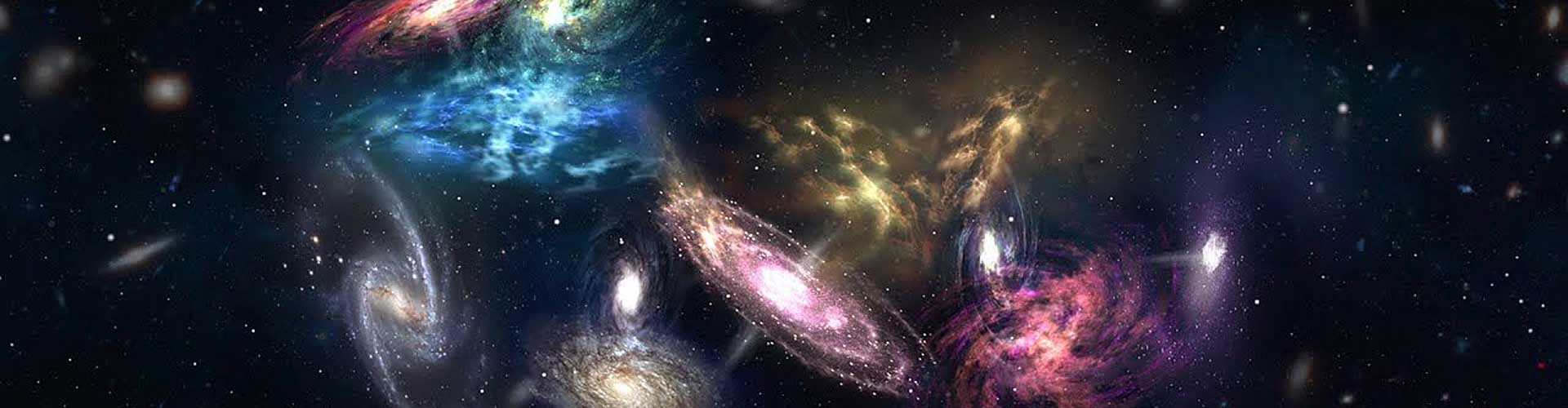
The Magellanic Clouds are a pair of irregular dwarf galaxies—the Large Magellanic Cloud (LMC/PGC 17223) and the Small Magellanic Cloud (SMC/PGC 3085)—that orbit our Milky Way galaxy. Featured image: Small Magellanic Cloud. Credit: NASA/Ames Research Center/SPACETV
Related channels: GALAXIES, GALAXY CLUSTERS, THE MILKY WAY, ANDROMEDA GALAXY, HUBBLE SPACE TELESCOPE, STARS, GRAVITY, ASTRONOMY, COSMOLOGY, DARK MATTER
Latest Magellanic Clouds videos
1
/
2


Flying over the Magellanic Clouds
The Magellanic Clouds are two dwarf galaxies that orbit our home galaxy, the Milky Way. Using ESO’s Visible and Infrared Survey Telescope for Astronomy (VISTA) astronomers have taken very deep infrared images of the cores of these galaxies that will allow us to better understand their 3D shapes and motion. By repeating these observations over several years they could measure the subtle motion of stars in the cores. Moreover, they also monitored periodic changes in the brightness of certain stars, which can be used to measure distances and therefore reconstruct the 3D structure of the cores of these galaxies.
Credit:
ESO
Animations & footage: ESO/M. R. Cioni et al., VMC Survey, P. Horálek, Zdeněk Bardon, N. Risinger (skysurvey.org)
Music: Mylonite – Composition 129
Script: J. C. Muñoz
Editing: M. Martins
More information and download options: https://www.eso.org/public/videos/potw2637a/
Real-Time View of the Small Magellanic Cloud (NGC 292)
In this video, I capture the Small Magellanic Cloud (SMC), one of our closest galaxies, about 200,000 light-years away, in real time using Electronically Assisted Astronomy (EAA) from my Bortle 7 suburban backyard.
The SMC is invisible to the naked eye under light-polluted skies, but with my wide-field EAA setup using the Svbony SV555, live stacking reveals its hidden beauty, glowing star-forming regions like NGC 371 and NGC 346, and countless stars within this nearby dwarf galaxy. Equipment used:
Telescope: Svbony SV555 54mm f/4.5 refractor
Mount: Sky-Watcher EQ AL55i
Camera: ZWO ASI585MC
Filter: Svbony UV/IR Cut Filter
Mini PC: MeLE Quieter4C Ultrathin Fanless N100
Power Box: Svbony SV241
Power Adaptor: Alitove AC 220-240V to DC 12V 10A 120W
Power Supply: EcoFlow River 2 portable power station
Control Software: NINA
Stacking Software: SharpCap Pro Music from #Uppbeat
https://uppbeat.io/t/simon-folwar/resurgence
License code: RC3XDHROHMIXS0FM
https://uppbeat.io/t/all-good-folks/years
License code: AIMHG0XV4STKHTDH Image credits:
Small Magellanic Cloud image — NASA/JPL-Caltech/UCLA (Public Domain)
Local Group Galaxies Comparison — Wikimedia Commons (CC BY 3.0) #EAA #Astronomy #SmallMagellanicCloud #SMC #ElectronicallyAssistedAstronomy
Radial velocity survey of stars stripped in binaries in the Magellanic Clouds -Alex Laroche
Speaker: Alex Laroche
Title: Radial velocity survey of stars stripped in binaries in the Magellanic Clouds
Abstract: Massive stars govern a variety of astrophysical phenomena, from galactic evolution to gravitational wave mergers. A third of all massive stars should undergo envelope stripping, but the first population of stripped stars was only recently discovered. I will describe progress to date in characterizing the first sample of stripped stars. I will then present ongoing work to measure stripped star binary orbits, with data spanning six years. I will present stripped star orbital properties and compare to other observed samples, comment on their companions, and the mass transfer which produced them. Finally, I will describe how our observations fit into the broader stripped star landscape, and the exciting work ahead as we transition from a dearth of stripped stars to large observational samples.
Major Surprise From One of the Oldest Stars in Large Magellanic Cloud Galaxy
Get a Wonderful Person Tee: https://teespring.com/stores/whatdamath
More cool designs are on Amazon: https://amzn.to/3QFIrFX
Alternatively, PayPal donations can be sent here: http://paypal.me/whatdamath
Hello and welcome! My name is Anton and in this video, we will talk about a discovery of an ancient star in the Large Magellanic Cloud
Links:
https://news.uchicago.edu/story/scientists-find-one-most-ancient-stars-formed-another-galaxy
Methuselah star: https://youtu.be/qLbN53v8xTs
Supernova nearby: https://youtu.be/ElrlkZyR2fw
LMC black hole: https://youtu.be/DMqxDL1yRqQ
Magellanic stream: https://youtu.be/YwMV8zEYPIU
#lmc #largemagellaniccloud #oldeststar
0:00 Ancient star in the Large Magellanic Cloud 1:01 How we find ancient stars 3:30 Second generation star in LMC and its properties 5:00 Why it's special - carbon 5:50 History of LMC and how it all connects 7:10 Why this matters of astrobiology 7:50 Compared to Milky Way
Support this channel on Patreon to help me make this a full time job:
https://www.patreon.com/whatdamath
Bitcoin/Ethereum to spare? Donate them here to help this channel grow!
bc1qnkl3nk0zt7w0xzrgur9pnkcduj7a3xxllcn7d4
or ETH: 0x60f088B10b03115405d313f964BeA93eF0Bd3DbF
Space Engine is available for free here: http://spaceengine.org
Enjoy and please subscribe.
Twitter: https://twitter.com/WhatDaMath
Facebook: https://www.facebook.com/whatdamath
Twitch: http://www.twitch.tv/whatdamath
The hardware used to record these videos:
New Camera: https://amzn.to/34DUUlv
CPU: https://amzn.to/2LZFQCJ
Video Card: https://amzn.to/2M1W26C
Motherboard: https://amzn.to/2JYGiQQ
RAM: https://amzn.to/2Mwy2t4
PSU: https://amzn.to/2LZcrIH
Case: https://amzn.to/2MwJZz4
Microphone: https://amzn.to/2t5jTv0
Mixer: https://amzn.to/2JOL0oF
Recording and Editing: https://amzn.to/2LX6uvU
Some of the above are affiliate links, meaning I would get a (very small) percentage of the price paid.
Thank you to all Patreon supporters of this channel
Special thanks also goes to all the wonderful supporters of the channel through YouTube Memberships
Images/Videos:
NRAO/AUI/NSF; ALMA (ESO/NAOJ/NRAO); Herschel/ESA; NASA/JPL-Caltech; NOAO
ESO/J. Colosimo - http://www.eso.org/public/images/potw1511a/ CC BY 4.0
Licenses used:
https://creativecommons.org/licenses/by/4.0/
https://creativecommons.org/licenses/by-sa/4.0/
https://creativecommons.org/licenses/by/3.0/
https://creativecommons.org/licenses/by-sa/3.0/
https://creativecommons.org/licenses/by/2.5/
https://creativecommons.org/licenses/by-sa/2.5/
https://creativecommons.org/licenses/by/2.0/
https://creativecommons.org/licenses/by-sa/2.0/
Small Magellanic Cloud Revealed as 2 Objects
Scientists have long spoken of the Large and Small Magellanic Clouds as satellite galaxies to our Milky Way. We know they orbit each other and also orbit our galaxy's core, over a great sweep of time lasting some 1.5 billion years. But a new study suggests the Small Magellanic Cloud isn't a single dwarf galaxy, after all. Scientists say the Small Cloud appears to be two distinct star-forming regions, lying along a single line of sight, separated from each other by about 16,000 light-years. Read more here: https://earthsky.org/space/small-magellanic-cloud-two-star-forming-structures/
Producer/Host: Kelly Kizer Whitt
#milkyway #galaxy #SmallMagellanicCloud #earthsky
This Whole Time Small Magellanic Cloud Was Actually Two Galaxies
Get a Wonderful Person Tee: https://teespring.com/stores/whatdamath
More cool designs are on Amazon: https://amzn.to/3QFIrFX
Alternatively, PayPal donations can be sent here: http://paypal.me/whatdamath
Hello and welcome! My name is Anton and in this video, we will talk about a discovery that Small Magellanic Cloud is not one but two galaxies
Links:
https://arxiv.org/pdf/2312.07750.pdf
https://en.wikipedia.org/wiki/Small_Magellanic_Cloud
Dwarf galaxies: https://youtu.be/L9Goi0OkasY
Magellanic Stream: https://youtu.be/YwMV8zEYPIU
https://youtu.be/yEWFwK0MyAo
Galaxy that formed the Sun: https://www.youtube.com/watch?v=ah-ymQdF6LQ
#smc #smallmagellaniccloud #galaxy
0:00 Small Magellanic Cloud surprise
0:40 Local group and nearby galaxies
1:40 Magellanic clouds in a nutshell
3:50 What's inside this galaxy
4:35 MMC hypothesis
5:35 New study confirms the hypothesis
7:10 Galactic differences
8:00 Conclusions
Support this channel on Patreon to help me make this a full time job:
https://www.patreon.com/whatdamath
Bitcoin/Ethereum to spare? Donate them here to help this channel grow!
bc1qnkl3nk0zt7w0xzrgur9pnkcduj7a3xxllcn7d4
or ETH: 0x60f088B10b03115405d313f964BeA93eF0Bd3DbF
Space Engine is available for free here: http://spaceengine.org
Enjoy and please subscribe.
Twitter: https://twitter.com/WhatDaMath
Facebook: https://www.facebook.com/whatdamath
Twitch: http://www.twitch.tv/whatdamath
The hardware used to record these videos:
New Camera: https://amzn.to/34DUUlv
CPU: https://amzn.to/2LZFQCJ
Video Card: https://amzn.to/2M1W26C
Motherboard: https://amzn.to/2JYGiQQ
RAM: https://amzn.to/2Mwy2t4
PSU: https://amzn.to/2LZcrIH
Case: https://amzn.to/2MwJZz4
Microphone: https://amzn.to/2t5jTv0
Mixer: https://amzn.to/2JOL0oF
Recording and Editing: https://amzn.to/2LX6uvU
Some of the above are affiliate links, meaning I would get a (very small) percentage of the price paid.
Thank you to all Patreon supporters of this channel
Special thanks also goes to all the wonderful supporters of the channel through YouTube Memberships
Images/Videos:
NASA/CXC/JPL-Caltech/STScI
ESA/Hubble and Digitized Sky Survey 2 CC BY 4.0 https://en.wikipedia.org/wiki/Small_Magellanic_Cloud#/media/File:Small_Magellanic_Cloud_(Digitized_Sky_Survey_2).jpg
SkyFlubbler CC BY 3.0 https://en.wikipedia.org/wiki/Local_Group#/media/File:Local_Group_Galaxies_Comparison.png
Antonio Ciccolella CC BY-SA 4.0 https://en.wikipedia.org/wiki/Local_Group#/media/File:Local_Group_and_nearest_galaxies.jpg
ESO/S. Brunier - ESO CC BY 4.0 https://en.wikipedia.org/wiki/Magellanic_Clouds#/media/File:Magellanic_Clouds_%E2%80%95_Irregular_Dwarf_Galaxies.jpg
ESO/C. Malin - http://www.eso.org/public/images/ann13020a/ CC BY 4.0
-https://www.eso.org/public/images/eso1714a/
Licenses used:
https://creativecommons.org/licenses/by/4.0/
https://creativecommons.org/licenses/by-sa/4.0/
https://creativecommons.org/licenses/by/3.0/
https://creativecommons.org/licenses/by-sa/3.0/
https://creativecommons.org/licenses/by/2.5/
https://creativecommons.org/licenses/by-sa/2.5/
https://creativecommons.org/licenses/by/2.0/
https://creativecommons.org/licenses/by-sa/2.0/
Magellanic Clouds' Secret & Eris's Squishy Core | S27E02
**Host:** Stuart Gary
**Special Guest:** Technology Editor Alex Zaharov-Reutt
### Episode Highlights:
1. **The Dual Nature of the Small Magellanic Cloud**: New research suggests that what was previously thought to be a single galaxy, the Small Magellanic Cloud, is actually two distinct galaxies. This groundbreaking discovery, based on studies of stellar motion and the interstellar medium, challenges previous astronomical beliefs.
2. **The Dwarf Planet Eris's Unexpected Composition**: A recent study has indicated that Eris, a distant dwarf planet, might possess a more 'squishy' internal structure than previously assumed. This insight opens new avenues in understanding the formation and composition of such celestial bodies.
3. **NASA's PACE Satellite Launch Update**: The launch date for NASA's new PACE satellite is now scheduled for February 6th. This mission is expected to provide significant insights into oceanic ecosystems and atmospheric phenomena.
### In-Depth Analysis: -
**Exploring the Magellanic Clouds**: The episode delves into the history and importance of the Large and Small Magellanic Clouds. These satellite dwarf galaxies, named after the explorer Ferdinand Magellan, have played a crucial role in navigation and astronomical studies. -
**The Study of the Small Magellanic Cloud**: Utilizing data from the European Space Agency's Gaia spacecraft and the Australian Square Kilometer Array Pathfinder radio telescope, astronomers have uncovered surprising differences in chemical composition and star velocities within the Small Magellanic Cloud. -
**Eris and Its Moon Dysnomia**: Discussions include the intriguing relationship between Eris and its moon Dysnomia, focusing on their tidal interactions and implications for understanding planetary structures.
### Other Topics Covered: - NASA's PACE satellite mission details and objectives. - The historical significance of the Magellanic Clouds in astronomy and navigation. - The role of the Magellanic Clouds in current astronomical research.
### Final Thoughts: The episode concludes with a reflection on the continuous advancements in space exploration and astronomical research, emphasizing the importance of such discoveries in broadening our understanding of the universe.
Your support is needed... **Support SpaceTime with Stuart Gary: Be Part of Our Cosmic Journey!** SpaceTime is fueled by passion, not big corporations or grants. We're on a mission to become 100% listener-supported, allowing us to focus solely on bringing you riveting space stories without the interruption of ads. 🌌 **Here's where you shine:** Help us soar to our goal of 1,000 subscribers! Whether it's just $1 or more, every contribution propels us closer to a universe of ad-free content. **Elevate Your Experience:** By joining our cosmic family at the $5 tier, you'll unlock: - Over 350 commercial-free, triple episode editions. - Exclusive extended interviews. - Early access to new episodes every Monday. Dive in with a month's free trial on Supercast and discover the universe of rewards waiting for you! 🌠 🚀 [Join the Journey with SpaceTime](https://bitesznetwork.supercast.tech/) 🌟 [Learn More About Us](https://spacetimewithstuartgary.com) Together, let's explore the cosmos without limits!
Become a supporter of this podcast: https://www.spreaker.com/podcast/spacetime-with-stuart-gary--2458531/support (https://www.spreaker.com/podcast/spacetime-with-stuart-gary--2458531/support?utm_source=rss&utm_medium=rss&utm_campaign=rss) .
What is Hiding in the Large Magellanic Clouds? Featuring Dr. Anna Mcleod
In a remarkable discovery, astronomers have found......
https://www.eso.org/public/videos/astronomy-n44lmc/
"In a remarkable discovery, astronomers have found a disc around a young star in the Large Magellanic Cloud, a galaxy neighboring ours. It’s the first time such a disc, identical to those forming planets in our own Milky Way, has ever been found outside our galaxy. The new observations reveal a massive young star, growing and accreting matter from its surroundings and forming a rotating disc. The detection was made using the Atacama Large Millimeter/submillimeter Array (ALMA) in Chile, in which the European Southern Observatory (ESO) is a partner."
Dr. ANNA MCLEOD is an associate professor, at the CENTRE FOR EXTRAGALACTIC ASTRONOMY, DURHAM UNIVERSITY.
Dr. Mcleod’s main research interest is feedback from massive stars, and the key question she is trying to answer is: how exactly do massive stars influence their environment? Dr. McLeod uses data from so-called integral field spectrographs like MUSE or KMOS on the Very Large Telescope in Chile for her work.
YouTube Membership: https://www.youtube.com/channel/UCz3qvETKooktNgCvvheuQDw/join
Podcast: https://anchor.fm/john-michael-godier/subscribe
Apple: https://apple.co/3CS7rjT
More JMG
https://www.youtube.com/c/JohnMichaelGodier
Want to support the channel?
Patreon: https://www.patreon.com/EventHorizonShow
Follow us at other places!
@JMGEventHorizon
Music:
https://stellardrone.bandcamp.com/
https://migueljohnson.bandcamp.com/
https://leerosevere.bandcamp.com/
https://aeriumambient.bandcamp.com/
FOOTAGE:
NASA
ESA/Hubble
ESO - M.Kornmesser
ESO - L.Calcada
ESO - Jose Francisco Salgado (josefrancisco.org)
NAOJ
University of Warwick
Goddard Visualization Studio
Langley Research Center
Pixabay
JWST's Stunning Discovery in the Small Magellanic Cloud
The discoveries James Webb has made beyond the visible light spectrum. Join the official Astrum discord server plus a host of other rewards by becoming a patron or a member today: https://www.patreon.com/astrumspace or click the "Join" button above!
Episode Playlist: https://www.youtube.com/playlist?list=PL2gLpWRK0QlDU2llYRsq7yUgKkZRvSk1e
Astrum merch now available!
Apparel: https://astrum-shop.fourthwall.com/
Metal Posters: https://displate.com/promo/astrum?art=5f04759ac338b
SUBSCRIBE for more videos about our other planets.
Subscribe! http://goo.gl/WX4iMN
Facebook! http://goo.gl/uaOlWW
Twitter! http://goo.gl/VCfejs
Astrum Spanish: https://www.youtube.com/@astrumespanol
Astrum Portuguese: https://www.youtube.com/channel/UChn_-OwvV63mr1yeUGvH-BQ
Donate!
Patreon: http://goo.gl/GGA5xT
Ethereum Wallet: 0x5F8cf793962ae8Df4Cba017E7A6159a104744038
Become a Patron today and support my channel! Donate link above. I can't do it without you. Thanks to those who have supported so far!
#jameswebb #nasa #astrum
Hubble Discovers a Galactic Shield Protecting Magellanic Clouds
Get a Wonderful Person Tee: https://teespring.com/stores/whatdamath
More cool designs are on Amazon: https://amzn.to/3wDGy2i
Alternatively, PayPal donations can be sent here: http://paypal.me/whatdamath
Hello and welcome! My name is Anton and in this video, we will talk about a discovery of an intriguing corona that shields several galaxies from the Milky Way
Links:
https://www.nature.com/articles/s41586-022-05090-5
https://fuse.pha.jhu.edu/
https://www.nasa.gov/feature/goddard/2020/hubble-maps-giant-halo-around-andromeda-galaxy
https://hubblesite.org/contents/news-releases/2022/news-2022-030.html
Sgt Dwarf Galaxy Video: https://youtu.be/pbD1w8RIAUo
Galactic links between Magellanic clouds: https://youtu.be/ImuwdugaIzk
Ripples in the Milky Way: https://youtu.be/PvNZArscYpU
#galaxy #shield #magellanic
Support this channel on Patreon to help me make this a full time job:
https://www.patreon.com/whatdamath
Bitcoin/Ethereum to spare? Donate them here to help this channel grow!
bc1qnkl3nk0zt7w0xzrgur9pnkcduj7a3xxllcn7d4
or ETH: 0x60f088B10b03115405d313f964BeA93eF0Bd3DbF
Space Engine is available for free here: http://spaceengine.org
Enjoy and please subscribe.
Twitter: https://twitter.com/WhatDaMath
Facebook: https://www.facebook.com/whatdamath
Twitch: http://www.twitch.tv/whatdamath
The hardware used to record these videos:
New Camera: https://amzn.to/34DUUlv
CPU: https://amzn.to/2LZFQCJ
Video Card: https://amzn.to/2M1W26C
Motherboard: https://amzn.to/2JYGiQQ
RAM: https://amzn.to/2Mwy2t4
PSU: https://amzn.to/2LZcrIH
Case: https://amzn.to/2MwJZz4
Microphone: https://amzn.to/2t5jTv0
Mixer: https://amzn.to/2JOL0oF
Recording and Editing: https://amzn.to/2LX6uvU
Some of the above are affiliate links, meaning I would get a (very small) percentage of the price paid.
Thank you to all Patreon supporters of this channel
Special thanks also goes to all the wonderful supporters of the channel through YouTube Memberships
Images/Videos:
Amanda Smith, Institute of Astronomy, University of Cambridge
ESA/Gaia/DPAC CC BY-SA 3.0 https://en.wikipedia.org/wiki/Sagittarius_Dwarf_Spheroidal_Galaxy#/media/File:The_Sagittarius_dwarf_galaxy_in_Gaia's_all-sky_view_ESA399651.jpg
Ting Li CC BY-SA 4.0 https://en.wikipedia.org/wiki/List_of_stellar_streams#/media/File:Stellar_streams_2022_S5survey.jpg
David L. Nidever, et al., NRAO/AUI/NSF and Mellinger, LAB Survey, Parkes Observatory, Westerbork Observatory, and Arecibo https://en.wikipedia.org/wiki/Magellanic_Stream#/media/File:Tracing_the_origin_of_the_Magellanic_Stream.jpg
NASA/JWST/Hubble
ESO/VISTA VMC CC BY 4.0- https://www.eso.org/public/images/eso1714a/
ESO/J. Colosimo -CC BY 4.0 http://www.eso.org/public/images/potw1511a/
Robert Gendler/ESOCC BY 4.0 - https://www.eso.org/public/images/eso1021d/
Adam Block/Mount Lemmon SkyCenter/University of Arizona -CC BY-SA 3.0 http://www.caelumobservatory.com/gallery/ic5146.shtml
ESO/M. Kornmesser CC BY 4.0 - http://www.eso.org/public/images/eso1122a/
NASA https://en.wikipedia.org/wiki/Quasar#/media/File:Quasar_viewed_from_Hubble.jpg
Licenses used:
https://creativecommons.org/licenses/by/4.0/
https://creativecommons.org/licenses/by-sa/4.0/
https://creativecommons.org/licenses/by/3.0/
https://creativecommons.org/licenses/by-sa/3.0/
https://creativecommons.org/licenses/by/2.5/
https://creativecommons.org/licenses/by-sa/2.5/
https://creativecommons.org/licenses/by/2.0/
https://creativecommons.org/licenses/by-sa/2.0/
Dormant Black Hole With Unusual Origins Found In Large Magellanic Cloud
Good telescope that I've used to learn the basics: https://amzn.to/35r1jAk
Get a James Webb Wonderful Person shirt: https://teespring.com/stores/whatdamath
Alternatively, PayPal donations can be sent here: http://paypal.me/whatdamath
Hello and welcome! My name is Anton and in this video, we will talk about a discovery of a dormant black hole in the nearby Large Magellanic cloud
Links:
https://www.nature.com/articles/s41550-022-01730-y
https://www.eso.org/public/news/eso2210/?lang
https://en.wikipedia.org/wiki/Tarantula_Nebula
SN 1987: https://youtu.be/Uu15LrfXUG4
Closest black hole debunked: https://youtu.be/vBL7Bgvlmrw
#blackhole #lmc #galaxy
Support this channel on Patreon to help me make this a full time job:
https://www.patreon.com/whatdamath
Bitcoin/Ethereum to spare? Donate them here to help this channel grow!
bc1qnkl3nk0zt7w0xzrgur9pnkcduj7a3xxllcn7d4
or ETH: 0x60f088B10b03115405d313f964BeA93eF0Bd3DbF
Space Engine is available for free here: http://spaceengine.org
Enjoy and please subscribe.
Twitter: https://twitter.com/WhatDaMath
Facebook: https://www.facebook.com/whatdamath
Twitch: http://www.twitch.tv/whatdamath
The hardware used to record these videos:
New Camera: https://amzn.to/34DUUlv
CPU: https://amzn.to/2LZFQCJ
Video Card: https://amzn.to/2M1W26C
Motherboard: https://amzn.to/2JYGiQQ
RAM: https://amzn.to/2Mwy2t4
PSU: https://amzn.to/2LZcrIH
Case: https://amzn.to/2MwJZz4
Microphone: https://amzn.to/2t5jTv0
Mixer: https://amzn.to/2JOL0oF
Recording and Editing: https://amzn.to/2LX6uvU
Some of the above are affiliate links, meaning I would get a (very small) percentage of the price paid.
Thank you to all Patreon supporters of this channel
Special thanks also goes to all the wonderful supporters of the channel through YouTube Memberships
Images/Videos:
Pelligton and Aladin Sky Atlas in HST color CC-BY-SA-4.0 https://commons.wikimedia.org/wiki/File:VFTS_243_in_HST_color.png
ESO CC BY 4.0 https://www.eso.org/public/news/eso2210/?lang
E. Jehin CC BY 4.0 https://en.wikipedia.org/wiki/Tarantula_Nebula#/media/File:Tarantula_Nebula_TRAPPIST.jpg
Licenses used:
https://creativecommons.org/licenses/by/4.0/
https://creativecommons.org/licenses/by-sa/4.0/
https://creativecommons.org/licenses/by/3.0/
https://creativecommons.org/licenses/by-sa/3.0/
https://creativecommons.org/licenses/by/2.5/
https://creativecommons.org/licenses/by-sa/2.5/
https://creativecommons.org/licenses/by/2.0/
https://creativecommons.org/licenses/by-sa/2.0/
Small and Large Magellanic Clouds 26th November 2019
Samyaday Choudhury - Photometric metallicity maps of the Magellanic Clouds – what do they reveal?
ASTRO 3D ECR Astronomers in Australia Seminar Series
Samyaday Choudhury, Macquarie University - Photometric metallicity maps of the Magellanic Clouds – what do they reveal?
Dr Choudhury is a Postdoctoral Research Fellow at Macquarie University (Sydney, AU). He studies resolved stellar populations and star clusters in the Magellanic Clouds, a pair of satellite galaxies of the Milky Way. His studies aim to understand their chemical enrichment histories which are important tools to understand their evolution and interactive past.
Abstract: The Magellanic Clouds (MCs: the LMC and the SMC) are among the Milky Way’s nearest satellite dwarf galaxies. These satellites are evolving as independent stellar systems, but also under the influence of their mutual interactions and those with the Milky Way. However, the details of their evolution and interaction are not yet well-understood. We have estimated first-of-their-kind, high-spatial resolution metallicity maps of the MCs. The metallicity gradients within their inner regions (within 4º for the LMC and 2.5º for the SMC) suggest that (i) the metallicity gradient in the LMC is similar to those of large spirals; and (ii) a shallow metallicity gradient is present in the inner SMC, which was the subject of much debate. A detailed understanding of the evolution and interaction of the MCs requires metallicity estimations out to large radii. We recently applied our technique to the VMC/VISTA survey, which covers a three times larger area of the MCs compared with earlier studies using deep near-infrared passbands. The survey extends to regions where signatures of the mutual interactions between the MCs and with the Milky Way become evident. The SMC’s metallicity gradient is flatter towards the East (in the direction of the LMC) compared with the West. This hints at mixing and/or distortion of the spatial metallicity distribution within the inner 3º, presumably caused by tidal interactions with the LMC. The LMC maps extending out to a radius of ∼6º, exhibits a metal-rich bar, metal-poor outskirts and a radially asymmetric gradient which is flatter in the direction of the SMC. I will discuss these results and their implications in the context of the evolution and interaction history of these galaxies. ASTRO 3D is the ARC Centre of Excellence for All Sky Astrophysics in 3 Dimensions. Our astronomers are searching to understand the evolution of the matter, light, and elements from the Big Bang to the present day. Check out our website for astronomy news, our research updates, and our education and outreach programs.
Website: https://astro3d.org.au/
Facebook: https://www.facebook.com/ASTRO3D.ARC
Twitter: https://twitter.com/ARC_ASTRO3D
Instagram: https://www.instagram.com/astro_3d/
Gaia Early Data Release 3 - structure and properties of the Magellanic Clouds
A tour through the Magellanic Clouds highlighting some results from Gaia Early Data Release 3. Further reading: https://www.cosmos.esa.int/web/gaia/edr3-structure-magellanic-clouds Credits: ESA/Gaia/DPAC
License: CC BY-SA 3.0 IGO Acknowledgement:
Produced by Stefan Jordan and Toni Sagristà with Gaia Sky (http://www.zah.uni-heidelberg.de/gaia/outreach/gaiasky)
Based on Gaia Collaboration, X. Luri, et al.: "Gaia Early Data Release 3: structure and properties of the Magellanic Clouds", Astronomy and Astrophysics, 2020
Gaia Early Data Release 3 - Q&A - Magellanic Clouds
Gaia Early Data Release 3 - Q&A
Gaia Early Data Release 3 is released on 3 December 2020.
Antonella Vallenari, deputy chair of the Gaia Data Processing and Analysis Consortium (DPAC), answers the question: "How can we study our nearest neighbour galaxies, the Magellanic Clouds, with Gaia if they are so far away?"
Further reading: https://www.cosmos.esa.int/web/gaia/edr3-stories
Credit: ESA/Gaia/DPAC
Pan Large Magellanic Clouds (LMC)
A treasure trove of data from the Survey of the MAgellanic Stellar History (SMASH) survey unveils the Magellanic Clouds in exquisite detail.
More information and download options: http://noirlab.edu/public/videos/noirlab2030c/
Credit:
Images and Videos: CTIO/NOIRLab/NSF/AURA/SMASH/D. Nidever (Montana State University).
Image Processing: Travis Rector (University of Alaska Anchorage), Mahdi Zamani & Davide de Martin.
Magellanic Clouds: The Milky Way's Nearest Neighbors
Astronomer Remy Indebetouw describes the Magellanic Clouds, two fascinating dwarf galaxies that hang out with our giant Milky Way.
Discover more about Our Milky Way Galaxy on our website:
https://public.nrao.edu/radio-astronomy/our-milky-way-galaxy/
Take a virtual tour of the Milky Way Galaxy and its neighbors with NRAO's Milky Way Explorer!
https://public.nrao.edu/explore/milky-way-explorer/
Additional animation and video credits: A. Angelich, NRAO/AUI/NSF; ESO/NASA/JPL-Caltech/M. Kornmesser/R. Hurt; ESO/S. Brunier; Robert Gendler/Josch Hambsch; David L. Nidever et al., NRAO/AUI/NSF & A. Mellinger, LAB Survey, Parkes Obs., Westerbork Obs., Arecibo Obs.; Gurtina Besla; ESO/C. Malin; NASA/ESA/STScI; NCSA/NASA/A. Kritsuk/M. Norman/A. Boley.
Music: Geodesium.
Meet an Astronomer | Observing the Magellanic Clouds from Chile with Dr. Phil Massey
The Large and Small Magellanic Clouds cannot be seen from the continental United States, but are majestic denizens of the southern sky. These two galaxies are so nearby that we can make out their individual stars with even a modest sized telescope. Because their chemical compositions are a little bit different than that of our own Milky Way, they act as important astrophysical laboratories for studying massive stars.
Lowell astronomer Dr. Phil Massey has been traveling to Chile for the past 35 years to conduct studies of stars in the Magellanic Clouds. He will talk about what observing from the southern hemisphere is like, and what he and his collaborators have learned recently.
Zooming on the Large Magellanic Cloud
This video zooms on the Large Magellanic Cloud as revealed by the ESO's VISTA infrared survey telescope at the Paranal Observatory in Chile. Astronomers used this image to analyse in detail about 10 million individual stars in the Large Magellanic Cloud.
More information and download options: http://www.eso.org/public/videos/eso1914b/
Credit:
ESO, N. Rinsinger (skysurvey.org). Music: Astral Electronic
Astronomy With Earth & Sky - Episode 6: Magellanic Clouds
In this video, our astronomy guide Adrien Vilquin explains the fascinating subject of Magellanic Clouds in an easy to understand bite size video.
For more information about our tours, visit our website http://www.earthandsky.co.nz.
For any space related questions or to know more, contact [email protected].
1
/
2