
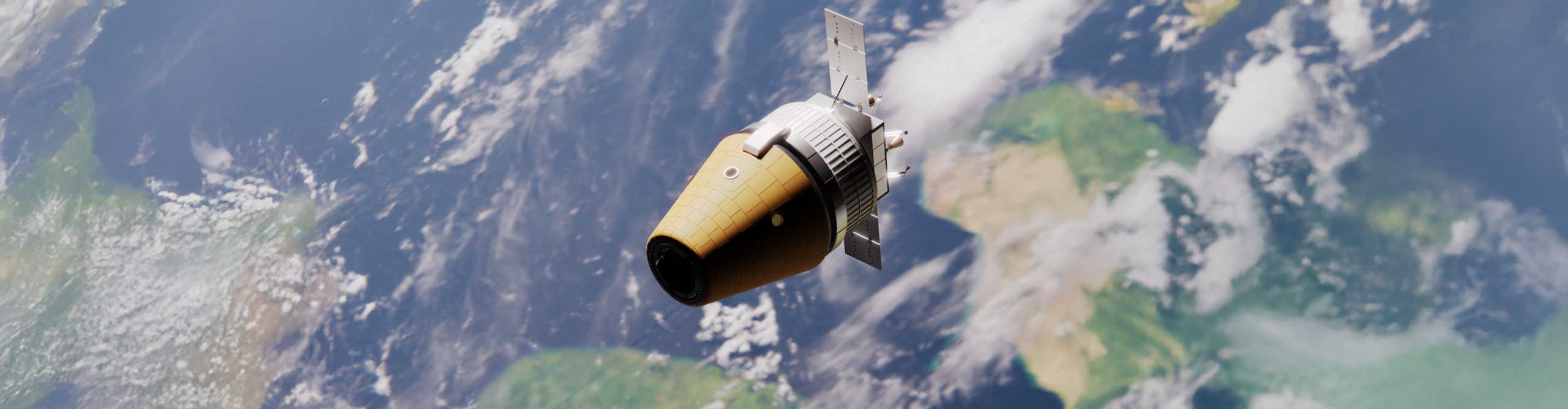
Solar wind Magnetosphere Ionosphere Link Explorer (SMILE) is a planned joint venture mission between the European Space Agency and the Chinese Academy of Sciences. SMILE will image for the first time the magnetosphere of the Sun in soft X-rays and UV during up to 40 hours per orbit, improving the understanding of the dynamic interaction between the solar wind and Earth’s magnetosphere. Image credit: European Space Agency
Related channels: SPACE WEATHER, PLANET EARTH, THE SUN, EUROPEAN SPACE AGENCY, CNSA, PARKER SOLAR PROBE (NASA SPACECRAFT), EARTH, STARS
Latest SMILE Videos and News


Let’s Smile (the full story)
In just two years, the European-Chinese Smile mission went from a handful of disconnected pieces to a fully operating satellite in space.
This video covers the period June 2024 to May 2026, featuring behind-the-scenes footage of the different parts of Smile arriving at ESA’s technical centre in the Netherlands, being attached together, tested and finally sent to Europe’s Spaceport in French Guiana for launch.
Featuring exclusive interviews with scientists and engineers from across Europe, it is the final instalment in the documentary series ‘Let’s Smile’, bringing together and supplementing the four shorter episodes released so far.
Access the other episodes of ‘Let’s Smile’: https://youtube.com/playlist?list=PLbyvawxScNbs1q8UOu60vte7t6U1SXR2Z&si=V4CohaLfFK7gSZv3
Smile (the Solar wind Magnetosphere Ionosphere Link Explorer) is a 50–50 collaboration between the European Space Agency (ESA) and the Chinese Academy of Sciences (CAS).
Credits: ESA/Lightcurve Films
Acknowledgements: Direction, main camera, sound, editing, post-production by Lightcurve Films. Original music by William Zeitler. Drone footage is by The Postboat Dronedepartment.
Access the video on the ESA video library:
★ Subscribe: http://bit.ly/ESAsubscribe and click twice on the bell button to receive our notifications.
Check out our full video catalog: http://bit.ly/SpaceInVideos
Follow us on Twitter: http://bit.ly/ESAonTwitter
On Facebook: http://bit.ly/ESAonFacebook
On Instagram: http://bit.ly/ESAonInstagram
On LinkedIn: https://bit.ly/ESAonLinkedIn
On Pinterest: https://bit.ly/ESAonPinterest
On Flickr: http://bit.ly/ESAonFlickr
We are Europe's gateway to space. Our mission is to shape the development of Europe's space capability and ensure that investment in space continues to deliver benefits to the citizens of Europe and the world. Check out https://www.esa.int/ to get up to speed on everything space related.
Copyright information about our videos is available here: https://www.esa.int/ESA_Multimedia/Terms_and_Conditions
From cleanroom to space: Smile mission
Smile successfully launched from Europe’s Spaceport in French Guiana on 19 May 2026.
This timelapse captures the excitement and precision of launch operations as the spacecraft begins its journey to study the connection between the Sun and Earth.
Smile (the Solar wind Magnetosphere Ionosphere Link Explorer) is an international space science mission designed to investigate how the solar wind interacts with Earth's magnetosphere. By observing these dynamic processes from space, Smile will help scientists better understand space weather and its effects on our planet's magnetic environment.
Credits: European Space Agency (ESA)
Access the video on the ESA video library: https://www.esa.int/ESA_Multimedia/Videos/2026/06/Smile_cleanroom_to_space
★ Subscribe: http://bit.ly/ESAsubscribe and click twice on the bell button to receive our notifications.
We are Europe's gateway to space. Our mission is to shape the development of Europe's space capability and ensure that investment in space continues to deliver benefits to the citizens of Europe and the world. Check out https://www.esa.int/ to get up to speed on everything space related.
Copyright information about our videos is available here: https://www.esa.int/ESA_Multimedia/Terms_and_Conditions
Launch of ESA’s Smile mission on Vega-C
ESA’s Smile satellite launched aboard a Vega-C rocket from Europe’s Spaceport in French Guiana. The rocket lifted off on at 04:52 BST / 05:52 CEST (00:52 local time) on 19 May 2026.
Smile flew to space on Vega-C flight VV29. At 35 m tall, a Vega-C weighs 210 tonnes on the launch pad and the rocket used three solid-propellant-powered stages to take Smile to orbit before the fourth liquid-propellant stage took over for a precise drop-off around Earth.Smile (the Solar wind Magnetosphere Ionosphere Link Explorer) is a joint mission between the European Space Agency (ESA) and the Chinese Academy of Sciences (CAS).
Smile will use four science instruments to study how Earth responds to the solar wind from the Sun. In doing so, Smile will improve our understanding of solar storms, geomagnetic storms and the science of space weather.
Credits: European Space Agency (ESA)
Access the video on the ESA video library: https://www.esa.int/ESA_Multimedia/Videos/2026/05/Smile_launch_highlights
★ Subscribe: http://bit.ly/ESAsubscribe and click twice on the bell button to receive our notifications.
We are Europe's gateway to space. Our mission is to shape the development of Europe's space capability and ensure that investment in space continues to deliver benefits to the citizens of Europe and the world. Check out https://www.esa.int/ to get up to speed on everything space related.
Copyright information about our videos is available here: https://www.esa.int/ESA_Multimedia/Terms_and_Conditions
ESA's Smile mission launch (Official broadcast)
Join us live on 19 May, as we broadcast the launch of the European-Chinese Smile mission.
Smile will head to space on a Vega-C rocket from Europe's Spaceport in French Guiana.
This stream will include live launch footage from the launchpad and control room, as well as real-time interviews with people involved in the mission and its launch.
For the first time, Smile is going to reveal what really happens when charged particles from the Sun crash into Earth's magnetic shield.
It carries an X-ray camera to make the first X-ray observations of how exactly this shield responds to the solar wind, and an ultraviolet camera to watch the resulting northern lights for 45 hours at a time.
Find out more at esa.int/smile
Chapters:
00:00 Waiting
00:57 Programme begins
22:20 Liftoff
1:18:45 Smile separation
1:20:25 First signal from Smile and deployment of solar arrays
★ Subscribe: http://bit.ly/ESAsubscribe and click twice on the bell button to receive our notifications.
We are Europe's gateway to space. Our mission is to shape the development of Europe's space capability and ensure that investment in space continues to deliver benefits to the citizens of Europe and the world. Check out https://www.esa.int/ to get up to speed on everything space related.
Copyright information about our videos is available here: https://www.esa.int/ESA_Multimedia/Terms_and_Conditions
SMILE: ESA & CHINA team up to forecast the next killer solar storm
Hi Spacecats, I'm Dr Maggie Lieu and welcome to my channel, where you can find all things space, astronomy and physics! ESA & CAS have teamed up to build the first ever global X-ray imager space satellite that will transform our understanding of solar storms. Planned launch date: 19 May 2026, 05:52 CEST. So let's talk about !
Links:
https://www.esa.int/Science_Exploration/Space_Science/Smile/Smile_sets_sail_for_Europe_s_Spaceport_in_French_Guiana
Special thanks to my YouTube Members: Steven Yee, Bill Fratt, David Brant, Gregory McCoy, Nigel Draper, Jordan Workshop, Eurico Roberto, Steve - Plano, John Lewis, Seyda, Christopher Senn, Wheely Big Bike Trip, Simfromzim, Potterma63, Anders Welander, johnomeara7240, Mark Earnest, Rob Tung, Joaoponeis, tomo9546, Malleus Flavus, vapFlo, Markus Cosmos, KRASHDOWN, Gnanagowry Vithiyananthan, Catherine Joy, Quantify 36, toptier4093, Dwinato Saputra, Jonathan S
You can also sign up on my channel page to get access to perks:
https://www.youtube.com/channel/UClO6TuRE6XLzbMBmQ_KY38A/join
Support me through my shop:
www.maggielieu.com/shop
My book:
UK🇬🇧 https://amzn.to/4kVm7V4
USA 🇺🇸 https://amzn.to/3HxKpGn
If you enjoyed the video, please consider by liking, sharing and subscribing! I'm also on:
twitter: https://twitter.com/space_mog
instagram: https://instagram.com/space_mog/
facebook: https://facebook.com/spacemog/
Preparing Smile for space
Before Smile can begin studying how Earth responds to the streams of particles and bursts of radiation from the Sun, the spacecraft had to complete an extraordinary journey here on Earth.
Follow the mission through its final launch preparations at Europe’s Spaceport in French Guiana, from fuelling and encapsulation inside its protective fairing, to meeting the rest of the Vega-C rocket that will take it to space.
Smile is flying to space on Vega-C flight VV29. At 35 m tall, Vega-C weighs 210 tonnes on the launch pad and the rocket will take Smile to orbit with three solid-propellant-powered stages before the fourth liquid-propellant stage takes over for a precise drop-off around Earth.
Smile (the Solar wind Magnetosphere Ionosphere Link Explorer) is a joint European-Chinese mission to study the interaction between the solar wind and Earth’s magnetic environment from a unique highly elliptical orbit. During the next three years, it will go high above the North Pole every two days to collect X-ray and ultraviolet images of Earth’s magnetic shield and the northern lights.
Credits: European Space Agency (ESA)
Access the video on the ESA video library: https://www.esa.int/ESA_Multimedia/Videos/2026/05/Preparing_Smile_for_space
★ Subscribe: http://bit.ly/ESAsubscribe and click twice on the bell button to receive our notifications.
We are Europe's gateway to space. Our mission is to shape the development of Europe's space capability and ensure that investment in space continues to deliver benefits to the citizens of Europe and the world. Check out https://www.esa.int/ to get up to speed on everything space related.
Copyright information about our videos is available here: https://www.esa.int/ESA_Multimedia/Terms_and_Conditions
Smile's journey from launch to orbit
Our next space science mission is about to begin its space adventure.
After more than 10 years of designing, developing, building and testing, Smile is now ready for action.
Its ride to space will be a Vega-C rocket, departing from Europe’s Spaceport in French Guiana on 19 May. The rocket will drop Smile off in a circular orbit 700 km above Earth’s surface.
Smile will then fire its own engines 11 times, taking itself higher and higher above the North Pole. From there, it will use X-ray and ultraviolet vision to watch how Earth defends itself from streams of particles and bursts of radiation from the Sun. Nobody has ever seen Earth’s magnetic shield like this before.
Smile (the Solar wind Magnetosphere Ionosphere Link Explorer) is a joint mission between the European Space Agency and the Chinese Academy of Sciences.
Learn more about Smile: https://www.esa.int/Science_Exploration/Space_Science/Smile
Credits: European Space Agency (ESA)
Access the video on the ESA video library: https://www.esa.int/ESA_Multimedia/Videos/2026/04/Smile_s_journey_from_launch_to_orbit
★ Subscribe: http://bit.ly/ESAsubscribe and click twice on the bell button to receive our notifications.
We are Europe's gateway to space. Our mission is to shape the development of Europe's space capability and ensure that investment in space continues to deliver benefits to the citizens of Europe and the world. Check out https://www.esa.int/ to get up to speed on everything space related.
Copyright information about our videos is available here: https://www.esa.int/ESA_Multimedia/Terms_and_Conditions
Smile: A global answer to a global mystery
The European Space Agency and the Chinese Academy of Sciences are joining hands to uncover how Earth defends itself against dangerous particles and radiation from the Sun.
It’s the first time we will have images and videos of what happens when this solar wind crashes into our magnetic field. Smile will witness this interaction in action, using four onboard instruments to watch the drama unfold.
Life can only exist as we know it when nestled safe inside this giant magnetic bubble surrounding our planet. By imaging the bubble as a whole for the first time, Smile will help us build up the fundamental understanding that space weather forecasting will ultimately depend on.
Learn more about Smile: https://www.esa.int/Science_Exploration/Space_Science/Smile
Credits: European Space Agency (ESA)
Access the video on the ESA video library: https://www.esa.int/ESA_Multimedia/Videos/2026/03/What_is_Smile_about_to_discover
★ Subscribe: http://bit.ly/ESAsubscribe and click twice on the bell button to receive our notifications.
We are Europe's gateway to space. Our mission is to shape the development of Europe's space capability and ensure that investment in space continues to deliver benefits to the citizens of Europe and the world. Check out https://www.esa.int/ to get up to speed on everything space related.
Copyright information about our videos is available here: https://www.esa.int/ESA_Multimedia/Terms_and_Conditions
ESA Smile
ESA's Smile mission will use a new scientific technique to provide a fuller understanding of the Sun–Earth connection, adding to our scientific knowledge and helping us understand space weather impacts.
Learn more about the UK's involvement in the mission.
SMILE to give global view on Earth’s ‘magnetic shield’, thanks to Leicester-built telescope
The Solar Wind Magnetosphere Ionosphere Link Explorer (SMILE) is planning to study how the solar wind, a high energy particle stream from our sun, interacts with the earth's magnetic environment. Among the range of instruments on board is the Soft X-ray Imager (SXI), a wide-field X-ray telescope led by the University of Leicester that uses micropore optics to spectrally map the location, shape, and motion of Earth’s magnetospheric boundaries.
It is the first instrument to be delivered using facilities at the University’s £100 million research, innovation and teaching hub, Space Park Leicester.
SMILE is a joint mission between the European Space Agency (ESA) and the Chinese Academy of Sciences (CAS) and is slated to be launched from Kourou, French Guiana on Thursday 9 April. It is set to give humankind its first complete look at how Earth reacts to streams of particles and bursts of radiation from the Sun.
We’re about to see Earth’s magnetic shield like never before
What really happens when the Sun’s charged particles slam into Earth’s magnetic shield?
Smile is about to reveal it for the first time.
This groundbreaking mission will observe Earth’s magnetosphere in X-rays while capturing the northern lights in ultraviolet, offering an entirely new way to see how our planet defends itself from solar storms.
A joint mission between the European Space Agency and the Chinese Academy of Sciences, Smile will launch aboard a Vega-C rocket on 19 May.
Learn more about Smile: https://www.esa.int/Science_Exploration/Space_Science/Smile
Credits: European Space Agency (ESA)
Access the video on the ESA video library: https://www.esa.int/ESA_Multimedia/Videos/2026/03/What_is_Smile_about_to_discover
★ Subscribe: http://bit.ly/ESAsubscribe and click twice on the bell button to receive our notifications.
We are Europe's gateway to space. Our mission is to shape the development of Europe's space capability and ensure that investment in space continues to deliver benefits to the citizens of Europe and the world. Check out https://www.esa.int/ to get up to speed on everything space related.
Copyright information about our videos is available here: https://www.esa.int/ESA_Multimedia/Terms_and_Conditions
Smile arrives in French Guiana
Following a two-week journey from the Netherlands, the Maritime Nantaise Colibri cargo ship carrying the Smile spacecraft docked in Kourou, French Guiana on Thursday 26 February.
Smile was then unloaded, transported to Europe's Spaceport, and then unpacked. During the coming weeks, the spacecraft will go through final preparations for its launch on a Vega-C rocket between 8 April and 7 May.
Find out more
Smile (the Solar wind Magnetosphere Ionosphere Link Explorer) is a joint mission between the European Space Agency and the Chinese Academy of Sciences.
Credits: ESA/CNES/Avio
Access the video on the ESA video library: https://www.esa.int/ESA_Multimedia/Videos/2026/03/Smile_arrives_in_French_Guiana
★ Subscribe: http://bit.ly/ESAsubscribe and click twice on the bell button to receive our notifications.
Our main YouTube channel: https://www.youtube.com/@EuropeanSpaceAgency
We are Europe's gateway to space. Our mission is to shape the development of Europe's space capability and ensure that investment in space continues to deliver benefits to the citizens of Europe and the world. Check out https://www.esa.int/ to get up to speed on everything space related.
Copyright information about our videos is available here: https://www.esa.int/ESA_Multimedia/Terms_and_Conditions
Smile orbit transfer and magnetometer boom deployment (artist impression)
The joint European-Chinese Smile (https://www.esa.int/Science_Exploration/Space_Science/Smile) mission will launch this spring from Europe’s Spaceport (https://www.esa.int/Enabling_Support/Space_Transportation/Europe_s_Spaceport/Europe_s_Spaceport2) in French Guiana, on a Vega-C (https://www.esa.int/Enabling_Support/Space_Transportation/Vega/Vega-C) rocket.
The rocket will place Smile into an almost-circular orbit around Earth’s poles.
Over the following month, Smile will gradually alter its orbit, firing its engines as it flies over Antarctica. Its final orbit will take it 121 000 km above the North Pole to collect information on Earth’s magnetic field and the northern lights, before flying close over the South Pole to deliver its data.
This special orbit will enable Smile to spend about 80% of its time at high altitude above the northern hemisphere, collecting continuous observations of the northern lights for 45 hours at a time.
After Smile has reached this final ‘science orbit’, it will deploy a three-metre-long boom that carries two magnetometer sensors at the end. These sensors will measure the strength and direction of magnetic fields around the spacecraft.
Known as ‘MAG’ (https://www.esa.int/ESA_Multimedia/Images/2023/12/Smile_s_magnetometer_MAG), data from this science instrument will be combined with data from Smile’s X-ray camera (https://www.esa.int/Science_Exploration/Space_Science/Smile/Smile_s_X-ray_vision), ultraviolet camera (https://www.esa.int/Science_Exploration/Space_Science/Smile/Smile_s_ultraviolet_vision), and particle detector to give humankind its first complete look at how Earth reacts to streams of particles and bursts of radiation from the Sun.
By improving our understanding of the solar wind (https://www.esa.int/Science_Exploration/Space_Science/The_solar_wind), solar storms and space weather, Smile will fill a stark gap in our understanding of the Solar System and help keep our technology and astronauts safe in the future.
Watch Smile’s launch and solar panel deployment (artist impression) here: https://www.youtube.com/watch?v=QmuxhO7o3kA
Smile (the Solar wind Magnetosphere Ionosphere Link Explorer) is a joint mission between the European Space Agency and the Chinese Academy of Sciences.
Credit: ESA
Acknowledgements: ATG Europe
We are Europe's gateway to space. Our mission is to shape the development of Europe's space capability and ensure that investment in space continues to deliver benefits to the citizens of Europe and the world. Check out https://www.esa.int/ to get up to speed on everything space related.
Copyright information about our videos is available here: https://www.esa.int/ESA_Multimedia/Terms_and_conditions_of_use_of_images_and_videos_available_on_the_esa_website
#sun #smile
Testing, testing, testing – Let’s Smile (episode 3)
Smile is a brand-new space mission currently in the making. It will study how Earth responds to the solar wind and solar storms.
At the European Space Agency’s technical heart in the Netherlands, engineers have spent the last four months carrying out ‘spacecraft environment testing’ – putting Smile through its paces to make sure it is ready for the shaky rocket launch, the vacuum of space and the extreme temperatures it will face in orbit around Earth.
Now all complete, Smile is one step closer to launch in 2026.
This video provides a glimpse into the testing process. It is the third episode in a series of short videos, and includes interviews with David Agnolon (ESA Smile Project Manager), Chris Runciman (ESA Smile System Engineer), Laura Malena Lottes (ESA Smile Mechanical Engineer), Benjamin Vanoutryve (ESA Smile AIT/AIV and Launcher Interface Principal Engineer), Li Jing (CAS Smile Project Manager), He Tau (CAS Smile Mechanical Engineer) and Zhu Xiaofei (CAS Smile Thermal Engineer).
Smile (the Solar wind Magnetosphere Ionosphere Link Explorer) is a joint mission between the European Space Agency and the Chinese Academy of Sciences. Smile is due to launch on a European Vega-C rocket in 2026. Follow the latest mission news via esa.int/smile.
Credit: ESA/Lightcurve Films
Acknowledgements: Direction, main camera, sound, editing, post-production by Lightcurve Films. Original music by William Zeitler.
★ Subscribe: http://bit.ly/ESAsubscribe and click twice on the bell button to receive our notifications.
Check out our full video catalog: http://bit.ly/SpaceInVideos
Follow us on Twitter: http://bit.ly/ESAonTwitter
On Facebook: http://bit.ly/ESAonFacebook
On Instagram: http://bit.ly/ESAonInstagram
On LinkedIn: https://bit.ly/ESAonLinkedIn
On Pinterest: https://bit.ly/ESAonPinterest
On Flickr: http://bit.ly/ESAonFlickr
We are Europe's gateway to space. Our mission is to shape the development of Europe's space capability and ensure that investment in space continues to deliver benefits to the citizens of Europe and the world. Check out https://www.esa.int/ to get up to speed on everything space related.
Copyright information about our videos is available here: https://www.esa.int/ESA_Multimedia/Terms_and_Conditions
Meet Smile: The first mission to X-Ray Earth’s shield
Every day, Earth faces a relentless attack from the Sun. A usually steady rain of tiny but fierce particles known as the solar wind can sometimes be interrupted by much bigger blasts, just like the one shown at the beginning of this video.
Luckily, we have a defence: Earth’s magnetic field. This shield that Earth holds up against the solar wind and coronal mass ejections is all that prevents our thriving planet from turning into a barren wasteland.
And finally, we’ve reached a moment in history where our scientific tools and technologies are advanced enough to get to the bottom of how exactly this magnetic shield works. Our latest investigator is a special space mission called Smile. Smile is equipped with a unique toolkit to give us our first complete look at the interaction between the solar wind and Earth.
It will be the first-ever mission to look at the edge of Earth’s magnetic field with X-ray vision, to uncover where and how our shield is hit.
At the same time, it will use ultraviolet vision to record the northern lights for 44 hours at a time, helping us understand how exactly Earth responds to solar storms. Smile will send the data it collects back down to Earth, mainly to a ground station in O’Higgins, Antarctica. Scientists will dig deep into this data to find out more.
They will tackle big questions like: What happens where the solar wind meets Earth’s magnetic shield? What causes magnetic glitches on the dark side of Earth? And how can we predict the most dangerous threats in advance?
Smile (the Solar wind Magnetosphere Ionosphere Link Explorer) is a joint mission between the European Space Agency and the Chinese Academy of Sciences.
Credit: European Space Agency (ESA)
Acknowledgements: ATG Europe
Acknowledgements: Direction, main camera, sound, editing, post-production by Lightcurve Films. Original music by William Zeitler. Artwork shown in the video is by Eryka Isaak and CAS.
★ Subscribe: http://bit.ly/ESAsubscribe and click twice on the bell button to receive our notifications.
Check out our full video catalog: http://bit.ly/SpaceInVideos
Follow us on Twitter: http://bit.ly/ESAonTwitter
On Facebook: http://bit.ly/ESAonFacebook
On Instagram: http://bit.ly/ESAonInstagram
On LinkedIn: https://bit.ly/ESAonLinkedIn
On Pinterest: https://bit.ly/ESAonPinterest
On Flickr: http://bit.ly/ESAonFlickr
We are Europe's gateway to space. Our mission is to shape the development of Europe's space capability and ensure that investment in space continues to deliver benefits to the citizens of Europe and the world. Check out https://www.esa.int/ to get up to speed on everything space related.
Copyright information about our videos is available here: https://www.esa.int/ESA_Multimedia/Terms_and_Conditions
Completing the spacecraft – Let’s Smile (episode 2)
Smile is a brand-new space mission currently in the making. It will study space weather and the interaction between the solar wind and Earth’s magnetic environment.
At the European Space Agency’s technical heart in the Netherlands, engineers have spent the last five months unboxing and testing different elements of the spacecraft, and joining the two main parts together. Due to launch by the end of 2025, Smile is now well on its way to being ready for space.
This video provides a glimpse into what we’ve been up to recently. It is the second episode in a series of short videos, and includes interviews with Adriana González Castro (ESA Smile Project Controller), Walfried Raab (ESA Smile Lead Payload Engineer), Sylvain Vey (ESA Smile Instrument and Operations Interface Engineer), Li Jing (CAS Smile Project Manager), Benjamin Vanoutryve (Smile AIT/AIV and Launcher Interface Principal Engineer), and José Ignacio Maestra Onteniente (Airbus Smile AIT Manager).
Credit: ESA/Lightcurve Films
Acknowledgment: Direction, main camera, sound, editing, post-production by Lightcurve Films. Original music by William Zeitler. Drone footage is by The Postboat Dronedepartment.
★ Subscribe: http://bit.ly/ESAsubscribe and click twice on the bell button to receive our notifications.
Check out our full video catalog: http://bit.ly/SpaceInVideos
Follow us on Twitter: http://bit.ly/ESAonTwitter
On Facebook: http://bit.ly/ESAonFacebook
On Instagram: http://bit.ly/ESAonInstagram
On LinkedIn: https://bit.ly/ESAonLinkedIn
On Pinterest: https://bit.ly/ESAonPinterest
On Flickr: http://bit.ly/ESAonFlickr
We are Europe's gateway to space. Our mission is to shape the development of Europe's space capability and ensure that investment in space continues to deliver benefits to the citizens of Europe and the world. Check out https://www.esa.int/ to get up to speed on everything space related.
Copyright information about our videos is available here: https://www.esa.int/ESA_Multimedia/Terms_and_Conditions
#ESA #Smile #Documentary
ESA SMILE Mission: Collaboration with China to Study Sun-Earth connection
CGTN Europe spoke to Philippe Escoubet, European Space Agency SMILE Project Scientist.
Introducing the Smile mission | Let's Smile (episode 1)
Smile is the Solar wind Magnetosphere Ionosphere Link Explorer, a brand-new space mission currently in the making. It will study space weather and the interaction between the solar wind and Earth’s environment.
Unique about Smile is that it will take the first X-ray images and videos of the solar wind slamming into Earth’s protective magnetic bubble, and its complementary ultraviolet images will provide the longest-ever continuous look at the northern lights.
In this first of several short videos, David Agnolon (Smile Project Manager) and Philippe Escoubet (Smile Project Scientist) talk about the why and the how of Smile. You’ll see scenes of the building and testing of the spacecraft’s payload module by Airbus in Madrid, including the installation of one of the European instruments, the Soft X-ray Imager from the University of Leicester.
Smile is a 50–50 collaboration between the European Space Agency (ESA) and the Chinese Academy of Sciences (CAS). ESA provides the payload module of the spacecraft, which carries three of the four science instruments, and the Vega-C rocket which will launch Smile to space. CAS provides the platform module hosting the fourth science instrument, as well as the service and propulsion modules.
Credit: ESA/Lightcurve Films
Acknowledgements: Direction, main camera, sound, editing, post-production by Lightcurve Films. Original music by William Zeitler. Artwork shown in the video is by Eryka Isaak and CAS.
★ Subscribe: http://bit.ly/ESAsubscribe and click twice on the bell button to receive our notifications.
Check out our full video catalog: http://bit.ly/SpaceInVideos
Follow us on Twitter: http://bit.ly/ESAonTwitter
On Facebook: http://bit.ly/ESAonFacebook
On Instagram: http://bit.ly/ESAonInstagram
On LinkedIn: https://bit.ly/ESAonLinkedIn
On Pinterest: https://bit.ly/ESAonPinterest
On Flickr: http://bit.ly/ESAonFlickr
We are Europe's gateway to space. Our mission is to shape the development of Europe's space capability and ensure that investment in space continues to deliver benefits to the citizens of Europe and the world. Check out https://www.esa.int/ to get up to speed on everything space related.
Copyright information about our videos is available here: https://www.esa.int/ESA_Multimedia/Terms_and_Conditions
#ESA #Smile #Documentary
Smile spacecraft (artist impression)
Smile will be ESA's first mission to view the full Sun-Earth connection, filling an essential gap in our understanding of the Solar System.
Specifically, Smile will improve our understanding of space weather (https://www.esa.int/Space_Safety/Space_weather) and solar storms. The magnetospheric bubble that surrounds Earth is invisible to our eyes, but with its UV and X-ray cameras, Smile will reveal this shield that protects us from the Sun. Its findings will help protect space-based technology and the lives of any humans in orbit around Earth, as well as infrastructure on Earth’s surface.
Find out more about Smile: https://www.esa.int/Science_Exploration/Space_Science/Smile
Smile is a collaboration between ESA and the Chinese Academy of Sciences.
Credit: ESA
We are Europe's gateway to space. Our mission is to shape the development of Europe's space capability and ensure that investment in space continues to deliver benefits to the citizens of Europe and the world. Check out https://www.esa.int/ to get up to speed on everything space related.
Copyright information about our videos is available here: https://www.esa.int/ESA_Multimedia/Terms_and_conditions_of_use_of_images_and_videos_available_on_the_esa_website
#sun #smile
Also Recommended
 Solar Orbiter (ESA Spacecraft)
 Proba-3 (ESA spacecraft)
 Arianespace Space Rider Spacecraft
 Vigil (ESA Spacecraft)
 JUICE (ESA SPACECRAFT)
 Parker Solar Probe (NASA spacecraft)
 Comet Interceptor (ESA Spacecraft)
 Aditya-L1 (ISRO Spacecraft)
 Hera (ESA Spacecraft)
 BepiColombo (ESA/JAXA Spacecraft)
 EnVision (ESA Spacecraft)
 CASSINI (NASA SPACECRAFT)
 VERITAS (NASA Spacecraft)
 Gaganyaan (ISRO spacecraft)
 Dragonfly (NASA Spacecraft)
 NEO Surveyor (NASA Spacecraft)
 Tianwen-1 Mars Mission (CNSA Spacecraft)
 NEW HORIZONS (NASA SPACECRAFT)




