Hypervelocity stars (designated as HVS or HV in stellar catalogues) have substantially higher velocities than the rest of the stellar population of a galaxy. Some of these stars may even exceed the escape velocity of the galaxy. Image credit: European Space Agency
Related channels: S5-HVS1, STARS, WHITE DWARFS, BROWN DWARFS, THE SUN, PULSARS, QUASARS, NEUTRON STARS, BLACK HOLES, ALPHA CENTAURI
1
/
2


The fastest Main-Sequence Star in the Universe
Blasting through space at a record speed of 6 million kilometres per hour (3.7 million mph), S5-HVS1 is known as the fastest Main-Sequence Star in the universe.
Learn more:
HYPERVELOCITY STARS https://www.spacetv.net/hypervelocity-stars/
STARS https://www.spacetv.net/stars/
BLACK HOLES https://www.spacetv.net/black-holes/
Written and narrated for SPACETV by Diedra O’Ree
http://www.dididoesvoices.com/
http://www.linkedin.com/in/dididoesvoices
Follow SPACETV on Twitter https://twitter.com/SPACETVnet
Join us on Facebook https://www.facebook.com/spacetv.net
and on Tiktok https://www.tiktok.com/@spacetvnet
Sources:
https://newatlas.com/space/fastest-star-hypervelocity-ejected-milky-way/
https://www.sciencealert.com/our-bossy-black-hole-kicked-out-a-star-and-it-s-shooting-through-the-galaxy-insanely-fast
https://www.cmu.edu/mcs/news-events/2019/1112_runaway-star.html
https://phys.org/news/2019-03-massive-hyper-runaway-star-ejected-milky.html
https://www.sciencealert.com/a-star-has-been-kicked-out-of-the-milky-way-it-knows-what-it-did
Credits:
James Josephides - Animator and Designer
Sergey Koposov
ESA / Hubble M. Kornmesser & L. L. Christensen
ESO / L. Calçada, INAF-Padua/S. Zaggia
ESO / L. Calçada / M. Kornmesser / spaceengine.org
ESO / Gravity Consortium / L. Calçada / N. Risinger (skysurvey.org)
NASA’s Goddard Space Flight Center
Music: https://www.purple-planet.com
SPACETV.NET 2021
Shooting A Star Out Of The Galaxy | Hills Mechanism
Jack Hills created the term hypervelocity star (HVS) in 1988 to describe a star ejected at 1000 km/s from the galaxy due to a three-body encounter with a massive black hole. This is where the Hills mechanism is drawn from.
Source: Source: https://arxiv.org/abs/astro-ph/0309084
Join this channel to get access to perks:
https://www.youtube.com/channel/UCdgpfQ5snGKcP-eqoVXI0pw/join
SUBSCRIBE ► https://goo.gl/PLLFPz
----
Website ► https://cosmoknowledge.com/
Instagram ► https://www.instagram.com/itscosmoknowledge
Facebook ► https://facebook.com/cosmoknowledge
TikTok ► https://www.tiktok.com/@cosmoknowledge
Twitter ► https://twitter.com/cosmoknowledge
Produced & Edited by:
Ardit Bicaj
Written by:
Nicole Amondi
Narrated by:
Russell Archey
https://www.ravonmedia.com/
Graphics:
Space Engine
NASA’s Goddard Space Flight Center/Chris Smith (USRA/GESTAR)
iStock.com/Rebus_Productions
ESO/Gravity Consortium/L. Calçada/N. Risinger (skysurvey.org)
Music:
ES_N20 - Power Druid
-
Cosmoknowledge brings news from space.
We love you, explorers!
The Fastest Star Moves At 8% The Speed Of Light
We all know planets orbit around their host star. Some of them go faster than others, and all of this depends on how distant they are from the star.
For example, Jupiter travels at an average velocity of 13.7 kilometres per hour in its orbit around the Sun, while the Earth at about 29.78 km per hour.
But have you ever wondered what is the average velocity of a star?
- -
Subscribe for more videos ►https://www.youtube.com/c/InsaneCuriosity?sub_confirmation=1?
Business Enquiries ► [email protected]
- -
Even if lesser than planets, stars could be very different from each other.
A lot of them are giants, some others are dwarfs. Some of them are very dense, while others have a big radius, but it's just because the gas they're made of has a low density.
Said so, how do we measure the velocity of a star?
Follow me in this video to get to know the answer to these questions, and to hear more about the fastest star in the Milky Way. Spoiler: it goes faster than you can imagine.
Not a long time ago, we spotted the fastest star in the Milky Way.
Shortly, it travels at 8% of the speed of light.
This means its average velocity is about...24.000 km per second, or 15.000 miles per second.
The star is dubbed S4714, but, from now on we will call it “Bolt”, just to make this video less boring!
Bolt survives in the extreme environment at the centre of our galaxy.
He's orbiting an unusual object, a very peculiar one, its majesty Sagittarius A*, the supermassive black hole of the Milky Way.
As we said, on its journey it reaches a speed of 8 per cent of the speed of light, but what if I told you that is not even the most amazing thing about it?
In fact, Bolt is a weird type of star, it's a squeezar. "If You happen to see any content that is yours, and we didn't give credit in the right manner please let us know at [email protected] and we will correct it immediately"
"Some of our visual content is under an Attribution-ShareAlike license. (https://creativecommons.org/licenses/) in its different versions such as 1.0, 2.0, 3,0, and 4.0 – permitting commercial sharing with attribution given in each picture accordingly in the video."
Credits: Ron Miller
Credits: Mark A. Garlick / MarkGarlick.com
Credits: Nasa/Shutterstock/Storyblocks/Elon Musk/SpaceX/ESA/ESO
Credits: Flickr
Video Chapters:
00:00 Introduction
01:05 Discovery of the Fastest Star
02:28 Characteristics of the Star
04:07 Another star found by team of Germany
05:47 What is Eccentricity?
07:34 Stellar Kinematics
#insanecuriosity #stars #milkyway
Fastest Star in the Milky Way | Escapes Supermassive Black Hole
This video is about Star S5-SVH1. This star was extremely lucky, when it not only escaped Sagittarius A*, but was ejected from the Supermassive Black Hole in the center of The Milky Way. The ejection of a star from a black hole was already an idea, being invented in 1989 and demonstrated in 2019. The star was part of a Binary Star System, meaning 2 stars orbiting around each-other. The star got its name S5 from extremely fast stars, stars that move at least 2x the speed of other stars.
#S5HVS1 #blackholes #space
Subscribe here👉 https://youtube.com/channel/UCUyxbFMJ
I hope you enjoyed this video! Videos come out 1-3 times per week, so don't miss out by subscribing and hitting the notification bell to know when videos come out!
The Fastest Star Ever Seen Is Moving At 8% The Speed Of Light!
As years go by we come across new discoveries that make us understand the Universe better.
Join me today as I explain one of the biggest discoveries that needs to be mentioned as we are going to talk about a very exciting discovery coming from the center of our own galaxy very close to the supermassive black hole Sagittarius.
-------------------------------------------------------------------------------------------
Subscribe for more videos:https://www.youtube.com/c/InsaneCuriosity?sub_confirmation=1?
Business Enquiries: [email protected]
-------------------------------------------------------------------------------------------
Through the years we found out that we are part of the Milky Way Galaxy. The Milky Way is a barred spiral galaxy, about 100,000 light years across. The Milky Way also contains two significant minor arms, as well as two smaller spurs. One of the spurs, known as the Orion Arm, contains the sun and the solar system. The Orion arm is located between two major arms, Perseus and Sagittarius.
There are many facts that make our galaxy interesting. One of them is that our Galaxy does not stand still but it is constantly rotating. The sun and the solar system travel with them. The solar system travels at an average speed of 515,000 mph (828,000 km/h). Even at this rapid speed, the solar system would take about 230 million years to travel all the way around the Milky Way. What we know for sure about the Milky Way is that contains over 200 billion stars. There is also enough dust and gas to make billions more and More than half the stars found in the Milky Way are older than the 4.5-billion-year-old sun.
What if I told you that we have detected the fastest star? Yes you heard correctly. We know who the fastest star is! Unbelievable huh?
Before we continue, be sure to like or dislike the video so that we can continue improve and make these videos better for you the viewer. Plus, be sure to subscribe to the channel so that you don’t miss any of our weekly videos!
Billions and billions miles away in the center of our galaxy, there is a realm where the things are so bizarre that it is hard even to imagine. While peering deep into the heart of the galaxy, astronomers have found the fastest star ever seen. What we know is that it is close to Sagittarius A*.
But what is Sagittarius A*?
Sagittarius A is a complex radio source located at the centre of the Milky Way Galaxy and belongs to the constellation of Sagittarius. It is known to be of a super massive black hole with millions of times the mass of our own Sun. Being so big, its gravitational effects are extreme and they can be detected by looking at the stars in its immediate vicinity. Orbiting Sagitarrius A* are a handful of stars moving at mind-melting speeds. The black hole has hundreds of stars pulled tightly into its orbit, traveling exceedingly fast from the gravitational boost granted by this close adjacency.
The black hole at the centre of the Milky Way lies at a distance of 26,000 light years from Earth. This happens because of relativity. It might appead to be excessive but in astronomical scale it is nothing. As we look closer they may emerge stars capable of even greater speeds.
It appears motionless, but there are clouds of dust and gas orbiting it, which provides a clue to the nature of the object. Astronomers calculated its mass using Kepler’s laws and measuring the period and semi-major axis of the orbit of a star that came within 17 light hours of the object. They arrived at approximately 4 million solar masses. The only kind of object that can be that massive and have a radius of about 100 astronomical units is a black hole. Astronomers have estimated that it contains 4.31 million solar masses.
The space research communities around the globe have theorized that there are stars orbiting close to the black hole which have been named as 'Squeezars'.
-------------------------------------------------------------------------------------------
"If You happen to see any content that is yours, and we didn't give credit in the right manner please let us know at: [email protected] and we will correct it immediately"
"Some of our visual content is under a Attribution-ShareAlike license. (https://creativecommons.org/licenses/) in it’s different versions such as 1.0, 2.0, 3,0 and 4.0 – permitting comercial sharing with attribution given in each picture accordingly in the video."
Credits: Ron Miller
Credits: Nasa/Shutterstock/Storyblocks/Elon Musk/SpaceX/Esa
Credits: Flickr
Video Chapters:
00:00 Introduction
00:49 The Milky Way Galaxy
02:23 Discovery of the Fastest Star
03:39 Calculation
05:41 Less Bright Star
06:21 Discovery of the New Two Stars
#insanecuriosity #star #astronomy
Fastest Star in The Galaxy Is a Mysterious Squeezar
You can buy Universe Sandbox 2 here: http://amzn.to/2yJqwU6
Or get a shirt: https://teespring.com/stores/whatdamath
Hello and welcome! My name is Anton and in this video, we will talk about a discovery of the fastest star in the galaxy moving around the central black hole Sgr A*
Recent observation: http://www.astronomerstelegram.org/?read=13935
Older paper: https://iopscience.iop.org/article/10.3847/1538-4357/ab5afd
Support this channel on Patreon to help me make this a full time job:
https://www.patreon.com/whatdamath
Space Engine is available for free here: http://spaceengine.org
Enjoy and please subscribe.
Twitter: https://twitter.com/WhatDaMath
Facebook: https://www.facebook.com/whatdamath
Twitch: http://www.twitch.tv/whatdamath
Bitcoins to spare? Donate them here to help this channel grow!
1GFiTKxWyEjAjZv4vsNtWTUmL53HgXBuvu
Alternatively, PayPal donations can be sent here: https://www.paypal.com/cgi-bin/webscr?cmd=_s-xclick&hosted_button_id=DNKM9SDWU3B3Q&source=url
The hardware used to record these videos:
CPU: https://amzn.to/2LZFQCJ
Video Card: https://amzn.to/2M1W26C
Motherboard: https://amzn.to/2JYGiQQ
RAM: https://amzn.to/2Mwy2t4
PSU: https://amzn.to/2LZcrIH
Case: https://amzn.to/2MwJZz4
Microphone: https://amzn.to/2t5jTv0
Mixer: https://amzn.to/2JOL0oF
Recording and Editing: https://amzn.to/2LX6uvU
Some of the above are affiliate links, meaning I would get a (very small) percentage of the price paid.
Thank you to all Patreon supporters of this channel
Specifically, great thanks to the following members:
Morrison Waud
Vlad Manshin
Mark Teranishi
TheHuntress
Ralph Spataro
Albert B. Cannon
Lilith Dawn
Greg Lambros
adam lee
Gabriel Seiffert
Henry Spadoni
J Carter
Jer
Silver surfer
Konrad Kummli
Nick Dolgy
UnexpectedBooks.com
Mario Rahmani
George Williams
Shinne
Jakub Glos
Johann Goergen
Jake Salo
LS Greger
Lyndon Riley
Lauren Smith
Michael Tiganila
Russell Sears
Vinod sethi
Dave Blair
Robert Wyssbrod
Randal Masutani
Michael Mitsuda
Assaf Dar Sagol
Liam Moss
Timothy Welter MD
Barnard Rabenold
Gordon Cooper
Tracy Burgess
Douglas Burns
Jayjay Volz
Anataine Deva
Kai Raphahn
Sander Stols
Bodo Graßmann
Daniel Charles Smith
Daniel G.
Eugene Sandulenko
gary steelman
Max McNally
Michael Koebel
Sergio Ruelas
Steven Aiello
Victor Julian Castillo
xyndicate
Honey Suzanne Lyons
Olegas Budnik
Dale Andrew Darling
Niji
Peter Hamrak
Matthew Lazear
Alexander Afanasyev
Anton Newman
Anton Reed
Black Hole Ejects Star Out Of Our Galaxy
A team of international astronomers has detected a runaway star after it got ejected by the Milky Way’s supermassive black hole. The star is called S5-HVS1.
SUBSCRIBE ► https://goo.gl/PLLFPz
----
Website ► www.cosmoknowledge.com
Facebook ► https://facebook.com/cosmoknowledgee
Instagram ► https://www.instagram.com/itscosmoknowledge
Twitter ► https://www.twitter.com/cosmoknowledge
Graphics & Credits:
Space Engine
Ahilan Parameswaran
Music:
Ocean Call - Ookean
-
Cosmoknowledge brings news from space.
We love you, explorers!
Ejection of star S5-HVS1 from the Milky Way
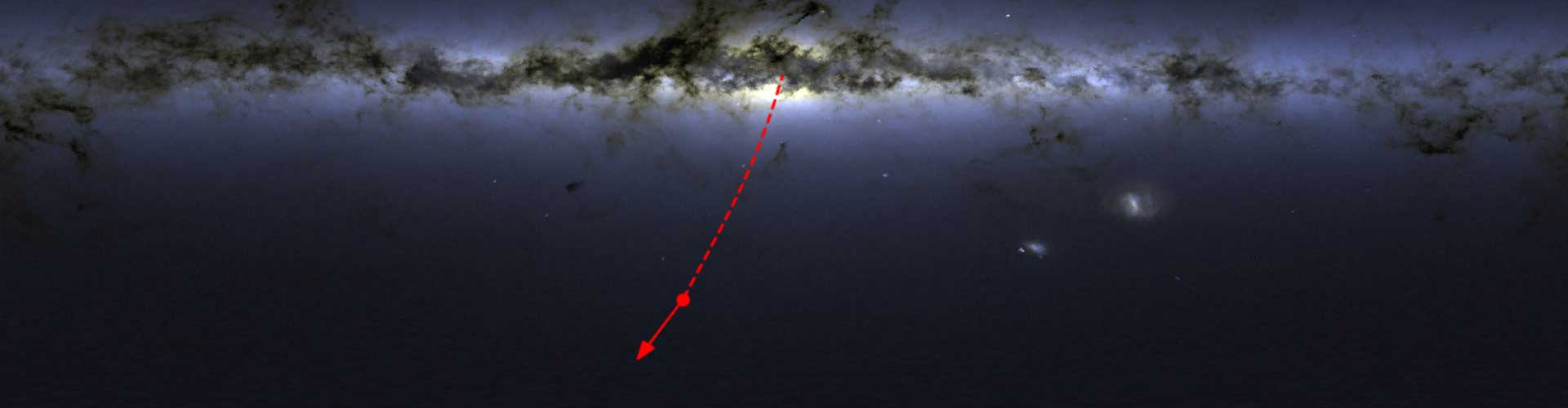
The view of the ejection of the S5-HVS1 star, as an observer from outside our galaxy would see it. The Sun is marked by an orange sphere, while the ejected star is shown by a blue sphere. Credit: Sergey Koposov (CMU)
Movie of the ejection of the star S5-HVS1 from the centre of the Milky Way
An animation of artist's impressions of the ejection of the star S5-HVS1 by the supermassive black hole at the centre of the Milky Way galaxy. Credit: James Josephides (Swinburne Astronomy Productions)
The numerical simulation of the hyper-velocity star like S5-HVS1 ejection by a black hole.
The video shows how two stars orbit each other in the binary, then approach the super-massive black hole in the center of the galaxy and then one star is ejected with high speed, while the other one is captured by the black hole. The
The Fastest Star Ever Is Going Through Our Galaxy
Unless you’re an astronomer, you probably don’t think of stars as moving all that quickly. You might not even know they move at all. If that’s the case, you’d be surprised to learn that a star called S5-HVS1 is zipping through our galaxy at over ten thousand miles per second.
As with many of the best discoveries, astronomers found this rogue star entirely by accident. One o them was going through some of the survey data when he came across some unusual readings. He was looking for stars with unusually rapid orbits, but was surprised to find one fleeing the galaxy at record speeds...
Other videos you might like:
NASA Has Just Discovered a New Planet! https://www.youtube.com/watch?v=TOGswBzxO54&
A Potentially Habitable Super Earth Has Been Discovered https://www.youtube.com/watch?v=6dUYK41ElO0&
The Real Size of the Universe (Even a Child Understands) https://www.youtube.com/watch?v=T3T08WOlFk4&
TIMESTAMPS:
What's so special about this star? 1:24
Hypervelocity stars 2:02
Why is it getting expelled from the galaxy? 3:10
What a three-body exchange is 3:33
The supermassive black hole at the center of our galaxy 5:57
Two theories about this star 7:05
#space #stars #brightside
SUMMARY:
- It’s hard to tell by looking at them, but stars are in constant motion, orbiting the center of the galaxy just like the Earth orbits the sun.
- S5-HVS1 (you know, let’s just him “Speedy”) is no ordinary star, and its movement isn’t at all normal. This recently discovered star is racing toward the outer edge of our galaxy, having been ejected from its orbit at a velocity never before seen in recorded history.
- Astronomers classify this white-hot ball of plasma as an A-type main-sequence star and have estimated it to be more than two times the size of the Sun.
- When a star goes supernova, it doesn’t always explode evenly. These lopsided detonations not only expel a few dozen Suns worth of gas and plasma, but also hurl what remains of the star through the cosmos at almost half the speed of light.
- But Speedy isn’t a neutron star. So why is it getting expelled from the galaxy like a spare tire improperly secured to the back of a truck?
- Things can get pretty wild when black holes are added to the mix. In this analogy, they’d be somebody’s loud friend who’s always around, leaving dishes in the sink and drinking the last Coke without asking.
- When these binary systems drift too close to a black hole, its mass disrupts the delicate balance of gravity and momentum that keeps the system stable.
- If you ever swung your keychain around your finger only to have it soar out of reach, you’ve seen a version of this in action.
- What differentiates Speedy from the other black hole ejections is the star’s comparatively low mass.
- To generate that much energy with a star that small, the black hole that disrupted Speedy’s orbit would need to be extremely massive.
- Before being batted across the universe, Speedy would’ve been paired with a second, much smaller star.
- Both stars originated in the supermassive black hole’s accretion disk.
- Astronomers may not have a perfect answer yet, but Speedy is still under observation and there’s no doubt more to uncover.
- For now, astronomers are eager to find more hypervelocity stars in hopes of gaining a better understanding of what’s going on in the Galactic Center, and how mass is distributed across the vast collection of stars we call the Milky Way.
Music by Epidemic Sound https://www.epidemicsound.com/
Subscribe to Bright Side : https://goo.gl/rQTJZz
----------------------------------------------------------------------------------------
Our Social Media:
Facebook: https://www.facebook.com/brightside/
Instagram: https://www.instagram.com/brightgram/
5-Minute Crafts Youtube: https://www.goo.gl/8JVmuC
Stock materials (photos, footages and other):
https://www.depositphotos.com
https://www.shutterstock.com
https://www.eastnews.ru
----------------------------------------------------------------------------------------
For more videos and articles visit:
http://www.brightside.me/
We Just Discovered The Fastest Main Sequence Star in the Galaxy
You can buy Universe Sandbox 2 game here: http://amzn.to/2yJqwU6
Hello and welcome! My name is Anton and in this video, we will talk about a newly discovered hyper velocity star known as S5-HVS1 that's now the fastest moving main sequence star in the galaxy.
Paper: https://arxiv.org/abs/1907.11725
Support this channel on Patreon to help me make this a full time job:
https://www.patreon.com/whatdamath
Space Engine is available for free here: http://spaceengine.org
Enjoy and please subscribe.
Twitter: https://twitter.com/WhatDaMath
Facebook: https://www.facebook.com/whatdamath
Twitch: http://www.twitch.tv/whatdamath
Bitcoins to spare? Donate them here to help this channel grow!
1GFiTKxWyEjAjZv4vsNtWTUmL53HgXBuvu
The hardware used to record these videos:
CPU: https://amzn.to/2LZFQCJ
Video Card: https://amzn.to/2M1W26C
Motherboard: https://amzn.to/2JYGiQQ
RAM: https://amzn.to/2Mwy2t4
PSU: https://amzn.to/2LZcrIH
Case: https://amzn.to/2MwJZz4
Microphone: https://amzn.to/2t5jTv0
Mixer: https://amzn.to/2JOL0oF
Recording and Editing: https://amzn.to/2LX6uvU
Thank you to all Patreon supporters of this channel
Specifically, great thanks to the following members:
Mark Teranishi
Mayumi
Morrison Waud
Vlad Manshin
Lilith Dawn
Daniel Rosvall
Greg Lambros
Nick Dolgy
Luminger
UnexpectedBooks.com
Richard Colombo
Bartholomew Macaluso
Jer
Lauren Smith
Michael Tiganila
Albert B Cannon
Konrad Kummli
Lyndon Riley
Michael Mitsuda
Jordan
Dave Blair
Ralph Spataro
George Williams
Shinne
Alexander Leimbeck
Jakub Glos
Johann Goergen
Henry Spadoni
Adam Lee
Jake Salo
Mercei Levi
LS Greger
Gordon Cooper
Tracy Burgess
Kai Raphahn
Sander Stols
Sergio Ruelas
Vinod Sethi
Russell Sears
Jayjay Volz
AA
Olegas Budnik
Robert Wyssbrod
Anataine Deva
Zachary Fluke
Madzor
Daniel S
RandalM
L Joseph Parker
Gary Steelman
Michael Koebel
Shelley Passage
Liam Moss
Bodo Graßmann
Steven Aiello
xyndicate
Honey Suzanne Lyons
Becky
Steven
Chase Staggs
Dale Andrew Darling
James Myers
Peter Hamrak
Niji
Matthew Lazear
Steve Wotton
Timothy Welter MD
Assaf Dar Sagol
Brian Szkotak
Mr Fluffington
Anton Reed
TBPony
Charles Nadeau
Minovsky Man
Anton Newman
George Lincoln Rockwell
Dave A
GrittyFlix
Paul Koploy
Sal Carrera
Doug Baker
Doug MacDonald
Jacob Spencer
Robert MacDonald
Rock Howard
Daniel Coleman
Vincent L. Cleaver
Veronika A. Czebe
Lee Densmore
Sir David Coyne
brian plummer
David Lewis
JohnTaylorWalker
Kyle eagle
Jon Haynes
Tarik Qassem
Claye Griffith
George Naumov
Michael J Fluharty
Howard Zhang
Hampton Tunis
Nathan Egan
Janne Vuorenpää
Lynn Johnson
Rob Law
Scary ASMR
Eric White
Ivan Gallagher
Troy Schmidt
Jordaen Davids
Greyson Flippo
Thierry Ray Jehlen Gasnier
William Warren
Bill Codair
Douglas Burns
Andrée Rosén
Chaos Gamer
Jan Šoulák
Alberto Diaz Saldana
Harry Evett
Rafael Aguila
Kearny Li
Marcin Jan
Adam Smith
Aaron Fineout
Aanand Joshi
Uwe Böhnke
Deanna Korell-Hall
Carla
Samuel Mathison
Josh Shultz
Dipen Bhattacharya
Tedd Speck
rfc1135
gene valle
david jungerman
JL Solidum
Doug Beeferman
Joseph Thompson
Sol Bergeron Beauchemin
Men I Trust
Luis M Gaytan Tovar
Brittany House
Luciano Sanchez
Lisa Stadlbauer
tom g.
Arp Lee
Lisette Ramos-Voigt
Rs Wlms
Reynir Örn Bachmann Guðmundsson
Márton Fülöp
Check the Patreon page to join.
2019 Discovery of an Unusual Fast Moving Star Escaping Our Galaxy
You can buy Universe Sandbox 2 game here: http://amzn.to/2yJqwU6
Hello and welcome! My name is Anton and in this video, we will talk about the newly discovered unusual hypervelocity star escaping our galaxy.
Read the paper about it here: https://iopscience.iop.org/article/10.3847/1538-4357/ab05c8
Support this channel on Patreon to help me make this a full time job:
https://www.patreon.com/whatdamath
Space Engine is available for free here: http://spaceengine.org
Enjoy and please subscribe.
Twitter: https://twitter.com/WhatDaMath
Facebook: https://www.facebook.com/whatdamath
Twitch: http://www.twitch.tv/whatdamath
Bitcoins to spare? Donate them here to help this channel grow!
1GFiTKxWyEjAjZv4vsNtWTUmL53HgXBuvu
The hardware used to record these videos:
CPU: https://amzn.to/2LZFQCJ
Video Card: https://amzn.to/2M1W26C
Motherboard: https://amzn.to/2JYGiQQ
RAM: https://amzn.to/2Mwy2t4
PSU: https://amzn.to/2LZcrIH
Case: https://amzn.to/2MwJZz4
Microphone: https://amzn.to/2t5jTv0
Mixer: https://amzn.to/2JOL0oF
Recording and Editing: https://amzn.to/2LX6uvU
Thank you to all Patreon
supporters of this channel
Specifically, great thanks to the
following members:
Thank you to all Patreon
supporters of this channel
Specifically, great thanks to the
following members:
Mark Teranishi
Mayumi
Marin Templeton
Sam Reed
Lilith Dawn
Lars Bo Rasmussen
William
Nick Dolgy
Greg Lambros
Luminger
UnexpectedBooks.com
Daniel Rosvall
Lauren Smith
Michael Tiganila
Jordan
Jer
Lyndon Riley
Michael Mitsuda
Dave Blair
Bartholomew Macaluso
Konrad Kummli
Alexander Leimbeck
Kai Raphahn
Sander Stols
Sergio Ruelas
George Williams
Justin Fortune
Shinne
Gordon Cooper
Tracy Burgess
Jakub Glos
Johann Goergen
Olegas Budnik
Richard Colombo
Sonja Prazic
AA
Jayjay Volz
Chase Staggs
Albert B. Cannon
Jake Salo
LS Greger
Marcel Levi
Anataine Deva
Becky
Robert MacDonald
gary steelman
Liam Moss
Michael Koebel
Shelley Passage
Steven Aiello
Tom Warren
xyndicate
Zachary Fluke
Bob Davies
Steven
Honey Suzanne Lyons
Patrick Ray
Vinod sethi
Bodo Graßmann
James Myers
Michael Rucker
Niji
Ralph Spataro
Robert Wyssbrod
Daniel Coleman
Matthew Lazear
Rock Howard
Steve Wotton
Arikkat Unnikrishnan
Aneliya Pancheva
Vincent L. Cleaver
Angelina Werner
Claye Griffith
George Naumov
Howard Zhang
Kyle eagle
Stan Komander
Tarik Qassem
Andrey Vesnin
MrR
Anton Newman
Charles Nadeau
Dave A
Doug Baker
George Lincoln Rockwell
GrittyFlix
Minovsky Man
Paul Koploy
Peter Hamrak
Sal Carrera
TBPony
Willem ter Harmsel
Doug MacDonald
Jacob Spencer
Jakub Rychecky
Shaun Cahill
Chris Miller
David Lewis
Eric White
Greyson Flippo
Hampton Tunis
Ivan Gallagher
Janne Vuorenpää
JohnTaylorWalker
Jon Haynes
Lynn Johnson
Michael J Fluharty
Mr. M-Bag
Nathan Egan
Rob Law
Scary ASMR
Thierry Ray Jehlen Gasnier
M Velt
Silvan Wespi
Thomas Erskine
Kendall Wake
William Warren
Arsenii Pilguk
Daniel Tyson
Dylan Do
Erik Storesund
Ged Warren
Hernán Coronel
Joachim W. Walewski
Jonas Reinitz
MiekWave
Robert Nenciu
Stephanie McAlea
Tedd Speck
Will Hardy
Adrian Boyko
Alex
Boone Torben
Cro-Magnon Gramps
David Heimbold
Declan
Dhiraj Sapkal
Exo Sol
Francis Lennon
J Youles
Jelle
Maximilian Jänicke
Orac
Paul dunn
RAJARSHI SHUKLA
Sun Sun
surfingdiamond
Uwe Böhnke
Russell Sears
Anton Reed
Mifxal
Mr Fluffington
Jordaen
Troy Schmidt
Matthias Fiebig
Check the Patreon page to join.
The Fastest Moving Stars
As many as half the stars in the universe might actually wander outside galaxies, flung off into the intergalactic void. They are called hypervelocity stars and they travel at extreme velocities.
SUBSCRIBE ► https://goo.gl/PLLFPz
Website ► www.cosmoknowledge.com
Facebook ► https://facebook.com/cosmoknowledgee
Instagram ► https://www.instagram.com/itscosmoknowledge
Graphics:
Space Engine
Music:
Doug Maxwell - Air to the Throne
Fastest Star in the Galaxy - US 708 - A Hypervelocity Star
Hello and welcome to What Da Math!
In this video, we will talk about a hypervelocity super star known as US 708.
Patreon page:
https://www.patreon.com/user?u=2318196&ty=h
You can purchase Universe Sandbox 2 game here: https://goo.gl/fuEv5s
Space Engine is available for free here: http://spaceengine.org
Enjoy and please subscribe.
Other videos here: https://www.youtube.com/playlist?list=PL9hNFus3sjE7jgrGJYkZeTpR7lnyVAk-x
Twitter: https://twitter.com/WhatDaMath
Facebook: https://www.facebook.com/whatdamath
Twitch: http://www.twitch.tv/whatdamath
The video introduction made by Daniel Bates
His YouTube channel with more of his work is here: https://www.youtube.com/mroutrochannel
The new music theme made by Bogdan Bratis
Check out his work here: http://www.bratis.uk/
The Mysterious Origins of Our Galaxy's Fastest Stars
A new paper that borrows old astrological data from the Voyager 2 probe has used brand-new computer simulations to find some new weird data about Uranus’s magnetic field. Another paper has new information about our galaxy’s fastest stars, called hypervelocity stars.
Hosted by: Caitlin Hofmeister
----------
Support SciShow by becoming a patron on Patreon: https://www.patreon.com/scishow
----------Alexander Wadsworth, Kevin Bealer, Mark Terrio-Cameron, KatieMarie Magnone, Patrick Merrithew, Charles Southerland, Fatima Iqbal, Sultan Alkhulaifi, Tim Curwick, Scott Satovsky Jr, Philippe von Bergen, Bella Nash, Chris Peters, Patrick D. Ashmore, Piya Shedden, Charles George
----------
Like SciShow? Want to help support us, and also get things to put on your walls, cover your torso and hold your liquids? Check out our awesome products over at DFTBA Records: http://dftba.com/scishow
----------
Looking for SciShow elsewhere on the internet?
Facebook: http://www.facebook.com/scishow
Twitter: http://www.twitter.com/scishow
Tumblr: http://scishow.tumblr.com
Instagram: http://instagram.com/thescishow
----------
Sources:
Uranus:
http://onlinelibrary.wiley.com/doi/10.1002/2017JA024063/full
https://www.newscientist.com/article/2138448-uranuss-crooked-messy-magnetic-field-might-open-and-shut-daily/
http://www.news.gatech.edu/2017/06/26/topsy-turvy-motion-creates-light-switch-effect-uranus
https://www.universetoday.com/18955/tilt-of-uranus/
http://www.jstor.org/stable/106717?seq=1#page_scan_tab_contents
http://adsabs.harvard.edu/abs/1912LowOB...2...19S
http://articles.adsabs.harvard.edu/cgi-bin/nph-iarticle_query?bibcode=1930PASP...42..330M&db_key=AST&page_ind=0&data_type=GIF&type=SCREEN_VIEW&classic=YES
https://forum.cosmoquest.org/showthread.php?118760-Uranus-Axial-Tilt&s=043db255050d4012edd517783ce1fffb&p=1918486#post1918486
https://science.nasa.gov/heliophysics/focus-areas/magnetosphere-ionosphere/
https://www.space.com/29875-neptune-strange-magnetic-field-video.html
https://www.exploratorium.edu/learning_studio/auroras/happen.html
https://www.nasa.gov/mission_pages/sunearth/multimedia/magnetosphere.html
http://www1.appstate.edu/~goodmanj/4401/notes/magnets/mnvsgn.html
https://pwg.gsfc.nasa.gov/polar/EPO/auroral_poster/aurora_all.pdf
http://zebu.uoregon.edu/disted/ph121/js21.html
https://www.windows2universe.org/uranus/interior/U_int_compo_overview.html
https://www.britannica.com/place/Uranus-planet/The-magnetic-field-and-magnetosphere
Hypervelocity stars:
https://academic.oup.com/mnras/article-abstract/469/2/2151/3573852/Hypervelocity-runaways-from-the-Large-Magellanic
https://arxiv.org/abs/1704.01373
https://www.cfa.harvard.edu/oir/sp/hypervel.html
http://www.astronomy.com/news/2015/03/thermonuclear-supernova-ejects-galaxys-fastest-star
https://www.nasa.gov/multimedia/imagegallery/image_feature_2434.html
http://iopscience.iop.org/article/10.1086/521385/
https://ned.ipac.caltech.edu/level5/March09/vanderMarel/vanderMarel4.html
Images:
https://commons.wikimedia.org/wiki/File:Geomagnetisme.svg
https://commons.wikimedia.org/wiki/File:Magnetic_field_of_Uranus.jpg
The Fastest Runaway Star in the Galaxy
Most stars orbit the center of the galaxy. Some stars don't. Learn what scientists think is going on, with Reid Reimers!
----------
Dooblydoo thanks go to the following Patreon supporters -- we couldn't make SciShow without them! Shout out to Justin Ove, David Campos, Chris Peters, Philippe von Bergen, Lilly Grainger, Happy Birthday!!, Fatima Iqbal, and Justin Lentz.
----------
Like SciShow? Want to help support us, and also get things to put on your walls, cover your torso and hold your liquids? Check out our awesome products over at DFTBA Records: http://dftba.com/SciShow
Or help support us by becoming our patron on Patreon:
https://www.patreon.com/scishow
----------
Looking for SciShow elsewhere on the internet?
Facebook: http://www.facebook.com/scishow
Twitter: http://www.twitter.com/scishow
Tumblr: http://scishow.tumblr.com
Instagram: http://instagram.com/thescishow
Sources:
http://www.sciencemag.org/content/347/6226/1126
http://arxiv.org/pdf/astro-ph/0501177v1.pdf
http://www.keckobservatory.org/recent/entry/thermonuclear_supernova_ejects_galaxys_fastest_star
https://www.cfa.harvard.edu/oir/sp/hypervel.html
http://www.space.com/28737-fastest-star-galaxy-strange-origin.html
http://www.bbc.com/earth/story/20150907-the-fastest-stars-in-the-universe
http://news.nationalgeographic.com/news/2015/03/150305-supernova-hypervelocity-star-white-dwarf-astronomy/
Supermassive Black Holes, Hypervelocity Stars, and Planets... Oh My! by Dr. Idan Ginsburg
Supermassive Black Holes, Hypervelocity Stars, and Planets... Oh My! by Dr. Idan Ginsburg.
How do you get something as massive as a star to move over 2 million miles per hour? Where would such a star originate, and where might it go? Why are such "hypervelocity stars" important, and what can "hypervelocity planets" teach us? Dr. Ginsburg will answer all these questions (and more) in his talk.
UH Institute for Astronomy
Recorded 06/13/2014 at the Advanced Technology Research Center in Pukalani, Maui, Hawaii.
HVSs-Hypervelocity Stars
A quick overview of hypervelocity stars; what they are, where they originate, and the discovery of new classes
Deleted video
This video is unavailable.
1
/
2