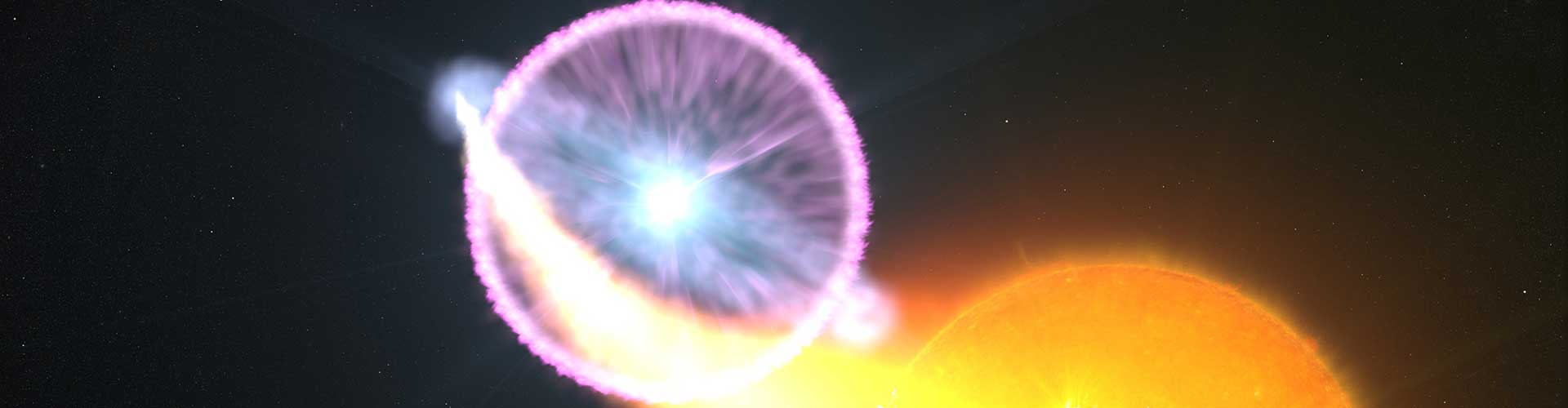
A kilonova (also called a macronova or r-process supernova) is a transient astronomical event that occurs in a compact binary system when two neutron stars or a neutron star and a black hole merge. Kilonovae are thought to emit short gamma-ray bursts and strong electromagnetic radiation due to the radioactive decay of heavy r-process nuclei that are produced and ejected fairly isotropically during the merger process. Image credit: University of Warwick/Mark Garlick
Related channels: NOVA, WHITE DWARFS, STARS, BROWN DWARFS, THE SUN, PULSARS, QUASARS, NEUTRON STARS, BLACK HOLES, ALPHA CENTAURI


Tour: The Unfolding Story of a Kilonova Told in X-rays
On August 8, 2017, scientists using gravitational wave detectors in the United States and Europe picked up a new signal. This object, which became known as GW170817, became the first time that gravitational waves and electromagnetic radiation – or light – were seen from the same source. Astronomers soon classified the burst of light as a “kilonova,” resulting from the merger of some of the densest objects in the Universe.
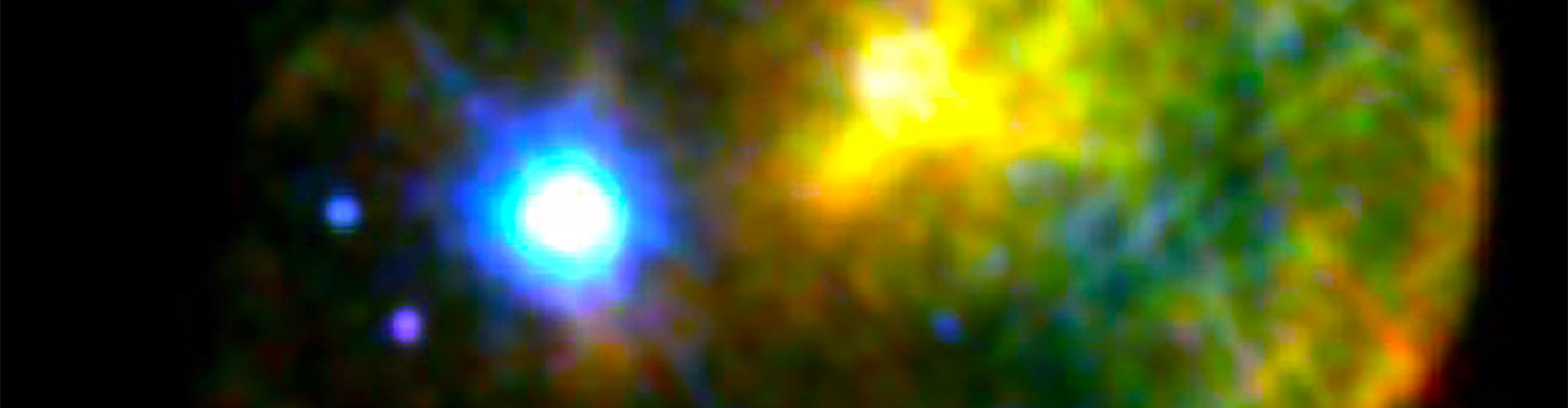
There were many telescopes that observed light from GW170817 in the hours and days immediately after the gravitational waves were detected. Most of those signals have faded away. NASA’s Chandra X-ray Observatory is the only observatory still able to detect light from this extraordinary cosmic collision more than four years after the original event.
What have astronomers seen in the Chandra data? Right after the initial LIGO detection was announced, scientists requested that Chandra quickly pivot from its current target to GW170817. At first, they did not see any X-rays from the source, but about nine days later Chandra looked again and found a point source of X-rays.
This non-detection of X-rays quickly followed by a detection provides evidence for a narrow jet of high-energy particles produced by the neutron star merger. The jet is "off-axis" – that is, not pointing directly towards Earth. Researchers think that Chandra originally viewed the narrow jet from its side, and therefore saw no X-rays immediately after the gravitational waves were detected.
However, as time passed, the material in the jet slowed down and widened as it slammed into surrounding material. This caused the cone of the jet to begin to expand more into Chandra’s direct line of sight, and X-ray emission was detected.
Since early 2018, the X-ray emission caused by the jet had steadily been getting fainter as the jet further slowed down and expanded. Researchers then noticed that from March 2020 until the end of 2020 the decline stopped, and the X-ray emission was approximately constant in brightness.
The fact that the X-rays stopped fading quickly was the best evidence yet that something in addition to a jet is being detected in X-rays in this source. In fact, the scientists had to identify a completely different source of X-rays to explain what they were seeing.
A leading explanation for this new source of X-rays is that the expanding debris from the merger has generated a shock, like the sonic boom from a supersonic plane. The emission produced by material heated by the shock is called a kilonova afterglow. An alternative explanation is that the X-rays come from material falling towards a black hole that formed after the neutron stars merged.
To distinguish between the two explanations, astronomers will keep monitoring GW170817 in X-rays and radio waves. If it is a kilonova afterglow, the radio emission is expected to get brighter over time and be detected again in the next few months or years. If the explanation involves matter falling onto a newly formed black hole, then the X-ray output should stay steady or decline rapidly, and no radio emission will be detected over time.
Astronomers will continue to monitor GW170817 with Chandra and other telescopes to see what new secrets this object may reveal. For more information, visit: https://chandra.si.edu/photo/2022/gw170817/
How Kilonovas Made the Earth and Killed Alternate Gravity - Ask a Spaceman!
Full podcast episodes: http://www.askaspaceman.com
Support: http://www.patreon.com/pmsutter
Follow: http://www.twitter.com/PaulMattSutter and http://www.facebook.com/PaulMattSutter
Part 2 of 2! How did the observation of a kilonova change astronomy? How did that one observation kill off alternate models of gravity? What’s in store for the future of gravitational waves? I discuss these questions and more in today’s Ask a Spaceman!
Follow all the show updates at http://www.askaspaceman.com, and help support the show at http://www.patreon.com/pmsutter!
Keep those questions about space, science, astronomy, astrophysics, and cosmology coming to #AskASpaceman for COMPLETE KNOWLEDGE OF TIME AND SPACE! Music by Jason Grady and Nick Bain.
Chapters:
00:00 One Afternoon in 2017
04:11 What is a Kilonova
09:23 What Happens During a Kilonova Explosion
14:40 How One Measurement Killed Alternate Gravity
15:50 The Future of Multi-Messenger Astronomy
Video credits: NASA, ESA, Planck, WMAP, Illustris
Powerful Neutron Star Kilonova Creates Magnetar
Far from across the Universe, a set of telescopes has captured the bright flash of a short gamma-ray burst. The brightest kilonova ever seen. About 5.5 billion light-years away, an enormous burst of gamma rays unleashed more energy in a half-second than the sun will produce over its entire 10-billion-year lifetime. That’s a kilonova. After gauging the incredibly bright burst with optical, X-ray, near-infrared, and radio wavelengths, a Northwestern University-led astrophysics team believes it potentially spotted the birth of a strange magnetic star.
Support us on Patreon and help Cosmoknowledge become the number one destination for science: https://www.patreon.com/cosmoknowledge
SUBSCRIBE ► https://goo.gl/PLLFPz
----
Website ► https://cosmoknowledge.com/
TikTok ► https://www.tiktok.com/@cosmoknowledge
Instagram ► https://www.instagram.com/itscosmoknowledge
Facebook ► https://facebook.com/cosmoknowledgee
Edited by:
Ardit Bicaj
Narrated by:
Russell Archey
https://www.ravonmedia.com/
Music:
Voiceless Whispering - Ethan Sloan
Clearer Views - From Now On
Thank you to our Patrons:
DonPig
Joe Chappell
xX-FLuKE-Xx
-
Cosmoknowledge brings news from space.
We love you, explorers!
How a Cosmic Kilonova Can Create Gold | How the Universe Works
After a neutron stars collide light years away, data indicates the possibility of heavy metals being formed, including elements such as gold!
Stream Full Episodes of How the Universe Works:
https://www.sciencechannel.com/tv-shows/how-the-universe-works/
Subscribe to Science Channel:
http://bit.ly/SubscribeScience
Like us on Facebook:
https://www.facebook.com/ScienceChannel
Follow us on Twitter:
https://twitter.com/ScienceChannel
Follow us on Instagram:
https://www.instagram.com/ScienceChannel/
Neutron Stars – The Most Extreme Things that are not Black Holes
Sources: https://sites.google.com/view/sources-neutron-stars/
Neutron stars are one of the most extreme and violent things in the universe. Giant atomic nuclei, only a few kilometers in diameter but as massive as stars. And they owe their existence to the death of something majestic. OUR CHANNELS
▀▀▀▀▀▀▀▀▀▀▀▀▀▀▀▀▀▀▀▀▀▀▀▀▀▀
German Channel: https://kgs.link/youtubeDE
Spanish Channel: https://kgs.link/youtubeES HOW CAN YOU SUPPORT US?
▀▀▀▀▀▀▀▀▀▀▀▀▀▀▀▀▀▀▀▀▀▀▀▀▀▀
This is how we make our living and it would be a pleasure if you support us!
Get Merch designed with ❤ from https://kgs.link/shop
Join the Patreon Bird Army 🐧 https://kgs.link/patreon DISCUSSIONS & SOCIAL MEDIA
▀▀▀▀▀▀▀▀▀▀▀▀▀▀▀▀▀▀▀▀▀▀▀▀▀▀
Reddit: https://kgs.link/reddit
Instagram: https://kgs.link/instagram
Twitter: https://kgs.link/twitter
Facebook: https://kgs.link/facebook
Discord: https://kgs.link/discord
Newsletter: https://kgs.link/newsletter OUR VOICE
▀▀▀▀▀▀▀▀▀▀▀▀▀▀▀▀▀▀▀▀▀▀▀▀▀▀
The Kurzgesagt voice is from
Steve Taylor: https://kgs.link/youtube-voice OUR MUSIC ♬♪
▀▀▀▀▀▀▀▀▀▀▀▀▀▀▀▀▀▀▀▀▀▀▀▀▀▀
700+ minutes of Kurzgesagt Soundtracks by Epic Mountain:
Spotify: https://kgs.link/music-spotify
Soundcloud: https://kgs.link/music-soundcloud
Bandcamp: https://kgs.link/music-bandcamp
Youtube: https://kgs.link/music-youtube
Facebook: https://kgs.link/music-facebook
The Soundtrack of this video:
Soundcloud: https://bit.ly/2ru4Zk2
Bandcamp: https://bit.ly/2Q4axfo
Youtube: https://bit.ly/2CZ6PeN
Facebook: http://bit.ly/2qW6bY4
🐦🐧🐤 PATREON BIRD ARMY 🐤🐧🐦
▀▀▀▀▀▀▀▀▀▀▀▀▀▀▀▀▀▀▀▀▀▀▀▀▀▀
Many Thanks to our wonderful Patreons from http://kgs.link/patreon who support us every month and made this video possible:
Clardia Beatty, Hans Husurianto, Shawn Lauzon, Jared Wilmer, Matt Reid, namingcrisis, Bart, Elizabeth Vaughn, Sergei Gutovets, Rasul Safa, Ryo Yamamoto, Zack Rosenblatt, TVVMC, Carla Prigmore, Sharwan, Венелин В., Jeff Maley, George Galan, Arttu, Patrick Abbs, Sean, Artsiom Yesis, Kolos Kantor, Lucas Swift, Chen Yi Tang, Emil Lund, Rene Melendez, Renan Havill, Brandon Pang, Jacqueline, Murad Gerad, Michael, Malek Teffaha, Bob Newman, Connor Gorrell, Barry, Dane, Kelly Boyd, Christian Smith, Patrick Kaufmann, Elliott, drantor, Gabriel Venegas, Andrew Millikan, Thib, Daniel Mushrow, LacyFacey, Tanya Barot, Farhad, Daniel Egan, Shray Sharma, Attila Mátó, Sam Law, Matt mcgrath, Nathan B, Isaiah, taylor elmhorst, CriMsin Crips, Cody Welborn, Kavita Luther, Seth Morin, Harmonia Huntington, Badr
“Turning Stars into Gold: The Discovery of the First Kilonova," Iair Arcavi, Tel Aviv University
On August 17, 2017, gravitational waves launched by two merging neutron stars were detected on Earth for the first time in history, and an alert was sent to astronomers across the globe. Within hours, several teams, using a variety of telescopes, were able to quickly capture the flash from the "kilonova" explosion accompanying the merger, marking the first time ever that gravitational waves and light were detected from the same event. This discovery has provided staggering insights about our Universe, perhaps more than any other single astronomical event in our lifetime, all while charting the course for a new age in astronomy.
GW170817 Kilonova Update - Massive Magnetar From Neutron Star Merger?
You can buy Universe Sandbox 2 game here: http://amzn.to/2yJqwU6
Hello and welcome to What Da Math!
In this video, we will talk about an event from Oct 2017 that produced a large Kilonova and probably resulted in the making of a magnetar.
Support this channel on Patreon to help me make this a full time job:
https://www.patreon.com/whatdamath
Space Engine is available for free here: http://spaceengine.org
Enjoy and please subscribe.
Twitter: https://twitter.com/WhatDaMath
Facebook: https://www.facebook.com/whatdamath
Twitch: http://www.twitch.tv/whatdamath
Bitcoins to spare? Donate them here to help this channel grow!
1GFiTKxWyEjAjZv4vsNtWTUmL53HgXBuvu
The hardware used to record these videos:
CPU: https://amzn.to/2LZFQCJ
Video Card: https://amzn.to/2M1W26C
Motherboard: https://amzn.to/2JYGiQQ
RAM: https://amzn.to/2Mwy2t4
PSU: https://amzn.to/2LZcrIH
Case: https://amzn.to/2MwJZz4
Microphone: https://amzn.to/2t5jTv0
Mixer: https://amzn.to/2JOL0oF
Recording and Editing: https://amzn.to/2LX6uvU Thank you to all Patreon supporters of this channel
Specifically, great thanks to the following members:
Mayumi
Lilith Dawn
William
Tim Sageser
Nick Dolgy
Luminger
Lauren Smith
Brad Ashmore
Michael Tiganila
Marin Templeton
Jordan
Michael Mitsuda
Mark Teranishi
Greg Lambros
Galaxia
Lyndon Riley
The Amazing Spatterman
Alexander Leimbeck
Sander Stols
Kai Raphahn
Sergio Ruelas
Moonic
Olegas Budnik
Chase Staggs
Robert MacDonald
Jer
Tracy Burgess
Leo Wehrli
Jason Neuschmid
Gordon Cooper
Adrian Sierra
Arikkat A Unnikrishnan
Aneliya Pancheva
Becky
Steven
Jayjay Volz
Alexander Mahrt
AA
Aneliya Pancheva
Andy DeLay
Angelina Werner
Bob Davies
Jakub Glos
Andrey Vesnin
Steve Wotton
MrR
Check the Patreon page to join
Kilonova: an electromagnetic signal of heavy element nucleosynthesis
Severo Ochoa Colloquium given by Gabriel Martínez Pinedo (GSI/Technische Universität Darmstadt) on May 10, 2018. More information at https://bit.ly/2rDr0Ky
What is a kilonova and how do you detect one? - Dr Phil Evans University of Leicester
Dr Phil Evans from the University of Leicester Department of Physics and Astronomy explains what a kilonova is, and how NASA's spacecraft Swift helped to see one.
Kilonova! Gravitational Waves AND Radiation Detected From a Neutron Star Collision
Astronomers have made the groundbreaking detection of two neutron stars colliding in a galaxy 130 million light years away. They detected the gravitational waves AND the blast of radiation released from the collision, observing a kilonova for the first time.
Support us at: http://www.patreon.com/universetoday
More stories at: http://www.universetoday.com/
Follow us on Twitter: @universetoday
Like us on Facebook: https://www.facebook.com/universetoday
Google+ - https://plus.google.com/+universetoday/
Instagram - http://instagram.com/universetoday
Team: Fraser Cain - @fcain / [email protected]
Karla Thompson - @karlaii / https://www.youtube.com/channel/UCEItkORQYd4Wf0TpgYI_1fw
Chad Weber - [email protected]
Chloe Cain - Instagram: @chloegwen2001
I know we’ve been talking about gravitational waves quite a bit here on the Guide to Space, and a few episodes ago, I hinted at the tantalizing possibility that gravitational waves could, maybe, perhaps, be used to detect colliding neutron stars.
You know, once more sensitive instruments came online, and physicists tweaked and tuned them. Well, it turns out such a detection had already been made when I recorded that, now, hilariously out of date video.
But it gets even better. At the same time they detected the rippling distortion of spacetime produced by the gravitational waves, different teams of astronomers were actually able to watch blast of radiation released by the neutron star using every wavelength at their disposal.
They detected the gravitational waves and then saw the collision in the sky. I promise you, this is one of the biggest discoveries of the year.
'Kilonova' from Neutron Star Merger Observed by Multiple ESO Telescopes
Several European Southern Telescopes were used to discover the "kilonova," the merging of the neutron stars. The ESOcast video series explains. -- First Glimpse of Colliding Neutron Stars Yields Stunning Pics: https://www.space.com/38481-colliding-neutron-stars-stunning-pictures.html
Credit: ESO
Five theories the kilonova confirmed
When two extremely dense neutron stars crashed together in a distant galaxy, astronomers struck scientific gold
Kilonova GW 170817 Update 10/16/2017
This is an update on the newly detected kilnova GW 170817 for October 16, 2017.
www.patreon.com/johnmichaelgodier
Press release:
https://www.ligo.caltech.edu/page/press-release-gw170817
Music:
Cylinder Eight by Chris Zabriskie is licensed under a Creative Commons Attribution license (https://creativecommons.org/licenses/by/4.0/)
Source: http://chriszabriskie.com/cylinders/
Artist: http://chriszabriskie.com/
Zooming in on the kilonova in NGC 4993
The sequence starts with a broad view of the night sky. We then zoom in towards the constellation of Hydra. This was the direction from which gravitational waves were detected by LIGO-Virgo on 17 August 2017. The blue region shows the large area in which the source was expected to lie. Once identified many ESO telescopes and instruments scrutinised the region around the galaxy NGC 4993, where a transient source had been spotted. These included VISTA, the VST, the GROND instrument on the MPG/ESO 2.2-metre telescope and VIMOS and other instruments on the VLT. The final sequence shows how VISTA monitored this source, a kilonova created by the merging of two neutron stars, as it brightened and then became must redder in colour and faded.
More information and download options: http://www.eso.org/public/videos/eso1733f/
Credit:
N. Risinger (skysurvey.org), LIGO-Virgo, Digitized Sky Survey 2, ESO. Music: Johan B. Monell (www.johanmonell.com)
Neutron star merger animation ending with kilonova explosion
This artist’s impression video shows how two tiny but very dense neutron stars merge and explode as a kilonova. Such a very rare event is expected to produce both gravitational waves and a short gamma-ray burst, both of which were observed on 17 August 2017 by LIGO–Virgo and Fermi/INTEGRAL respectively. Subsequent detailed observations with many ESO telescopes have confirmed that this object, seen in the galaxy NGC 4993 about 130 million light-years from the Earth, is indeed a kilonova. Such objects are the main source of very heavy chemical elements, such as gold and platinum in the Universe.
More information: https://www.eso.org/public/videos/eso1733b/
Credit:
ESO/L. Calçada. Music: Johan B. Monell (www.johanmonell.com)
SvC News: Discovery of a KILONOVA
Science vs Cinema host Dr. Andy Howell explains the discovery of a never-before-seen astronomical phenomenon: a KILONOVA, the merger of two neutron stars detected via gravitational waves, which was observed by Las Cumbres Observatory.
Deleted video
This video is unavailable.